The Number on Your Cannabis Label Is Partly a Function of Which Lab Your Brand Chose
Most cannabis consumers evaluate products by THC percentage and strain name — two data points that tell you less about what you’re actually buying than almost anything else on the label. The cannabis lab report sitting behind that QR code contains more useful purchasing information than every budtender recommendation and marketing description combined. Here’s how to read it.
What a Cannabis COA Actually Is — and the Gap Nobody Talks About
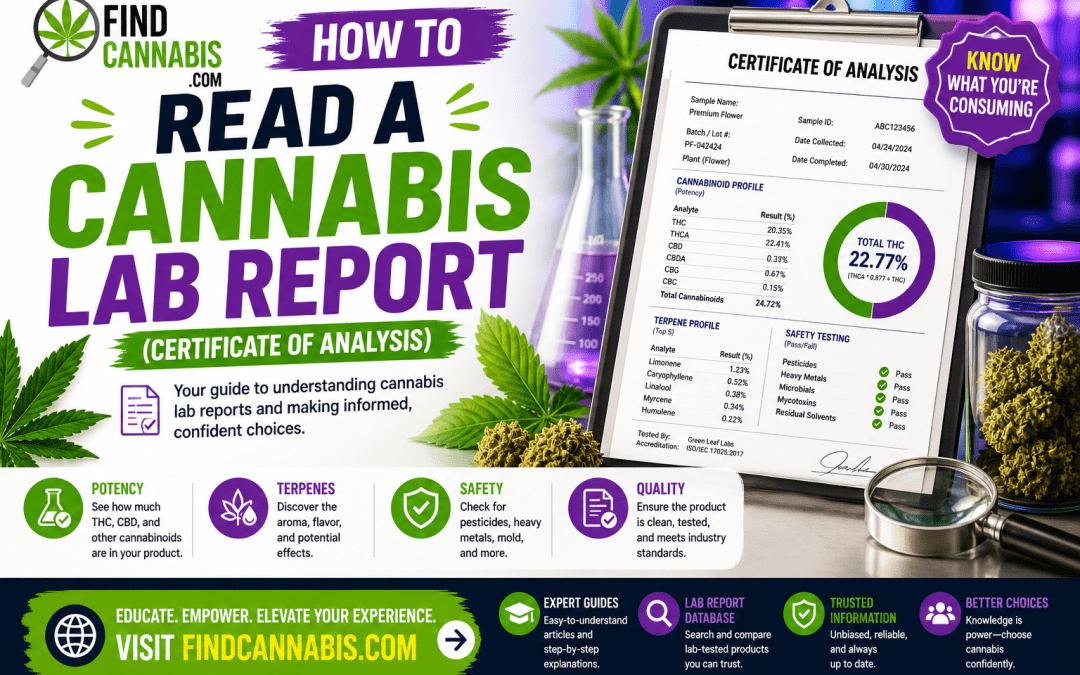
A Certificate of Analysis is a document from an accredited, independent laboratory confirming the chemical composition of a cannabis product. In legal cannabis states, products at licensed dispensaries must be independently tested before sale. The COA documents that testing — and for hemp and CBD products sold outside licensed dispensaries, where third-party testing is voluntary, it’s the consumer’s only real protection.
A 2017 study in JAMA tested 84 CBD products purchased online and found fewer than a third were accurately labeled. That number is the reason requiring a cannabis lab report before purchasing anything in the CBD and hemp space isn’t optional consumer diligence. It’s basic protection.
Here’s the gap most COA guides don’t address: a product can pass every required testing panel and still be mediocre. Minimum compliance isn’t quality. Passing results tell you a product cleared regulatory thresholds — not whether the potency claim is honest, the terpene profile is rich or thin, or the brand is doing thorough safety testing versus the minimum their state requires.
Reading cannabis test results well means reading past the pass/fail outcomes to the data patterns underneath. That’s what this covers.
A complete cannabis lab report includes potency, terpenes, pesticides, heavy metals, microbials, residual solvents (for extracts), and mycotoxins (state-dependent). The panels a brand includes — and how many compounds each covers — is a quality signal before you read a single number.
Finding the Lab Report — and What That Process Reveals
At a licensed dispensary, ask your budtender for the cannabis COA on anything you’re considering. Shops that maintain current lab reports for all inventory and share them readily are operating with genuine transparency. Shops that struggle to produce them, or hand over documents that don’t match current inventory, are telling you something worth knowing before you buy.
Most products include a QR code linking to lab results. Brands that make this frictionless — working code, clean results page, batch number clearly visible — are investing in transparency as a practice rather than a compliance checkbox. Brands where the QR doesn’t work, or routes to a generic testing page without batch-specific results, are communicating something too.
Brand websites should have a searchable COA library organized by product and batch date. The best operators do this. Minimum-compliance operators post a single lab report per product regardless of batch — which can mean a document that’s a year old and irrelevant to what’s currently on shelves.
Worth knowing before you start: no available cannabis lab report, test results older than 12 months, an unidentifiable lab, or a COA covering only potency with no safety panels — any of these is a reason to look elsewhere.
Before You Read the Numbers
Every cannabis lab report begins with sample identification. Check this section before anything else.
The batch or lot number ties the test to a specific production run. If it doesn’t match the number on your packaging, you’re looking at results from a different batch — with potentially different test outcomes. Batch-to-batch variation is real, particularly for craft producers working with smaller runs where environmental variables affect results more directly than in large-scale controlled production.
The test date establishes whether the document is relevant. COAs older than 12 months should be treated with skepticism — potency degrades over time, and safety testing reflects conditions at the time of testing, not at point of sale.
The testing laboratory name and accreditation status matters more than most consumers realize — which connects directly to the article’s opening point. ISO/IEC 17025 accreditation is the international standard for laboratory competence. State licensing is a parallel requirement in legal markets. Both should be independently verifiable. And knowing whether a lab trends conservative or generous on potency — something insiders track — gives you useful context for interpreting what you’re reading.
The Insight Most Consumers Never Reach
Before the safety panels, before the potency numbers, there’s a section of the cannabis lab report that most people scroll past entirely: the terpene panel.
After a decade of reviewing COAs professionally, the finding that consistently surprises people is this: total terpene concentration is a more reliable quality indicator for flower than THC percentage. Not a proxy for it. More reliable than it.
A flower testing at 18% total THC with 2.8% total terpenes will produce a richer, more nuanced experience than one testing at 26% THC with 0.4% terpenes — every time. The high-THC product will be stronger in the narrow sense. The high-terpene product will be more interesting, more complex, and typically more therapeutically useful across the full range of effects cannabis produces. The number the entire industry built itself around is the least useful one on the page.
Here’s what a well-developed terpene panel looks like:
| Terpene | % |
|---|---|
| Myrcene | 0.52% |
| Limonene | 0.31% |
| Caryophyllene | 0.28% |
| Linalool | 0.15% |
| Pinene (α) | 0.08% |
| Humulene | 0.07% |
| Total Terpenes | 1.41% |
Myrcene dominance at 0.52% points toward sedating, body-focused effects. Limonene at 0.31% adds mood-lifting counterbalance. Caryophyllene contributes stress-relieving and anti-inflammatory character through CB2 receptor partial agonism. Linalool layers in calming, anxiolytic effects.
Total terpenes at 1.41% clears the 1% threshold worth using as a quality floor when evaluating flower. Products below 0.5% are typically less expressive regardless of THC percentage. The best craft flower reviewed over a decade in this industry tested between 3-4% total terpenes — a range that produces experiences high-THC, low-terpene alternatives simply can’t match.
Quick terpene-to-effect reference:
- Myrcene → Relaxing, sedating, body-focused
- Limonene → Uplifting, mood-elevating, energizing
- Caryophyllene → Anti-inflammatory, stress-relieving
- Pinene → Alert, focused, clear-headed
- Linalool → Calming, anti-anxiety, sleep-supportive
- Terpinolene → Uplifting, energizing, creative
Reading the Potency Panel Accurately
Potency is percentage by weight for flower, milligrams per serving for edibles, milligrams per milliliter or gram for oils and extracts. The unit system varies — paying attention to it prevents misreading results significantly.
The calculation that actually matters
THCA is raw, unactivated THC that converts when heated. THC (Delta-9) is already-activated THC present before consumption. Neither number alone tells you what you’re getting.
Total THC is the operative figure for flower: (THCA × 0.877) + THC. The 0.877 factor accounts for molecular weight loss during decarboxylation. Many dispensary menus display only THCA, which consistently overstates available potency. Total THC is the number to use. Total CBD follows identical logic: (CBDA × 0.877) + CBD.
The cannabinoids worth paying attention to
CBG concentration indicates harvest timing — higher levels often reflect earlier harvest, since CBG is the precursor that converts to THC and CBD as the plant matures. CBN is the freshness indicator: under 0.1% in flower means fresh and well-stored; trending toward 0.3% suggests age or improper storage. For concentrates, CBN above that range warrants attention regardless of the date on the document.
THCV — associated with certain African sativa lineages — points toward clearer, more energetic effects and potential appetite suppression. Its presence in a cannabis lab report tells you something specific about genetics that strain names rarely convey.
What consistency reveals
Brands with consistent potency across batches demonstrate production control. Highly variable results suggest less controlled conditions. Potency numbers that consistently land at perfectly round figures warrant a closer look at which lab produced them.
Flower example:
| Cannabinoid | % |
|---|---|
| THCA | 24.6% |
| THC | 0.3% |
| Total THC | 21.9% |
| CBDA | 0.1% |
| CBD | 0.04% |
| Total CBD | 0.13% |
| CBG | 0.8% |
| CBN | 0.05% |
High-potency, THC-dominant, very low CBN — fresh, well-produced flower.
CBD product example:
| Cannabinoid | mg/serving |
|---|---|
| CBD | 25.3mg |
| CBDA | 0.8mg |
| THC | 0.1mg |
| THCA | 0.04mg |
| CBG | 1.2mg |
| CBN | 0.3mg |
Full-spectrum CBD at 25.3mg per serving, trace cannabinoids consistent with full-spectrum formulation, THC at 0.1mg — well below psychoactive territory.
The Safety Panels — Where Minimum Compliance Gets Exposed
Safety panels are where real quality differentiation shows up in cannabis testing — and where reviewing many lab reports across many brands reveals patterns individual consumers rarely see.
Cannabis pesticide testing
Cannabis accumulates agricultural chemicals readily, and some become genuinely harmful when inhaled. Results appear in parts per million (ppm) or parts per billion (ppb) against state action limits. PASS or ND (Non-Detect) across every compound is what you’re looking for. A single FAIL means the product shouldn’t be on shelves.
Panel breadth is the quality signal. California’s required pesticide panel covers 66 compounds. Some states require fewer than 20. A brand voluntarily testing against a more rigorous panel than their state mandates is demonstrating safety commitment worth recognizing when comparing cannabis lab reports.
Heavy metals
Cannabis is a hyperaccumulator — it draws heavy metals from soil at higher concentrations than most other plants, which is why it’s been studied for environmental remediation and why this panel matters more here than in most agricultural contexts. Lead, mercury, arsenic, and cadmium are the four tested universally. All should read ND or well below action limits. Consistent ND results across batches point to clean, controlled soil inputs; variable results suggest less controlled sourcing.
Microbials
Total yeast and mold flags cultivation, curing, or storage problems. Aspergillus is the species of greatest clinical concern — capable of causing serious pulmonary infections, particularly in immunocompromised consumers. Many states specifically require testing for four strains: niger, fumigatus, flavus, and terreus. E. coli, Salmonella, and coliforms should all be absent. Consistent microbial passes across a brand’s flower batches indicate post-harvest process control — improper curing can cause failures even in well-cultivated product.
Residual solvents (extracts only)
For concentrates, oils, and vape cartridges, this is one of the most important sections in the entire cannabis lab report. Butane, isobutane, propane, and ethanol are the most common solvents tested. Benzene, toluene, and acetone are more toxic and shouldn’t appear at any detectable level. Consistently clean results across a brand’s concentrate line indicate controlled post-extraction processing.
Mycotoxins
Aflatoxins and Ochratoxin A are carcinogenic fungal toxins — not universally required in cannabis testing, but where included, all results should be ND. Voluntary mycotoxin testing indicates above-minimum safety commitment.
The Part Most COA Guides Won’t Tell You
The cannabis testing system, as currently structured across most US state markets, has a fundamental conflict of interest built in.
Brands pay testing laboratories for their tests. Labs compete for brand business. That creates structural pressure — not necessarily corruption, but pressure — for labs to produce results brands find favorable. The lab-to-lab potency variation mentioned at the top of this article is partly a consequence of that pressure playing out across a competitive market over years.
None of this makes cannabis test results meaningless. It means they’re produced within a system with known incentive problems, and reading them with that awareness makes you a more sophisticated consumer. It’s also why verification matters — cross-checking a COA against a lab’s own portal, confirming accreditation, matching batch numbers — because those steps work around the system’s weaknesses rather than assuming it’s airtight.
States with the most rigorous testing systems — California, Oregon, and Nevada among them — have implemented independent market surveillance testing, where state agencies pull products from retail and test them independently of brand-commissioned results. Those findings, when they reveal discrepancies, are public record worth seeking out when evaluating brands in those markets.
Verifying the Document
COA fabrication exists, primarily in the unregulated CBD and hemp market. Here’s the verification process worth running on any cannabis lab report:
Go to the lab’s portal directly and enter the sample ID or batch number. Confirm the cannabis test results match your document exactly. Two minutes. Removes most authenticity uncertainty.
Verify accreditation independently. ISO/IEC 17025 accreditation is granted by bodies like A2LA or Perry Johnson in the US. State licensing is separately verifiable through your state’s cannabis regulatory agency.
Match the batch number to your packaging — the most commonly skipped verification step and one of the most important.
Read the data pattern. Real cannabis lab results have natural variation — numbers aren’t perfectly round, compounds at the edge of detection show as trace rather than zero. Perfectly clean data with round numbers and zero variance across multiple compounds is a pattern associated with fabricated documents.
Applying This at the Point of Purchase
At a dispensary: Request the cannabis COA before purchasing, especially for concentrates, vapes, and edibles. Calculate total THC — never accept THCA alone as the potency figure. Use terpene data to predict effects more reliably than strain names allow. Check CBN: under 0.1% means fresh, trending toward 0.3% means it’s been sitting.
For concentrate and vape products: The residual solvents panel is non-negotiable. Evaluate each product category’s COA independently — quality standards don’t always carry across a brand’s full line.
For CBD and hemp products: Never buy from a brand that won’t provide a current, batch-specific lab report. Verify CBD content against the label. For drug-tested athletes, confirm THC reads ND rather than merely “below 0.3%” — a product at 0.28% THC clears the federal threshold but carries enough THC to affect drug test outcomes. And check the date: a cannabis COA from 2022 tells you nothing about what’s in a 2026 product.
Quick Reference
| Section | What You Want to See | Quality Signal |
|---|---|---|
| Sample Info | Batch # matches product, recent date | Matches packaging exactly |
| Potency | Total THC/CBD clearly stated | Consistent across batches |
| Terpenes | Rich profile, 1%+ total | Higher total = higher quality |
| Pesticides | All PASS or ND | Comprehensive panel (50+) |
| Heavy Metals | All ND or below limits | Consistent ND = clean inputs |
| Microbials | All PASS, no Aspergillus | Consistent passes = process control |
| Residual Solvents | All ND (extracts) | Clean = purging quality |
| Lab Accreditation | ISO/IEC 17025 + state licensed | Both independently verifiable |
What the Testing System Still Gets Wrong
The cannabis COA is more useful, more standardized, and more accessible than it’s ever been. The conflict of interest problem persists. The lab-to-lab variation problem persists. The minimum-compliance-masquerading-as-quality problem persists. And the consumer education problem — most cannabis consumers have never read a COA, and most retail environments aren’t designed to change that — persists most stubbornly of all.
The long-term fix is state-level independent surveillance testing that publicly validates or contradicts brand-commissioned results. California has implemented this with meaningful effect. The short-term fix is consumers who know how to read a cannabis lab report well enough to ask the right questions and catch the gaps.
That’s what’s available to you right now. The brands worth supporting are the ones whose COAs hold up to scrutiny. The ones that don’t are telling you something — you just have to know how to read it. 🌿🔬
Find licensed dispensaries with transparent testing near you at FindCannabis.com.