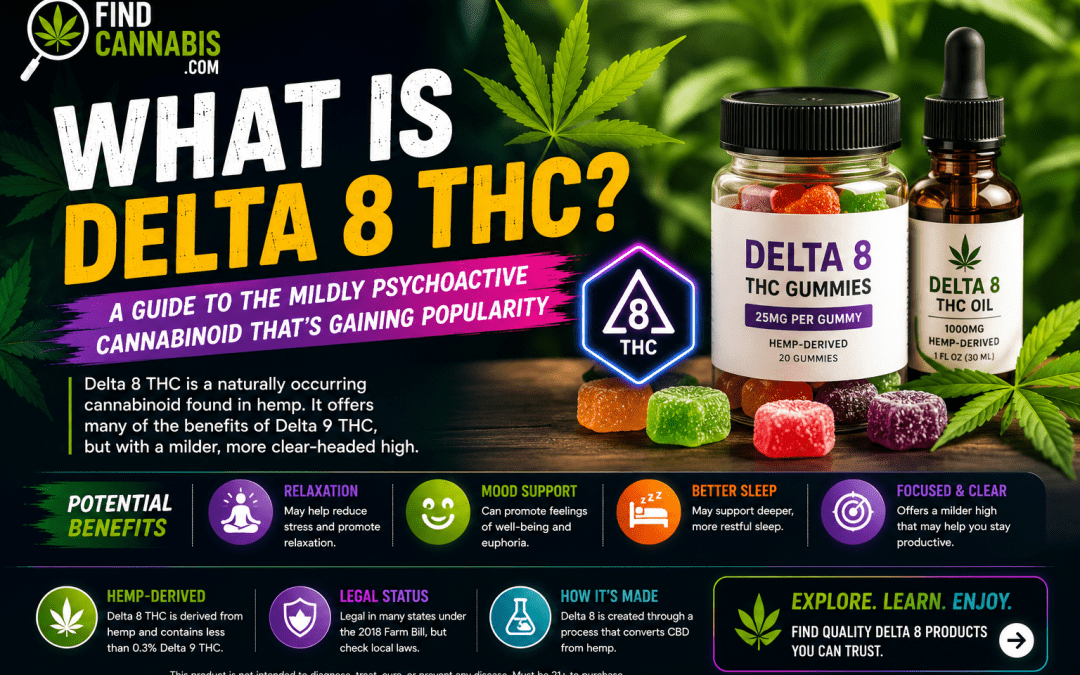
What Is Delta 8 THC — And Why Is It Everywhere?
You’ve seen the signs. Gas stations, convenience stores, vape shops — “Delta 8 THC” on gummies, vape pens, tinctures, sold right next to the energy drinks and lottery tickets. Maybe you’ve wondered whether it’s real, whether it’s safe, whether “legal THC” actually means anything. The answers are more interesting and more concerning than the marketing suggests.
What’s Actually in Those Products
Most people who buy Delta 8 THC products assume they’re buying something extracted from a cannabis or hemp plant. That assumption is almost always wrong.
Delta 8 THC occurs naturally in cannabis at concentrations below 1% of dry weight — far too little to extract commercially. The multi-billion dollar Delta 8 market wasn’t built on plant extraction. It was built on chemistry: CBD extracted from legal hemp, dissolved in organic solvents, treated with acid catalysts, and converted into Delta 8 THC through a process called acid-catalyzed isomerization.
The chemistry isn’t inherently dangerous. What’s dangerous is that the isomerization reaction produces more than just Delta 8. A 2021 study in Chemical Research in Toxicology found olivetol and olivetol derivatives in commercial Delta 8 products — substances not typically found in cannabis, not on any label, and with no established human safety profile. Many products also contained Delta 9 THC above the legal 0.3% threshold and novel cannabinoid byproducts with unknown pharmacology. All of this in products sold with essentially no mandatory testing requirements.
That’s the Delta 8 market. Understanding it requires understanding why it exists, what it’s made of, and how the regulatory gap that created it is closing faster than most consumers realize.
Why Delta 8 THC Is Actually Interesting — The Molecule
Delta 8 and Delta 9 THC share the same molecular formula (C21H30O2) but differ in the position of a double bond in the cyclohexene ring — at the 8th carbon in Delta 8 rather than the 9th in Delta 9. That single positional difference produces lower CB1 receptor binding affinity, which is the pharmacological basis for Delta 8’s milder, less anxiogenic character compared to Delta 9.
CB1 binding affinity determines how strongly a cannabinoid activates the receptor systems responsible for both psychoactive effects and anxiety. Delta 9’s higher binding affinity produces stronger amygdala activation — the likely mechanism behind the anxiety and paranoia that a significant subset of cannabis consumers experience. Delta 8’s lower binding affinity produces less of that amygdala response while maintaining meaningful analgesic, appetite-stimulating, and relaxation effects.
Research published in Cannabis and Cannabinoid Research has characterized Delta 8 as producing anxiolytic, appetite-stimulating, analgesic, and neuroprotective effects at reduced psychotropic potency. A 1973 Science study by Hollister and Gillespie found Delta 8 approximately two-thirds as potent as Delta 9 on measures of psychoactive effect — one of the earliest controlled human comparisons, and consistent with more recent work.
The Delta 8 high is real and pharmacologically distinct. Not a watered-down version of Delta 9. A genuinely different cannabinoid experience.
The Honest Case for Delta 8 THC
Here’s the argument that the Delta 8 safety conversation tends to obscure: the cannabinoid itself has legitimate therapeutic value, and dismissing it because of the unregulated market’s problems conflates the molecule with the industry.
There’s a real population of cannabis consumers who don’t tolerate Delta 9 THC well. The anxiety, the racing thoughts, the “too high” experience that accompanies high-potency Delta 9 — this isn’t unusual. Cannabis harm reduction practitioners who work with consumers who’ve had adverse Delta 9 experiences describe Delta 8 as a meaningful option for this population. Not a perfect solution, but a cannabinoid with a significantly more manageable anxiety profile that still provides the pain relief, relaxation, and appetite stimulation they were looking for.
Delta 8 also serves a genuine geographic access function. For consumers in states without legal cannabis, it has represented the only practical THC option available. Whatever problems exist in the Delta 8 market, that underlying need is real.
In a regulated context — mandatory testing, accurate labeling, age verification — Delta 8 would be a genuinely useful addition to the legal cannabis product landscape. The problem isn’t the cannabinoid. It’s that the market that grew up around it was built specifically to avoid the regulatory frameworks that would make it safe.
Delta 8 THC Effects, Onset, and Duration
Delta 8 THC effects are generally characterized as milder psychoactive intensity than Delta 9 (approximately 50-75% potency), reduced anxiety and paranoia risk, more body-focused and less cerebral at equivalent doses, and sedating at higher amounts — similar to indica-dominant Delta 9 products.
Onset and duration by format:
- Smoked/vaped: Minutes to onset, 2-4 hours duration
- Edibles: 30 minutes to 2 hours onset, 4-8 hours duration
- Tinctures: 15-45 minutes onset, 4-6 hours duration
Because product potency in the unregulated market is inconsistently accurate, starting at half the stated dose — particularly for edibles — is the appropriate approach until individual response to a specific product is established.
The Drug Test Problem Nobody Talks About Clearly
Delta 8 THC is metabolized by the same hepatic enzyme systems as Delta 9 — primarily CYP3A4 and CYP2C9 — producing THC-COOH as the primary urinary metabolite. Standard immunoassay drug tests screen for THC-COOH. They don’t distinguish between Delta 8 and Delta 9 origin.
The drug test result is unambiguous: positive, in the same detection window as comparable Delta 9 consumption. Occupational health physicians who’ve encountered Delta 8-related positive results consistently report that the “but it’s hemp-derived” explanation has not been accepted as a basis for excusing positive tests under standard workplace drug policies.
“Legal THC” is a legal argument about federal scheduling — not a statement about drug test detection. The Delta 8 market’s tendency to conflate these two distinct questions has produced genuinely harmful outcomes for consumers who assumed legal meant undetectable.
Is Delta 8 Legal? The Honest Answer Is Contested
The Farm Bill argument
The 2018 Agricultural Improvement Act legalized hemp and hemp-derived cannabinoids, defining legal hemp as cannabis with less than 0.3% delta-9 THC. The argument for hemp-derived Delta 8’s legality: it’s not explicitly listed as a controlled substance, and the Farm Bill’s THC threshold specifically references “delta-9 THC” rather than THC isomers generally.
Cannabis attorneys who’ve built practices around hemp law describe this argument as legally colorable but structurally fragile — a position that holds until a definitive court ruling or regulatory action says otherwise. Both conditions have been moving in the wrong direction since 2020.
The DEA’s position
The DEA issued an Interim Final Rule in August 2020 stating that “all synthetically derived tetrahydrocannabinols remain Schedule I controlled substances.” Because Delta 8 THC is produced through chemical synthesis from CBD rather than extracted from cannabis, the DEA’s position is that it’s synthetically derived and federally illegal regardless of its hemp feedstock.
This interpretation hasn’t been definitively resolved by federal courts as of 2026. Which means the legal Delta 8 THC market may already be operating in violation of existing federal law — not a future regulatory risk, but a present one that nobody has forced to a conclusion.
Where it’s banned
States with explicit Delta 8 THC bans include Alaska, Arizona, Arkansas, Colorado, Delaware, Idaho, Iowa, Mississippi, Montana, New York, North Dakota, Rhode Island, Utah, Vermont, Virginia, and others — a list that has grown substantially since 2022. Colorado’s inclusion is particularly telling: a state with full legal adult-use cannabis and every incentive to be cannabinoid-permissive decided the unregulated Delta 8 market was a problem worth prohibiting anyway.
Verify Delta 8 THC’s legal status in your specific state before purchasing. What was legal eighteen months ago may not be legal today.
The Safety Record — Specific Numbers, Not Vague Concerns
Product quality failures: The 2021 Chemical Research in Toxicology study found undisclosed cannabinoids and reaction byproducts — including olivetol derivatives with no established human safety profile — in commercial Delta 8 THC products. The 2022 United States Cannabis Council report found most sampled products contained Delta 9 THC above the 0.3% federal limit, labeled Delta 8 content was frequently inaccurate, and heavy metal contamination was detected in some samples.
FDA adverse events: Between December 2020 and February 2022, the FDA received 104 adverse event reports involving Delta 8 THC products — 77% involving human exposures and 8% requiring hospitalization.
Poison control: The CDC reported a 2,362% increase in Delta 8 THC-related poison control calls between January 2020 and February 2022. A disproportionate share involved children who consumed Delta 8 edibles that looked like conventional candy. Emergency physicians at pediatric hospitals in states with significant Delta 8 market presence have described treating children with clinical presentations including sedation and respiratory depression.
None of this happens at scale in the licensed cannabis market, where child-resistant packaging, accurate labeling, and age-verified retail are legally mandated. The comparison is not subtle.
Delta 8 THC vs Licensed Dispensary Cannabis
| Delta 8 THC (Unregulated) | Licensed Dispensary Cannabis | |
|---|---|---|
| Potency testing | Not universally required | Mandatory pre-sale |
| Pesticide testing | Not universally required | Mandatory pre-sale |
| Heavy metal testing | Not universally required | Mandatory pre-sale |
| Residual solvent testing | Not universally required | Mandatory pre-sale |
| Label accuracy | Often inaccurate (documented) | Required accurate labeling |
| Age verification | Often minimal | Strict ID verification |
| Legal status | Federally contested | Clear in legal states |
For consumers in legal cannabis states, this comparison resolves clearly. There is no safety argument for choosing unregulated Delta 8 THC over licensed dispensary cannabis — and the quality infrastructure that legal markets built took years to develop.
For consumers in non-legal states, Delta 8 THC may be the only practical option. That context makes product selection discipline more important, not less.
How to Navigate the Delta 8 Market
Require a current, batch-specific COA. Any Delta 8 THC company worth purchasing from provides a Certificate of Analysis from an accredited laboratory showing Delta 8 content matching the label, Delta 9 THC below 0.3%, non-detect for residual solvents and acid catalysts, and heavy metal and pesticide results within established limits. Testing date within the past 12 months. No COA, no purchase.
Avoid gas station Delta 8 THC. These products represent the lowest-quality tier — highest likelihood of inadequate testing, poorest quality control, most significant labeling inaccuracy.
Avoid hemp flower coated with Delta 8 distillate. The distribution of Delta 8 across flower surfaces is difficult to control, producing dosing variability that vape cartridges and precisely dosed edibles don’t have.
Start at half the stated dose for edibles. Potency variability in the Delta 8 THC market is documented. Calibrate individual response before using standard amounts.
A Direct Warning About Minors
Delta 8 THC products must not be used by anyone under 21. The CDC’s 2,362% increase in poison control calls reflects real children consuming real products with real consequences. Delta 8 edibles are often visually identical to conventional candy. They’re sold at gas stations with minimal age verification. This is not a hypothetical risk — it’s the documented record of what the unregulated market produced.
Where This Is All Heading
The FDA issued warning letters to five Delta 8 THC companies in 2022, citing unlawful claims, marketing to minors, and manufacturing safety concerns. Cannabis policy analysts describe explicit federal scheduling of synthetically derived THC as a realistic near-term outcome. State prohibitions keep expanding. And as more states establish regulated adult-use cannabis markets, Delta 8’s core value proposition — legal THC access in prohibition states — shrinks by the year.
Here’s the thought worth sitting with: the Delta 8 THC story is a case study in what happens when a regulatory gap meets a market incentive at scale. The 2018 Farm Bill created a legal ambiguity. The industry identified it within months. Billions of dollars of products moved through that gap before any oversight could respond — and the documented harms, particularly to children, are the cost of that gap.
The cannabinoid itself deserved better than the market that commercialized it. A regulated Delta 8 THC product — tested, accurately labeled, sold through age-verified channels — would be a genuinely useful addition to the cannabis landscape for consumers who don’t tolerate Delta 9 well. That product largely doesn’t exist because the market that developed around Delta 8 had no incentive to build it.
That’s worth remembering the next time you see it next to the lottery tickets. 🌿⚗️
Find licensed dispensaries with regulated cannabis products near you at FindCannabis.com.
Frequently Asked Questions About Delta 8 THC
What is Delta 8 THC?
Delta 8 THC is a psychoactive cannabinoid similar to Delta 9 THC but generally produces milder effects with less anxiety and paranoia. Most commercial Delta 8 products are made by chemically converting hemp-derived CBD into Delta 8 THC.
Is Delta 8 THC legal in 2026?
Delta 8 THC exists in a legally contested area. Some companies argue hemp-derived Delta 8 is federally legal under the 2018 Farm Bill, while the DEA considers synthetically derived THC federally illegal. Many states have banned Delta 8 products entirely.
Can Delta 8 THC make you fail a drug test?
Yes. Delta 8 THC produces the same THC metabolites targeted by standard drug tests. Most workplace tests cannot distinguish between Delta 8 and Delta 9 THC use.
How does Delta 8 compare to Delta 9 THC?
Delta 8 THC is typically less potent and often described as calmer and more body-focused than Delta 9 THC. Many users report reduced anxiety and paranoia compared to traditional cannabis products.
Are Delta 8 THC products safe?
Some Delta 8 products may contain contaminants, residual solvents, inaccurate potency levels, or unknown byproducts due to limited regulation. Always look for products with third-party laboratory testing and current Certificates of Analysis (COAs).
Why is Delta 8 sold in gas stations and vape shops?
Delta 8 products became widely available because hemp-derived cannabinoids entered a legal gray area after the 2018 Farm Bill. This allowed retailers outside licensed dispensaries to sell Delta 8 with minimal oversight.
How long do Delta 8 effects last?
Effects vary by product type. Vape products usually last 2–4 hours, tinctures around 4–6 hours, and edibles may last 4–8 hours or longer depending on dose and metabolism.
What should I look for before buying Delta 8 THC?
Only purchase Delta 8 THC products with a recent batch-specific Certificate of Analysis verifying cannabinoid potency and screening for heavy metals, pesticides, residual solvents, and Delta 9 THC compliance.
Your content goes here. Edit or remove this text inline or in the module Content settings. You can also style every aspect of this content in the module Design settings and even apply custom CSS to this text in the module Advanced settings.