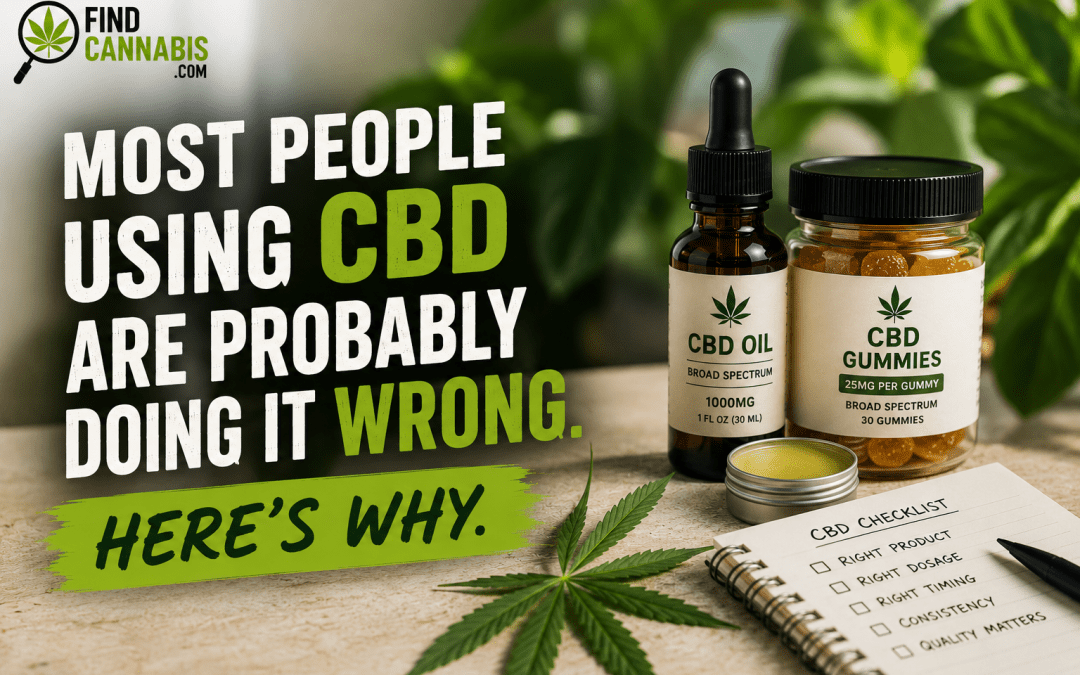
Most People Using CBD Are Probably Doing It Wrong. Here’s Why.
CBD interacts with blood thinners, antiepileptics, and immunosuppressants through the same liver enzyme mechanism as grapefruit. If you’ve ever seen a “do not take with grapefruit” warning on a prescription bottle, CBD operates through similar pathways — at sufficient doses, it can meaningfully change how your body processes those medications. Most CBD marketing doesn’t mention this. Most people using CBD don’t know it. That’s the kind of gap this article is trying to close.
What CBD Actually Is
CBD (cannabidiol) is a phytocannabinoid — one of over 140 identified cannabinoid compounds produced by the Cannabis sativa plant. First isolated in 1940, its structure wasn’t fully characterized until 1963. The endocannabinoid system — the biological network CBD works through — wasn’t discovered until the early 1990s. Researchers knew about CBD for fifty years before they understood the system it operates within.
The distinction that matters most for consumers: THC directly activates CB1 receptors in the central nervous system, producing intoxication. CBD has very low binding affinity for CB1 receptors and doesn’t produce psychoactive effects at any dose. This is receptor pharmacology, not marketing. CBD will not get you high.
How CBD Works
Understanding CBD’s effects requires knowing about the endocannabinoid system (ECS) — a regulatory network present in all vertebrates, consisting of cannabinoid receptors (CB1 and CB2) distributed throughout the body, endocannabinoids your body produces naturally, and the enzymes that break them down.
CBD’s mechanisms are distinct from THC and worth understanding specifically:
FAAH inhibition — CBD inhibits the enzyme that breaks down anandamide (your body’s own “bliss molecule”), increasing anandamide availability at receptors. This is likely the primary driver of CBD’s anxiolytic effects.
5-HT1A serotonin receptor partial agonism — CBD directly activates the same receptor targeted by buspirone, a pharmaceutical anxiolytic — providing anxiolytic effects through a pathway independent of the endocannabinoid system entirely.
TRPV1 receptor activation — TRPV1 is involved in pain signaling and inflammation; CBD’s activity here contributes to analgesic effects.
Negative allosteric modulation of CB1 — CBD doesn’t just ignore CB1 receptors. It changes their shape in ways that reduce THC’s ability to activate them. This is why products with significant CBD alongside THC tend to produce less anxiety than pure THC — CBD is literally modulating the receptor that would otherwise be driving the anxiety response.
This multi-target pharmacology explains both why CBD produces diverse effects and why it behaves differently depending on what else is in the product.
The Dosing Problem Nobody Talks About
This is the most practically important section in the article, and it deserves to stand on its own.
Clinical trial doses for CBD are substantially higher than typical consumer doses. Anxiety studies used 300mg in a single administration (Masataka, 2019; Bergamaschi et al., 2011). The Shannon et al. real-world case series used a mean initial dose of 25mg with a range up to 175mg. Epidiolex, the FDA-approved CBD medication for epilepsy, doses at 10-20mg/kg/day in pediatric patients.
A standard CBD gummy: 10-25mg. A standard tincture serving: 15-30mg.
The gap between the anxiety trial doses (300mg) and typical consumer products (25mg) is a factor of 10-12. This doesn’t mean 25mg is useless — FAAH inhibition and 5-HT1A effects occur at lower doses than controlled trial doses, and Shannon et al. produced real results at 25mg in some patients. But consumer expectations shaped by “CBD reduces anxiety by 79%” headlines may not match what a single 25mg gummy delivers.
CBD isolate adds another complication: its dose-response curve is bell-shaped, meaning at higher doses, isolate becomes less effective. Full spectrum products don’t show this pattern — their dose-response relationship is linear — which is one reason practitioners tend to recommend full spectrum for consistent results.
Cannabis pharmacists who specialize in CBD dosage describe the same pattern repeatedly: patients taking 10-15mg for two or three days, concluding CBD doesn’t work, when they may need 3-5x that dose sustained over several weeks for CBD’s accumulation in fatty tissues to produce stable effects. If you’ve tried CBD and decided it doesn’t work, dose and duration are the first variables to examine.
What the Clinical Evidence Actually Shows
Epilepsy: The unambiguous application
Epidiolex received FDA approval in 2018 for Dravet syndrome and Lennox-Gastaut syndrome based on randomized, double-blind, placebo-controlled trials. In the pivotal Dravet syndrome trial (New England Journal of Medicine, 2017), CBD produced a median seizure reduction of 38.9% versus 13.3% in the placebo group. Neurologists who work with these patient populations describe Epidiolex as genuinely changing outcomes for families who had exhausted every other option.
CBD for anxiety: Real evidence with caveats
The 2019 Masataka study found 300mg CBD significantly reduced anxiety in teenagers with social anxiety during a simulated public speaking test. Bergamaschi et al. (2011) found similar results in adults with social anxiety disorder. Shannon et al. (2019) found 79.2% of 72 patients reported decreased anxiety scores in the first month of CBD use.
Mechanistic support is strong — FAAH inhibition and 5-HT1A partial agonism are both well-characterized anxiolytic pathways. Cannabis wellness practitioners who work primarily with anxiety patients describe CBD as their most consistently recommended cannabinoid intervention, particularly for patients who’ve experienced THC-induced anxiety. The CB1 modulation mechanism means CBD may actually attenuate the anxiogenic effects of THC — a pharmacologically distinct benefit.
CBD for sleep: Mostly indirect
Sleep effects are mediated primarily through anxiety reduction and pain relief rather than direct sedation. Shannon et al. found 66.7% of patients reported improved sleep in the first month. Sleep medicine practitioners note CBD works most reliably for sleep disruption driven by anxiety or pain; effects on primary insomnia without those underlying drivers are less consistent.
CBD for pain: Strong preclinical mechanism, developing human evidence
CB2 receptor activity on immune cells, TRPV1 activation, and FAAH inhibition all contribute to anti-inflammatory and analgesic effects. The 2019 Pain Medicine study on topical CBD for peripheral neuropathy showed significant improvements in pain intensity and quality. A 2020 retrospective study found 53% of chronic pain patients reduced or eliminated opioid use while taking CBD.
For topical applications specifically, local CB2 receptor activity in skin and subcutaneous tissue makes the mechanism particularly direct — cannabinoids don’t need to reach the bloodstream to produce localized anti-inflammatory effects. Physical therapists who recommend CBD topicals describe outcomes meaningfully different from what systemic CBD produces for the same joint and muscle applications.
What the evidence doesn’t establish
CBD is not a proven treatment for neurodegenerative diseases, cancer, or the broad range of conditions claimed during the 2018-2019 hype period. The neuroprotective mechanisms are genuinely interesting. Human clinical evidence isn’t there yet, and the distinction matters.
Why the Source of Your CBD Matters
CBD occurs in both hemp (Cannabis sativa with less than 0.3% delta-9 THC) and marijuana (Cannabis sativa with higher THC content). The 2018 Farm Bill established the 0.3% threshold as the federal legal definition of hemp, making hemp-derived CBD federally legal.
Hemp-derived CBD is federally legal and widely available — pharmacies, grocery stores, online. US agricultural regulations provide some quality baseline, though the consumer market remains largely unregulated. A 2017 JAMA study found 69% of CBD products were mislabeled — 26% containing less than labeled, 43% containing more.
Cannabis-derived CBD from licensed dispensaries is subject to mandatory pre-sale third-party testing for potency, pesticides, heavy metals, and residual solvents. That regulatory infrastructure is what makes the mislabeling problem substantially less likely in a licensed dispensary than in general retail — and it’s the most direct answer to the 2017 JAMA findings that still apply today.
Full Spectrum vs Broad Spectrum vs Isolate
Full spectrum CBD contains the complete phytochemical profile — CBD, CBG, CBN, trace THC below 0.3%, terpenes, and flavonoids. The entourage effect hypothesis, proposed by Mechoulam and Ben-Shabat in 1998, holds that these compounds work better in combination than in isolation.
Gallily et al. (2015, Pharmacology & Pharmacy) provides direct evidence: full spectrum extract was significantly more effective than CBD isolate at equivalent doses for anti-inflammatory effects, with a linear dose-response curve versus isolate’s bell-shaped one. Cannabis pharmacists who provide clinical consultation generally default to full spectrum for most applications, with broad spectrum or isolate indicated for specific circumstances.
Broad spectrum CBD retains terpenes and minor cannabinoids with THC removed — appropriate for consumers who want more than isolate provides but need reliable THC-free status for drug testing or personal preference.
CBD isolate is 99%+ pure cannabidiol. No entourage effect, bell-shaped dose-response curve, but absolutely no THC. CBD isolate with a COA confirming non-detect THC is the appropriate choice for consumers with genuine zero-THC requirements.
Delivery Methods — The Bioavailability Variable Most People Ignore
The format you choose determines what percentage of CBD actually reaches your bloodstream. The differences are large enough to change whether a dose is effective.
Tinctures (sublingual): Bypasses first-pass hepatic metabolism. Estimated bioavailability: 13-19%. Onset: 15-45 minutes. Duration: 4-6 hours. Consistently the format dispensary staff recommend for new CBD users — dosing flexibility and higher bioavailability make individual calibration more practical than fixed-dose formats.
Edibles and capsules (oral): First-pass metabolism substantially reduces what reaches the bloodstream. Estimated bioavailability: 6-19%, with meaningful individual variation based on fat content, gut health, and hepatic enzyme activity. Onset: 30-120 minutes. Duration: 6-8 hours. Consumers who find edibles ineffective at a given dose often respond better to tinctures at the same labeled amount — sublingual absorption simply delivers more.
Vaporization (inhalation): Estimated bioavailability: 31-56%. Onset: 1-5 minutes. Duration: 2-3 hours. Most bioavailable format with the fastest CBD effects. The trade-off is respiratory risk — long-term effects of CBD vaporization specifically aren’t fully characterized.
Topicals: Local CB2 receptor activity in skin and subcutaneous tissue without meaningful systemic absorption. Appropriate for localized pain and inflammation; not appropriate for anxiety, sleep, or effects requiring systemic delivery.
Drug Interactions — Back to Where We Started
CBD is a moderate inhibitor of CYP3A4 and CYP2C19 — two cytochrome P450 enzymes responsible for metabolizing a substantial proportion of pharmaceutical drugs. When these enzymes are inhibited, drugs they process accumulate at higher concentrations than intended.
This is the grapefruit mechanism. The “do not take with grapefruit” warnings on certain prescriptions exist because grapefruit contains furanocoumarins that inhibit these same enzymes. CBD operates through similar pathways at sufficient doses.
Clinically significant interactions include warfarin and blood thinners (CYP2C9 inhibition can increase warfarin levels, raising bleeding risk — documented and clinically significant), antiepileptic drugs (interactions were identified in the Epidiolex clinical trials themselves), benzodiazepines and CNS depressants, and immunosuppressants including tacrolimus and cyclosporine — narrow therapeutic window drugs where plasma level changes carry serious consequences.
Anyone taking pharmaceutical medications should discuss CBD with their prescribing physician before use. This is a clinical recommendation grounded in documented enzyme pharmacology.
CBD Dosage — Evidence-Based Starting Points
General wellness and mild anxiety: 15-25mg per day via tincture. Assess after two weeks — CBD accumulation in fatty tissues means effects often improve meaningfully over this period rather than plateauing at the initial response.
Moderate anxiety or sleep disruption: 25-50mg per day. The Shannon et al. case series mean initial dose was 25mg.
Chronic pain or significant conditions: 50-150mg per day, with some patients under medical supervision using higher doses.
CYP2C19 genetic variation produces meaningful differences between individuals at the same dose — fast metabolizers may need substantially higher doses, slow metabolizers may find lower doses effective but experience more drug interactions. Start low, adjust deliberately, and give any dose at least two weeks before concluding it’s insufficient.
CBD and Drug Testing
Standard immunoassay urine tests screen for THC-COOH — the primary metabolite of THC — not CBD itself. CBD won’t cause a positive test.
The realistic risk is with full spectrum products: trace THC (up to 0.3%) can accumulate in fatty tissues with regular consumption at higher doses. At doses above 50mg/day of full spectrum CBD used consistently, accumulated THC-COOH can potentially exceed the standard 50 ng/mL immunoassay threshold. Occupational health professionals who advise drug-tested employees consistently document positive results attributed to full spectrum CBD at higher doses — the risk is real for a specific subset of consumers.
CBD isolate with verified non-detect THC on a current COA presents negligible drug test risk. For anyone subject to testing, isolate is the appropriate product type.
Finding Products That Are What They Claim to Be
Only 31% of CBD products were accurately labeled in the 2017 JAMA study. The market has improved; the problem hasn’t disappeared. Here’s how to avoid the other 69%:
Require a current, batch-specific COA from an ISO-accredited independent laboratory — cannabinoid content matching the label, THC below 0.3%, non-detect for pesticides, heavy metals, and residual solvents. Testing date within 12 months. No COA, no purchase.
Check the actual CBD content per serving before forming any conclusions about effectiveness. Many products are significantly underdosed relative to research doses.
Prioritize US-grown hemp — subject to USDA oversight that imported material often isn’t.
Use licensed dispensaries in legal states — mandatory testing requirements substantially reduce the mislabeling risk documented in general retail.
Established reference brands: Charlotte’s Web, Lazarus Naturals, Medterra, and Joy Organics have demonstrated consistent quality and testing transparency over years.
CBD vs THC — The Differences That Actually Matter
| CBD | THC | |
|---|---|---|
| Psychoactive? | No — negligible CB1 binding affinity | Yes — direct CB1 agonist |
| Drug test risk | Low (isolate) to moderate (full spectrum, higher doses) | High |
| Anxiety effects | Anxiolytic via 5-HT1A and FAAH inhibition | Can be anxiogenic via CB1 at high doses |
| FDA approval | Epidiolex (epilepsy) | Marinol, Syndros (nausea) |
| Drug interactions | CYP3A4/2C19/2C9 inhibition — clinically documented | Less documented |
| Available without prescription? | Yes | Dispensary only in legal states |
The Thing Worth Sitting With
The 2017 JAMA mislabeling study and the clinical trial dosing gap point to the same underlying problem: an unregulated market has made it genuinely difficult for consumers to access what the research describes.
Anxiety studies used 300mg doses. The pharmacy shelf product contains 10mg per gummy. One is a precisely formulated pharmaceutical intervention tested in controlled conditions. The other is an unregulated consumer item whose actual CBD content may not match the label.
None of this is an argument against CBD. It’s an argument for approaching it with more precision than most marketing encourages — verified products, doses calibrated to the evidence, enough time to assess actual effects, and a conversation with a physician if you take other medications.
The distance between “CBD doesn’t work” and “CBD works” is often the distance between a 10mg gummy from a gas station and a 50mg tincture from a verified source, taken consistently for four weeks. That’s a navigable gap — and now you have what you need to navigate it.
Use FindCannabis.com to find licensed dispensaries near you. 🌿
Find licensed dispensaries with CBD products near you at FindCannabis.com.
Frequently Asked Questions About CBD
What is CBD?
CBD, or cannabidiol, is a non-intoxicating cannabinoid found in Cannabis sativa. Unlike THC, CBD does not directly activate CB1 receptors in the brain and does not produce a high.
Can CBD get you high?
No. CBD will not get you high because it has very low binding affinity for CB1 receptors, which are the receptors responsible for THC’s intoxicating effects.
How does CBD work?
CBD works through several pathways, including FAAH inhibition, serotonin receptor activity, TRPV1 receptor activation, and modulation of CB1 receptors. This helps explain why CBD may affect anxiety, pain, inflammation, and sleep differently depending on the person and product.
What dose of CBD should beginners start with?
A common starting point is 15–25mg of CBD per day, especially with a tincture. Effects may become more noticeable with consistent use over two weeks, so it is best not to judge CBD from one low-dose gummy.
Can CBD interact with medications?
Yes. CBD can affect liver enzymes involved in drug metabolism, similar to the grapefruit warning on some prescriptions. People taking blood thinners, antiepileptics, benzodiazepines, immunosuppressants, or other medications should talk with their physician before using CBD.
What is the difference between full spectrum CBD, broad spectrum CBD, and CBD isolate?
Full spectrum CBD contains CBD, minor cannabinoids, terpenes, flavonoids, and trace THC. Broad spectrum CBD removes THC while keeping other hemp compounds. CBD isolate is purified CBD with no THC or entourage effect.
Can CBD make you fail a drug test?
CBD itself does not trigger standard THC drug tests. However, full spectrum CBD can contain trace THC, which may accumulate with regular use. If drug testing matters, CBD isolate with a current COA showing non-detect THC is the safest option.
What is the best way to take CBD?
CBD tinctures are usually the best starting point because they allow flexible dosing and better absorption than many edibles. Topicals are better for localized pain, while edibles and capsules last longer but may absorb less efficiently.