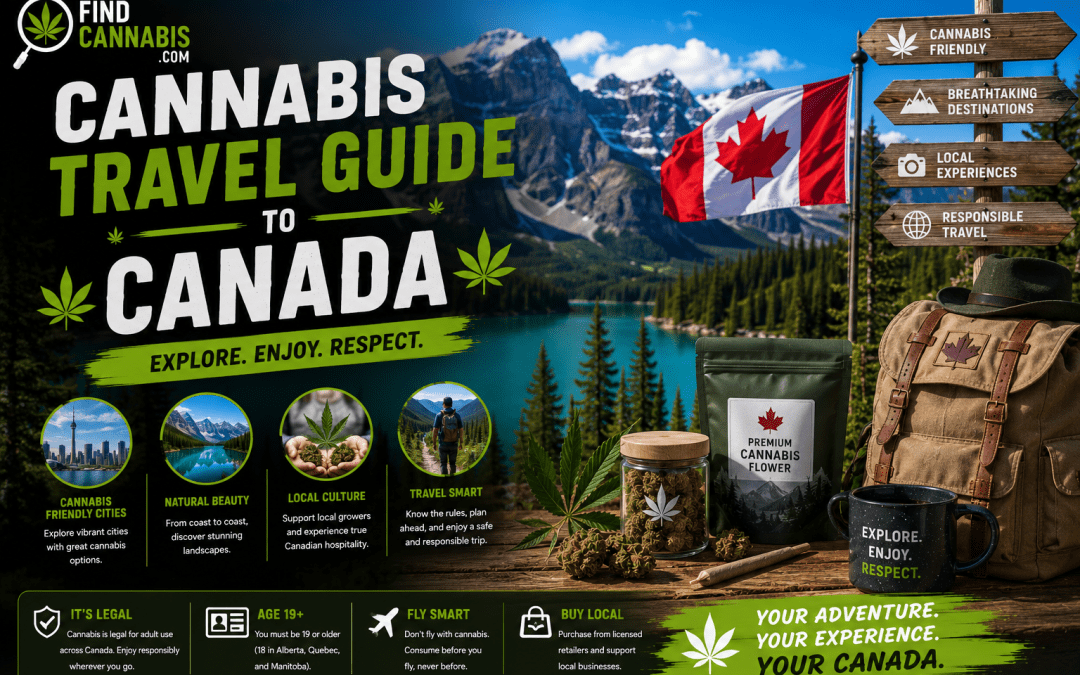
Cannabis Travel Guide to Canada
Canada is the only G7 nation to have federally legalized recreational cannabis — and it did so eight years ago while the world’s largest economy still classifies it as a Schedule I controlled substance alongside heroin. The question worth asking isn’t whether Canada made the right call. Eight years of data has answered that. The question is what that means for you as a cannabis consumer planning a trip there, and what you’d be missing if you didn’t go.
Before You Cross the Border — Read This First
US Customs and Border Protection can permanently ban you from entering the United States for admitting to legal cannabis use in Canada. Not temporarily. Permanently.
The authority exists, it’s been exercised, and it applies to legal cannabis use in a country where cannabis is fully federally legal. USCBP officers have broad discretionary authority to deny entry based on admissions of cannabis use — legal or otherwise — because cannabis remains a Schedule I controlled substance under US federal law regardless of what Canada has done. Transporting cannabis across the US-Canada border in either direction is a federal crime, full stop.
Leave all cannabis behind before crossing. Buy fresh from a licensed Canadian retailer when you arrive. Bring nothing home. Cannabis tourism attorneys who advise clients on cross-border travel describe this as the most non-negotiable rule in the space — the downside risk (federal criminal charges, permanent entry bans) is disproportionate to any upside.
With that established, here’s how to make the most of cannabis travel in Canada.
What Federal Legalization Actually Created
Canada’s Cannabis Act came into force on October 17, 2018. Federal parameters apply nationwide: adults may possess up to 30 grams in public, cultivate up to 4 cannabis plants at home (subject to provincial overrides), must purchase from licensed retailers, and may not transport cannabis across international borders.
Federal parameters are where national consistency ends.
Provinces set their own retail models, consumption rules, age requirements, and home cultivation policies — producing six meaningfully different regulatory environments among Canada’s most-visited jurisdictions. The variation isn’t superficial. It produces genuinely different cannabis travel experiences, different price points, and different public consumption realities.
Age requirements:
- 18+: Alberta and Quebec (Quebec compensates with stricter rules on everything else)
- 19+: BC, Ontario, Manitoba, Saskatchewan, Nova Scotia, New Brunswick, PEI, Newfoundland, and the territories
Tax structure: Federal excise duty is the higher of $1.00 per gram or 10% of the producer’s sale price. Total consumer tax burden in Canada is generally lower than comparable US state cannabis tax burdens — a meaningful contributor to the competitive pricing that has developed in Canada’s mature legal market.
Provincial Cannabis Rules — Where the Experience Diverges
Ontario — The Largest Market, With a Rocky Start
Ontario’s cannabis story starts with an instructive failure: the province launched in April 2019 with only 25 licensed stores despite being Canada’s most populous province. A lottery-based licensing system produced bizarre early supply-demand mismatches — long lines, product shortages, the illegal market continuing to thrive alongside a legal one that could barely stock itself.
The province has since expanded aggressively. Ontario now has over 1,500 licensed cannabis retailers — the largest retail count of any province. Public consumption is permitted in most outdoor spaces where tobacco smoking is allowed. Not permitted in cars, near schools, on bar and restaurant patios, or in indoor public spaces. Home growing: up to 4 plants. Age: 19+.
British Columbia — The Benchmark
BC benefits from decades of pre-legalization cannabis culture. Vancouver had a developed dispensary ecosystem that preceded federal legalization, providing retail infrastructure and consumer sophistication that other provinces lacked. BC’s craft cannabis production sector is among the most developed in Canada, supported by the province’s climate and agricultural history. The mix of private retailers and government BC Cannabis Stores has evolved toward private market dominance as consumers have demonstrated a clear preference for competitive retail over government-operated alternatives.
Public consumption generally permitted outdoors where smoking is allowed. Vancouver maintains designated consumption areas and consistently relaxed enforcement. Home growing: up to 4 plants. Age: 19+.
Alberta — The Private Market That Sets the Standard
Alberta’s decision to launch with a fully private retail model was controversial at the time and has been vindicated by results. More retailers per capita than any other province, lower prices than government-operated markets, and product selection that reflects genuine retail competition rather than centralized procurement. The Alberta Gaming, Liquor and Cannabis (AGLC) licenses private retailers and operates as the province’s wholesale distributor — the public/private split that produced Alberta’s competitive consumer market.
Public consumption prohibited in public spaces; permitted on private property. Home growing: up to 4 plants. Age: 18+.
Quebec — The Case for Managing Expectations
Quebec deserves honest discussion rather than neutral presentation. The SQDC government monopoly, the 21+ age requirement (raised from 18 in January 2020), the prohibition on home growing, and more restricted public consumption rules collectively produce a cannabis travel experience that is objectively more limited than Ontario, BC, or Alberta. The SQDC has improved considerably — from 12 stores at launch to over 90 across the province, with meaningfully better product quality and variety — but the government monopoly model structurally cannot produce the retail innovation, price competition, or craft cannabis curation of private retail markets.
If Montreal is your primary cannabis travel destination, go knowing this. The city is extraordinary. The dispensary experience is functional. Lower your retail expectations and raise your restaurant and culture expectations — Montreal delivers spectacularly on those.
Manitoba and Saskatchewan
Private retail, public consumption prohibited, no home growing. Age: 19+. More conservative regulatory frameworks producing more limited cannabis travel experiences than BC or Ontario.
The Contrarian Case — Why Quebec Might Still Be Worth Your Trip
Montreal’s limitations as a cannabis travel destination are real and documented. The SQDC is a government monopoly. The age is 21+. The retail experience is utilitarian.
And Montreal is still one of the best cities in North America to visit if you use cannabis. The café culture, the bilingual energy, the extraordinary restaurant scene, the architecture, the music — Montreal as a city is magnificent. The SQDC produces adequate cannabis at consistent quality. “Adequate and consistent” isn’t exciting compared to Vancouver’s craft cannabis scene, but it’s sufficient for an exceptional Montreal trip where cannabis is supporting a broader experience rather than being the primary destination.
The honest framing: don’t go to Montreal for the dispensary experience. Go for Montreal, and treat the SQDC as the functional procurement operation it is. Then go to Toronto or Vancouver if you want the dispensary visit to be the highlight.
The Best Dispensaries in Canada — 2026
Toronto
Ontario’s retail expansion has made Toronto one of the most competitive cannabis markets in the world. The concentration of quality, design-forward retail makes it a genuine cannabis travel destination.
Tokyo Smoke — Multiple Toronto Locations | tokyosmoke.com
Tokyo Smoke helped establish the aesthetic vocabulary of premium Canadian cannabis retail — minimal, sophisticated, treating cannabis as a lifestyle product worthy of serious design investment. Among the best dispensaries in Toronto for product curation alongside the retail experience itself.
Best for: Design-forward retail, curated product selection, gift shopping Vibe: Premium, minimal, sophisticated
Superette — Multiple Toronto Locations | superetteshop.com
Where Tokyo Smoke goes minimal, Superette goes exuberantly colorful — a deliberate counterpoint that has proven equally effective. Their brand identity development is studied in Canadian cannabis industry circles as a benchmark for building consumer loyalty through consistent aesthetic and product quality commitment.
Best for: Approachable, fun retail; strong product selection; consistent quality Vibe: Colorful, welcoming, genuinely enjoyable
The Hunny Pot Cannabis Co. — Toronto | thehunnypot.com
Opened October 17, 2018 — the first day of Canadian legal recreational cannabis — and still operating at the same downtown location. In a market with substantial operator turnover, that continuity says something. For cannabis travel in Canada with historical context, this is the Toronto dispensary that delivers it.
Best for: Toronto cannabis history, consistent quality, established community connection Vibe: Local institution, warm, genuinely knowledgeable
Canna Cabana — Multiple Ontario Locations | cannacabana.ca
Among Canada’s largest cannabis retail chains by location count, emphasizing competitive pricing and accessibility over premium positioning. Wide selection, multiple GTA locations, consistently stocked. The reliable chain answer when convenience matters more than curation.
Best for: Wide selection, competitive pricing, multiple locations Vibe: Value-focused, accessible, reliably stocked
Vancouver
Vancouver is the standout cannabis travel destination in Canada. Decades of pre-legalization consumer sophistication, exceptional BC craft cannabis production, and consistently relaxed consumption enforcement create something no other Canadian market fully replicates.
Evergreen Cannabis Society — Vancouver | evergreencannabis.ca
Evergreen’s product curation philosophy — prioritizing BC craft producers with documented provenance — reflects the retail approach that experienced cannabis consumers consistently prefer in mature markets. Cannabis industry observers who track Vancouver’s independent retail sector identify Evergreen as the benchmark for quality-focused independent retail in the city.
Best for: BC craft cannabis, expert staff consultation, quality-prioritizing consumers Vibe: Community rooted, locally focused, genuinely expert
FOUR20 Premium Market — Vancouver | four20market.com
Fewer SKUs, higher average quality threshold — a deliberately curated menu that experienced cannabis consumers consistently rate more useful than maximum selection breadth. Vancouver’s competitive retail market makes premium positioning difficult to sustain without genuine product differentiation; FOUR20 has sustained it.
Best for: Premium product selection, sophisticated retail experience, quality-first consumers Vibe: Premium, design-forward, earned positioning
Minerva Cannabis — Vancouver | minervacannabis.ca
The neighborhood dispensary model at its most effective — community-integrated, staffed by people who develop genuine product expertise and customer relationships over time. For cannabis travel in Canada that prioritizes authentic local experience over chain retail, Minerva is the Vancouver answer.
Best for: Neighborhood experience, fair pricing, genuine service relationships Vibe: Local, warm, community-integrated
BC Cannabis Stores — Multiple Vancouver Locations | cannabis.gov.bc.ca
Less dynamic than the best independents, but operating under provincial quality and inventory standards that guarantee baseline consistency. The private retail market has won the consumer preference battle in BC — BC Cannabis Stores now serve primarily as reliability backstops for tourists who want guaranteed quality without independent research.
Best for: Tourists seeking guaranteed quality baseline, comprehensive product availability Vibe: Government-operated, consistent, dependable
Calgary
Alberta’s fully private retail model has produced Calgary’s competitive market — more licensed retailers per capita than most Canadian cities, meaningful price competition, and product variety reflecting genuine retail competition.
Dutch Love — Calgary | dutch.love
Strong reputation across Alberta for consistent product quality and staff training investment that produces measurably better consultations than discount-focused competitors. Multiple Calgary locations with consistent standards across all of them.
Best for: Knowledgeable staff, quality products, consistent multi-location standards Vibe: Professional, welcoming, quality-focused
Canna Cabana — Multiple Calgary Locations | cannacabana.ca
Multiple convenient Calgary locations with competitive pricing and wide product range. Alberta’s AGLC wholesale distribution model means product availability is consistent across retailers.
Montreal
SQDC (Société québécoise du cannabis) — Multiple Montreal Locations | sqdc.ca
Quebec’s government cannabis monopoly and the only legal retail option in the province. From 12 stores at launch to over 90 across the province as of 2026, with meaningfully improved product quality and variety. The sqdc.ca website provides current inventory by location — use it before arriving rather than after.
Best for: The only legal option for buying cannabis in Quebec; consistent quality standards Vibe: Government-operated, functional, improving
Ottawa
Hobo Recreational Cannabis — Ottawa | hoborec.com
Hobo has built genuine consumer loyalty through staff training investment and community engagement. Cannabis retail observers who track Ottawa’s independent sector identify Hobo as a consistent benchmark for service quality in the capital region — a worthwhile stop on any cannabis travel Canada itinerary.
Best for: Capital region cannabis experience, expert staff consultation, community-focused retail Vibe: Local institution, genuine, knowledgeable
Canadian Cannabis Products — What’s Different From American Markets
The craft cannabis sector
Canada’s micro-cultivator license — capped at 200 square meters of canopy — structurally forces small producers to prioritize quality over volume in ways that larger licensed producers cannot. Consumer behavior data from mature provincial markets shows increasing craft cannabis market share as cannabis tourism in Canada develops.
At every dispensary you visit, ask specifically about micro-cultivator license holders rather than making general requests. In BC, ask about BC-licensed micro-cultivators. In Ontario, ask about Ontario craft producers. This single question consistently produces the best product recommendations you’ll receive during cannabis travel in Canada.
The 10mg edibles constraint
Canada’s THC limit is 10mg per edibles package — a federal regulation requiring federal legislative action to change, with no change on the horizon as of 2026. American consumers accustomed to higher package limits should calibrate accordingly. Adjust expectations or buy multiple packages.
Canadian hash
Canada produces domestically grown and processed hashish distinct in character from Moroccan or Afghan varieties. Among the most underexplored Canadian cannabis products by cannabis travel visitors — genuinely worth seeking out at quality-focused retailers.
What Cannabis Costs in Canada
Representative 2026 prices:
- Flower (per gram): CAD $7-15 ($5-11 USD)
- Pre-rolls: CAD $5-12 per joint
- Edibles: CAD $5-15 per package (note 10mg THC limit)
- Vape cartridges: CAD $25-60 per cartridge
Alberta’s competitive private retail model consistently produces lower consumer prices than government-operated markets — a documented outcome of genuine retail price competition. For value-focused cannabis travel in Canada, Alberta delivers meaningfully better pricing than Quebec’s standardized monopoly pricing.
Cannabis Tourism Experiences by Region
Vancouver and BC — The essential cannabis travel destination in Canada. Stanley Park (405 hectares of urban forest and ocean views), Whistler (world-class skiing 120km north with natural mountain town cannabis culture), and the Gulf Islands (accessible by BC Ferries, genuinely spectacular) together make BC the richest cannabis travel experience in the country.
Toronto and Ontario — The urban cultural capital version. Kensington Market’s cannabis culture history, the Art Gallery of Ontario, the Toronto Islands (car-free, ten minutes by ferry, surprisingly peaceful). Toronto’s dispensary scene is world-class; the city’s cultural offerings make it a complete destination.
Alberta’s Rockies — Banff and Jasper National Parks are federal land where cannabis consumption is technically prohibited. Surrounding towns and private accommodations operate under Alberta provincial law. The scenery justifies every logistical complication.
Prince Edward Island — Canada’s quietest cannabis travel experience and genuinely underrated. Red sand beaches, rolling farmland, a small but charming dispensary scene, and a pace of life that suits cannabis-enhanced appreciation of uncrowded, beautiful places.
Practical Tips Before You Go
Provincial age verification: Alberta’s 18+ requirement is the exception nationally — plan accordingly if traveling with a group of mixed ages.
Finding craft cannabis: Ask dispensary staff specifically about micro-cultivator license holders at every dispensary you visit. This question consistently produces the most interesting consultations and the best product.
Try Canadian hash: Domestically produced Canadian hash is genuinely underexplored by cannabis travel visitors. Seek it out specifically at quality-focused retailers.
Provincial retailer directories: Ontario’s OCS website, Alberta’s AGLC directory, and BC’s cannabis retailer directory provide current licensed retailer lists — more reliable than third-party directories for confirming licensure status.
Public consumption enforcement reality: Written provincial cannabis rules and enforcement practice differ meaningfully in some jurisdictions. Vancouver’s practical reality is more permissive than Alberta’s written prohibition. Know both dimensions before assuming anything.
Don’t bring cannabis across the border. Leave everything behind, buy fresh when you arrive, bring nothing home. This is the rule that doesn’t bend.
The Thought Worth Taking Home
The Alberta vs Quebec comparison that runs through this article isn’t just an interesting policy observation — it’s a preview of a debate that will define cannabis policy globally for the next decade.
Every jurisdiction that legalizes cannabis faces the same fundamental choice: government-operated retail with standardized pricing and monopoly control, or private retail with competitive pricing and market-driven innovation. Canada has been running both models simultaneously since 2018. The results are in. Private retail markets consistently produce better consumer outcomes on pricing, selection, and retail experience. Government monopolies consistently produce more controlled markets with fewer consumer choices.
What Canada’s natural experiment demonstrates — and what American states, European nations, and other jurisdictions considering legalization should be watching — is that how you legalize matters as much as whether you legalize. The Cannabis Act’s decision to federally legalize while delegating retail authority to provinces created the conditions for this experiment.
Eight years in, Alberta’s consumers are getting better cannabis at lower prices through more retail options than Quebec’s consumers. That’s not a coincidence. It’s a policy outcome. And the rest of the world is watching. 🍁🌿
Find dispensaries across Canada at FindCannabis.com — your global cannabis directory.
Frequently Asked Questions About Cannabis Travel in Canada
Is cannabis legal in Canada?
Yes. Recreational cannabis has been federally legal in Canada since October 17, 2018 under the Cannabis Act.
Can tourists buy cannabis in Canada?
Yes. Tourists who meet provincial age requirements can legally buy cannabis from licensed Canadian retailers with valid government-issued identification.
Can you bring cannabis across the US-Canada border?
No. Transporting cannabis across the US-Canada border is federally illegal regardless of cannabis legality in either country or state.
What is the legal age for cannabis in Canada?
The legal cannabis age is 18 in Alberta and Quebec, and 19 in most other Canadian provinces including Ontario and British Columbia.
Can you smoke cannabis in public in Canada?
Public cannabis consumption rules vary by province. Ontario and British Columbia generally allow outdoor consumption where tobacco smoking is permitted, while Alberta and some other provinces are more restrictive.
What is the best cannabis travel destination in Canada?
Vancouver and British Columbia are widely considered the best cannabis travel destinations in Canada because of BC craft cannabis culture, relaxed consumption attitudes, and mature dispensary infrastructure.
Why are Canadian edibles limited to 10mg THC?
Canada federally limits cannabis edibles to 10mg THC per package under national Cannabis Act regulations.
What is BC craft cannabis?
BC craft cannabis refers to small-batch cannabis produced by British Columbia micro-cultivators, often focused on premium flower quality, terpene preservation, and boutique cultivation methods.