First Time at a Dispensary? Here’s Everything You Need to Know
The most useful thing you can say when you walk into a dispensary for the first time isn’t a strain name or a product category. It’s three words: “This is my first time.” Experienced budtenders describe this as the phrase that most completely changes the nature of the consultation — slower, more thorough, more honest. Most first-timers never say it because they’re worried about looking inexperienced. That hesitation costs them the best part of the visit.
What Most First-Timer Guides Leave Out
After a decade covering the legal cannabis industry — including regulatory frameworks, consumer behavior research, and firsthand observation of hundreds of dispensary experiences — I’ve noticed that most beginner dispensary guides are optimized for reassurance rather than preparation. They tell you what to bring, what to expect, and that everything will be fine. They leave out the things that would most change your behavior.
Here’s what they consistently miss:
THC concentrations have roughly doubled since the early 2000s. Legal market flower now commonly tests at 20-30% THC. Someone who tried cannabis in college and calibrated their tolerance to 10-15% products is working with outdated information. “Mild” in 2026 is not what “mild” meant fifteen years ago.
Cannabis interacts with certain medications through CYP450 enzyme pathways — the same metabolic system that processes blood thinners like warfarin, certain antidepressants, and some seizure medications. Most dispensary guides don’t mention this. Your budtender needs to know what you take.
The 2019 EVALI outbreak — a lung injury illness affecting primarily illicit market vape users — was traced to vitamin E acetate in unregulated products. This is the strongest argument for buying exclusively from licensed dispensaries, and most guides never make it.
Edibles are disproportionately represented in adverse cannabis experience reports. Colorado’s post-legalization data identified edibles as causing more emergency department visits relative to their market share than any other cannabis format. The product that looks most beginner-friendly is the one that most consistently overwhelms new consumers.
None of this is meant to frighten you. It’s meant to give you better information than you’d get elsewhere.
What a Licensed Cannabis Dispensary Actually Is
A dispensary is a state-licensed retail establishment operating under regulatory requirements that include mandatory employee training, product testing standards, and compliance monitoring. This regulatory framework is the practical reason to use licensed dispensaries — the consumer protections are real and substantive.
The staff — called budtenders — are retail cannabis specialists combining product knowledge, consumer education, and dosing guidance. Quality dispensaries invest significantly in budtender training, and the operators who’ve built genuinely loyal customer bases consistently credit staff expertise as the primary differentiator from competitors.
Dispensary formats vary by state:
- Recreational (adult-use) — adults 21 and over, valid ID, no medical documentation required
- Medical — requires a state-issued medical marijuana identification card and physician documentation
- Dual-use — serves both populations; the most common format in mature legal markets
The Regulatory Reality Before You Go
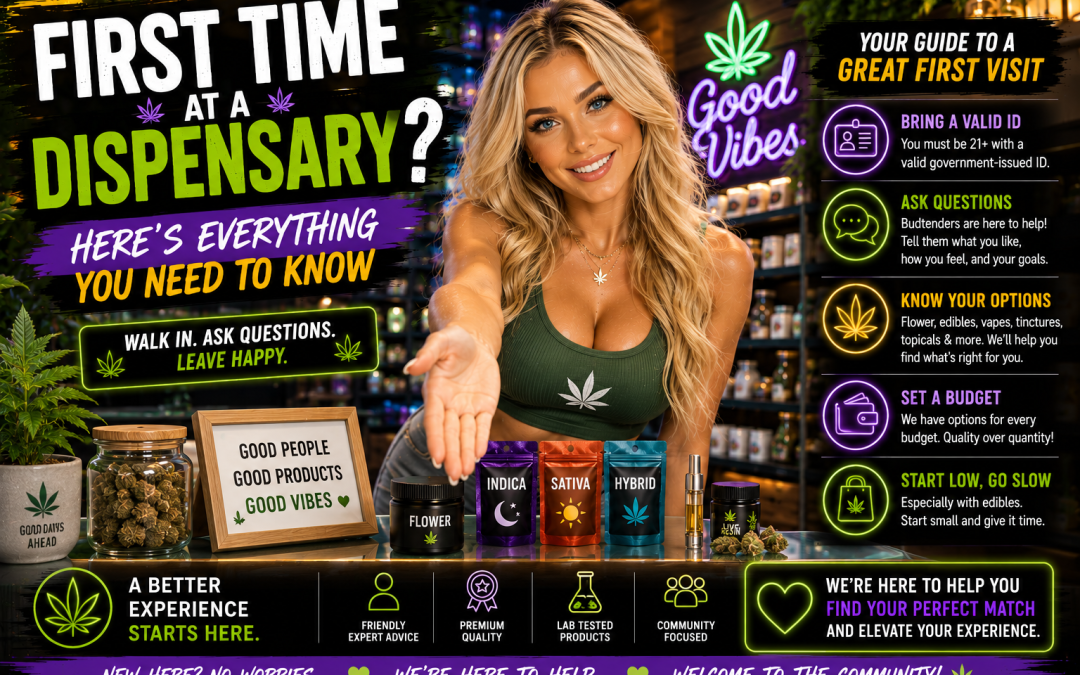
Age verification is legally mandatory at every licensed dispensary. Your ID is checked before you access the sales floor — not at point of sale, at point of entry. State compliance inspections can result in license suspension for any underage access violation, which is why this is enforced without exception. Bring a valid, unexpired government-issued photo ID: driver’s license, state ID, US passport, or military ID.
Federal banking restrictions affect how you pay. Cannabis remains federally illegal under the Controlled Substances Act, which means most financial institutions decline to service cannabis businesses. Many dispensaries operate cash-primary. Bring cash — most have an ATM on site, but fees add up over time.
Purchase limits are state law, not store policy. California’s limit is 1 ounce of flower per transaction. Colorado’s is the same. Nevada allows 1 ounce of flower or 3.5 grams of concentrate. First-time buyers are rarely near these limits, but they explain some of the questions staff will ask.
Medical cards unlock real financial benefits. In California, medical cannabis identification card holders are exempt from the state’s 15% excise tax — a savings of approximately $360 annually for a patient spending $200 per month. Medical patients also get higher purchase limits and, in some states, access to higher-potency formulations. If you’re using cannabis for a documented medical condition, completing the MMID application before your first visit is worth doing.
What Actually Happens When You Walk In
Entry. ID verification before you see anything. Security guard or reception staff. Standard at every licensed operation, no exceptions.
Wait times. Cannabis retail data from multiple legal markets identifies weekend afternoons and the period around 4:20 PM as consistently peak traffic. First-time visitors who want unhurried budtender attention should visit on weekday mornings — the experience is meaningfully different.
The budtender consultation. This is the highest-value part of your visit and the part most first-timers underutilize. The three words that unlock the best version of this interaction are the ones this article opened with. But the information you share beyond that matters just as much. Tell your budtender your specific goal (sleep, pain, anxiety, recreation, social ease), your prior cannabis experience, any medications you take, your tolerance for psychoactive effects, and your preferred consumption method.
Experienced dispensary staff describe honest first-timers as their most rewarding consultations. They’ve heard every question. Nothing you ask will surprise them.
The Product Menu — What Everything Is and What to Know
Flower
Dried cannabis buds — the classic format and the most controllable cannabis experience available. Cannabis industry sales data from mature markets consistently shows flower maintaining 40-50% of total dispensary sales by revenue despite the proliferation of alternatives. Onset within minutes of inhalation, dose directly controllable: one inhale, wait, assess, decide.
Flower is labeled Indica, Sativa, or Hybrid. These labels have genuine directional utility — terpene profiles correlating with Indica genetics produce measurably different effects than those correlating with Sativa genetics — but the specific cannabinoid and terpene profile of the individual strain matters more than the category label. Ask to see the Certificate of Analysis (COA) terpene data. It tells you more about expected effects than Indica/Sativa ever will.
For a first visit: 1 gram, THC under 18%.
Pre-Rolls
Cannabis flower pre-rolled and ready to go. No equipment, no technique required. Quality varies — ask your budtender what the pre-roll contains. The best ones use the same flower available for individual purchase. Lower-quality pre-rolls may contain trim or shake.
Vapes
Vaporizers heat cannabis material to temperatures that produce vapor without combustion, with faster onset than edibles and less respiratory impact than smoking. The 2019 EVALI context is worth understanding: that outbreak was traced primarily to vitamin E acetate in illicit market products. Licensed dispensaries sell tested products meeting state safety standards — one of the most significant practical reasons to buy exclusively from licensed retailers.
Edibles
Cannabis-infused foods and beverages. Popular with new consumers for understandable reasons: familiar format, no smoking. Also the highest-risk product category for first-timers. Edibles undergo first-pass liver metabolism, converting THC to 11-hydroxy-THC — a metabolite that crosses the blood-brain barrier more effectively and produces effects that are stronger and longer-lasting than an equivalent inhaled dose.
The correct edible protocol:
- Start with 2.5mg THC — half of a standard 5mg dose
- Eat with food to slow absorption
- Wait a minimum of 2 hours before assessing effects
- Do not consume more within that window regardless of what you feel or don’t feel
The classic first-timer pattern — consuming, feeling nothing after an hour, consuming more, regretting it when both doses arrive simultaneously — is documented, predictable, and entirely preventable. The 2-hour wait is pharmacologically appropriate, not overcautious. The dose will arrive.
Tinctures
Liquid cannabis extracts taken under the tongue. Sublingual absorption bypasses first-pass metabolism, producing onset in 15-30 minutes — more predictable than edibles and faster than digestion. Medical cannabis practitioners frequently recommend tinctures for patients who need precise, consistent dosing.
Concentrates
Extracts testing at 70-90% THC. Not for first-time visitors — the onset intensity and speed are substantially greater than flower or edibles. There is no appropriate first-visit scenario for concentrates.
Topicals
Cannabis-infused creams and balms applied to the skin. No psychoactive effects in standard formulations. Used for localized pain and inflammation through CB2 receptor-mediated anti-inflammatory mechanisms. Transdermal patches that deliver cannabinoids into the bloodstream are distinct and may produce some psychoactive effect.
CBD Products
CBD (cannabidiol) is non-psychoactive. The FDA approved pharmaceutical CBD (Epidiolex) for pediatric epilepsy in 2018 — federal acknowledgment that cannabis compounds have documented medical utility while cannabis itself remains Schedule I, a contradiction the industry navigates constantly. Consumer CBD products are used for anxiety, sleep, and pain. CBD also moderates THC’s psychoactive effects through CB1 receptor interaction, making 1:1 THC:CBD ratio products measurably gentler than THC-only equivalents.
What to Buy — Matched to Your Goal
Classic experience with controlled intensity: 1 gram of flower under 18% THC, pipe or pre-rolls. Maximum control, traditional format, rapid onset allows real-time dose assessment.
No smoking: Low-dose edible (2.5mg THC) or vape pen with hybrid or indica strain. If choosing edibles, follow the protocol above without improvisation.
Minimize anxiety risk: 1:1 THC:CBD ratio product or CBD-dominant product. CBD’s modulation of THC-induced anxiety through CB1 receptor interaction is pharmacologically established, not marketing.
Wellness benefits without psychoactivity: CBD tincture, CBD topical, or CBD gummy. Therapeutic mechanisms function without THC.
The Dosing Principles That Actually Matter
Individual endocannabinoid system variability is real. The same dose produces genuinely different effects across consumers based on receptor density, sensitivity, and prior exposure. There’s no reliable way to predict individual sensitivity before the first experience — which is why starting low is the medically appropriate approach, not just conventional wisdom.
Environment affects experience quality through documented mechanisms. The “set and setting” concept describes the influence of mindset and physical environment on cannabis experience quality. A familiar, comfortable environment with trusted company produces different neurological conditions than a stressful or unfamiliar one. Choose your first consumption environment deliberately — this is not a casual consideration.
Medication interactions warrant disclosure. Cannabis is metabolized through the CYP450 enzyme system. Significant interactions are documented with blood thinners, certain antidepressants, and some seizure medications. Tell your budtender what you take. If you have significant health concerns, discuss cannabis use with your physician before visiting.
Etiquette That Affects Other People
Keep your ID accessible throughout the visit. Tip your budtender — wages vary by market and tips represent meaningful compensation for work requiring genuine expertise. Don’t consume on dispensary premises; it’s illegal at standard dispensaries in every jurisdiction regardless of state adult-use laws. Don’t bring anyone under 21. Ask every question you have — experienced budtenders find the work more interesting when customers engage genuinely.
Most importantly: don’t rush the consultation. The five extra minutes with your budtender are the highest-value part of the visit.
How to Choose the Right Dispensary
Staff knowledge is the primary quality indicator — ask a specific question about terpene effects or dosing for your particular goals, then evaluate the answer. Knowledgeable staff give specific, evidence-based responses. Undertrained staff give vague or generic ones. The difference is immediately apparent.
Request COA documentation for products you’re considering. Certificates of Analysis are third-party lab test results showing cannabinoid content, terpene profile, and safety testing. This is your primary assurance that the product is what the label claims — and quality dispensaries can produce them without hesitation.
Ask about first-timer discounts before you shop. Many dispensaries offer 20-50% off first purchases and don’t advertise it proactively.
Use FindCannabis.com to search licensed dispensaries by city, filter by rating, and access current hours and contact information.
The Thought Worth Sitting With
The legal dispensary system was built to solve problems that most new consumers don’t know exist — mandatory product testing, trained staff who can flag medication interactions, COA documentation, the regulatory framework that eliminated vitamin E acetate from legal vape products. None of this exists outside of licensed retail.
The first dispensary visit isn’t just about finding something enjoyable. It’s about entering a system specifically designed to make cannabis safer and more predictable than any alternative available to you. The intimidation of walking through that door is understandable. But the dispensary is, genuinely, the safest place to have this experience.
Start low. Tell them it’s your first time. And if you do try edibles — wait the full two hours.
The dose will arrive. 🌿
Find licensed dispensaries near you at FindCannabis.com — search by city, see verified hours, and read consumer reviews.
Related Articles
- Best Dispensaries in Miami
- Best Dispensaries in Los Angeles
- Cannabis Travel Guide to Colorado
- Best Vaporizers of 2026
- Indica vs Sativa vs Hybrid — What’s the Difference?