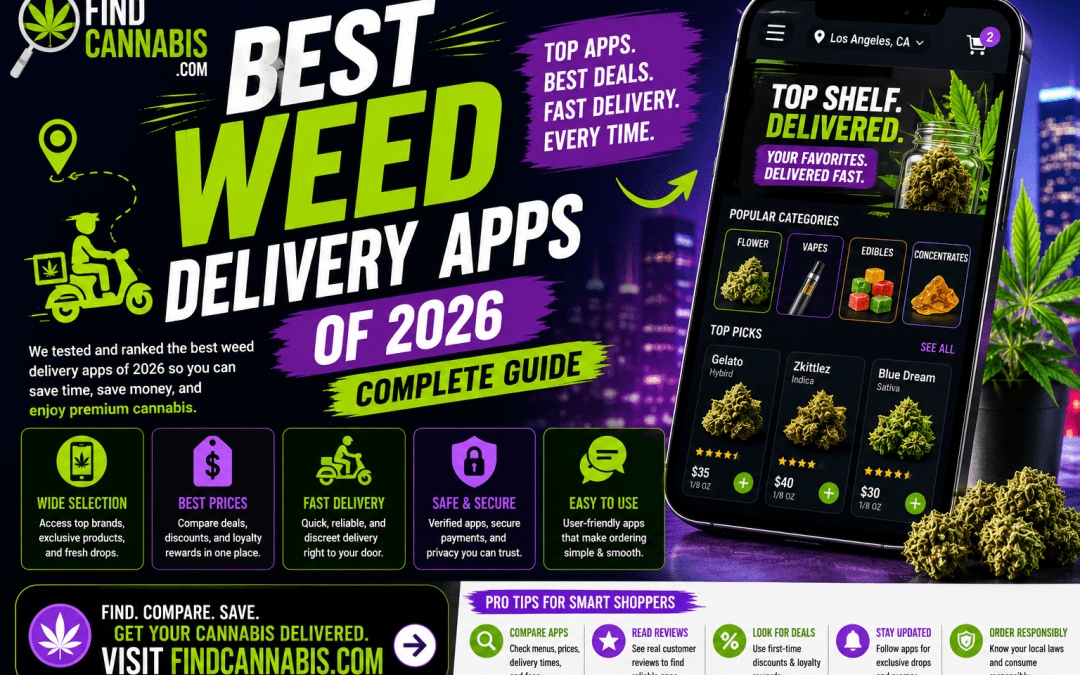
The Best Cannabis Delivery Apps of 2026 — An Industry Expert’s Honest Assessment
Which cannabis delivery apps actually deliver on their promises, what the data shows about consumer behavior, and how to navigate the most mature cannabis delivery market in history.
The cannabis delivery apps with the highest consumer brand recognition are frequently not the best choice for most consumers. The platforms with the lowest name recognition — Dutchie and Jane Technologies, which most people have never heard of — often deliver better pricing, more accurate inventory, and full loyalty point accrual. The reason comes down to a simple structural difference: one category takes a cut, the other doesn’t.
That’s the framing most cannabis delivery guides skip. This one won’t.
The Regulatory Reality No App Can Override
Cannabis delivery legality operates on at least three simultaneous levels — federal, state, and local — and the local level is where most consumer confusion originates.
At the state level, California, Michigan, Massachusetts, New Jersey, New York, Arizona, and Illinois all permit recreational cannabis delivery with varying restrictions. Nevada allows delivery but prohibits it on the Las Vegas Strip due to gaming commission jurisdiction — a detail that surprises tourists consistently. Colorado permits delivery but requires individual municipality approval, creating a patchwork where Denver has robust delivery infrastructure while neighboring jurisdictions do not.
California’s framework is the most instructive local-level case study. Despite statewide legalization, individual counties and cities retained the right to prohibit cannabis businesses including delivery services. As of 2026, a meaningful percentage of California’s jurisdictions have opted out — meaning a consumer in one zip code has access to six competing cannabis delivery apps while someone thirty miles away has none. This isn’t temporary. It’s a structural feature of how California legalized cannabis.
For medical-only states — Florida, Pennsylvania, and others — cannabis delivery is available but restricted to registered patients. Product quality is often comparable to recreational states; the access pathway is more regulated.
The single most important step before evaluating any cannabis delivery app: verify availability at your specific address. State-level legality tells you very little about what’s actually available where you live.
How Cannabis Delivery Actually Works — Including the Part Nobody Explains
The licensed dispensary model underpins almost everything. A licensed dispensary processes your order, prepares it, and dispatches a licensed driver carrying a delivery manifest documenting every product in transit. That manifest is a regulatory requirement with license-revocation consequences if violated — which explains why cannabis delivery involves procedural friction that food delivery doesn’t. The ID check isn’t optional caution. It’s a legal requirement, every time, for every customer.
Third-party cannabis delivery apps — Eaze being the clearest example — sit above this infrastructure as marketplace layers, providing the app, payment processing, logistics coordination, and customer service while partnering with licensed dispensaries for product and last-mile delivery. Think Instacart, not DoorDash. The platform facilitates the transaction; the product and delivery involve licensed partners with their own regulatory obligations.
White-label dispensary technology — Dutchie and Jane Technologies — is a third model most consumers encounter without recognizing it. These platforms power the online ordering systems of hundreds of individual dispensaries. When you order from a dispensary’s website, Dutchie or Jane is often the technology underneath the branding. Ordering through these systems means ordering direct: no platform markup, accurate real-time inventory, loyalty points that actually apply.
Payment processing is the detail nobody explains clearly. Federal banking restrictions mean major card networks officially prohibit cannabis transactions. Most cannabis delivery apps process debit cards through cashless ATM systems — transactions that appear on your bank statement as ATM withdrawals rather than purchases. Not a mistake. The banking workaround the entire industry depends on.
The Contrarian Case for Ordering Differently
Here’s the perspective most cannabis delivery app rankings skip: the most popular app is often not the right choice, and the platforms with the lowest consumer brand recognition frequently offer the best value.
The apps consumers have heard of — Eaze, Weedmaps, Leafly — are valuable in specific circumstances. Dutchie and Jane Technologies, which most consumers have never heard of, power direct ordering systems that typically offer better pricing, better inventory accuracy, and full loyalty point accrual for consumers who already have a dispensary they prefer. The 10-20% platform markup on third-party apps is real money over time. Ordering $100 in cannabis weekly through a third-party app rather than direct costs $500-1,000 annually in unnecessary fees.
The right framework isn’t “which cannabis delivery app is best” — it’s “what situation am I in?”
If you have a dispensary you already like: Order directly through their website. It’s almost certainly powered by Dutchie or Jane. Better pricing, better inventory accuracy, full loyalty points. The app you need is your dispensary’s website.
If you’re in California or Michigan without a preferred dispensary: Eaze for maximum selection, Grassdoor for competitive same-day delivery, Amuse if you’re in LA and speed is the priority.
If you’re outside California and Michigan: Weedmaps is likely your most functional option given its national dispensary partnership network.
If you care about specific strains: Leafly’s strain database combined with its delivery integration is genuinely superior to anything else for strain-specific shoppers.
The Platform-by-Platform Reality
Eaze — California’s Most Established Cannabis Delivery App
California and Michigan | iOS, Android, web | eaze.com
Eaze launched in 2014 — before California’s recreational market existed — and has operated through regulatory frameworks that didn’t exist when it started. That longevity shows in operational reliability. The platform maintains the largest single-catalog product selection in California cannabis delivery, average delivery times run 60-90 minutes in major markets, and repeat purchase rates rank among the highest of any cannabis delivery service — attributed to service consistency rather than promotional pricing.
First-time discounts run 20-30% off. Customer service actually responds, which is more notable in cannabis delivery than it should be. The limitation is geographic — California and Michigan only, a significant constraint compared to Weedmaps’ national reach.
Best for: California and Michigan consumers prioritizing selection breadth and operational reliability.
Weedmaps Delivery — The App With National Reach
All major legal states | iOS, Android, web | weedmaps.com
Weedmaps built its reputation as a dispensary directory and has converted that asset into a delivery platform. The cannabis delivery integration leverages thousands of existing dispensary relationships across every legal state, giving Weedmaps geographic coverage no dedicated delivery app can match.
Delivery quality varies significantly by market because it depends entirely on the quality of the local dispensary partner — reliable in mature markets, less consistent in newer ones with smaller partner pools. The platform’s irreplaceable value is coverage where dedicated delivery apps don’t operate. For consumers in Illinois, Massachusetts, New Jersey, and other non-California states, Weedmaps is often the only functional option.
Best for: Consumers outside California and Michigan, travelers who want delivery in unfamiliar markets.
Leafly — Built for Research-First Shoppers
All major legal states | iOS, Android, web | leafly.com
Leafly’s strain database — built over more than a decade with terpene profiles, cannabinoid ranges, effect data, and hundreds of thousands of user reviews — is the best publicly available cannabis product intelligence resource. The delivery integration converts that research into transactions without leaving the app.
Users show the longest pre-purchase session duration of any cannabis delivery platform, reflecting a base that values product information over convenience speed. For consumers who know the difference between a myrcene-dominant and limonene-dominant profile and care about it when purchasing, Leafly’s strain-specific search is genuinely superior to everything else.
Best for: Strain-specific shoppers, research-driven buyers, consumers who want educational context alongside their options.
Dutchie — The Best Value Most People Don’t Know About
All major legal states | Web and mobile via dispensary sites | dutchie.com
Dutchie powers online ordering for hundreds of independent dispensaries. Most consumers have used it without knowing — it’s the technology behind dispensary-branded ordering interfaces across the country. Ordering through Dutchie means ordering direct: no platform markup, real-time inventory accuracy pulled from the dispensary’s POS system, and full loyalty point accrual.
The trade-off is discovery. Dutchie doesn’t help you find a dispensary. It helps you order from one you’ve already chosen — which for consumers with established dispensary relationships makes it the most economical and accurate cannabis delivery option available. The company processes a significant share of all cannabis e-commerce transactions in the US, a market position reflecting how many independent dispensaries have adopted it as their ordering infrastructure.
Best for: Regulars at specific dispensaries, price-conscious consumers who want to eliminate platform markup.
Jane Technologies — The Other Direct-Ordering Option
Multiple legal states | Web and mobile | iheartjane.com
Jane Technologies operates the same category as Dutchie — white-label dispensary e-commerce infrastructure powering direct ordering through dispensary-branded websites. Consumer experience is functionally equivalent. Which dispensaries use Jane versus Dutchie varies by market.
Best for: Dispensary-direct ordering wherever your local shop uses Jane’s platform.
Grassdoor — California’s Same-Day Speed Leader
California | iOS, Android, web | grassdoor.com | Minimum: $35
Grassdoor has built delivery infrastructure in California — particularly in the Los Angeles basin and Bay Area — that rivals or exceeds Eaze on speed metrics. Same-day cannabis delivery is standard; express options exist in high-density areas. Heavy investment in logistics rather than marketing explains its lower consumer profile relative to its operational performance.
Pricing is competitive and deals are genuine — not inflated-then-marked-down. Consumer behavior data shows higher-than-average repeat purchase rates, attributed to reliability rather than promotional incentives.
Best for: California consumers for whom same-day speed and competitive pricing are the primary criteria.
Amuse — When Speed Is Everything in LA
Los Angeles | iOS, Android, web | amusedelivery.com | Minimum: $50
Amuse made a deliberate choice: geographic depth over market breadth. Thirty to sixty minute cannabis delivery in Los Angeles is standard, not aspirational. Product selection is curated rather than exhaustive — works well if you know what you want, limiting if you’re browsing without direction.
For the “I need cannabis delivery in the next hour” use case in LA, Amuse is the most reliable answer.
Best for: LA consumers for whom speed is the deciding factor.
Caliva — Vertically Integrated Premium Delivery
California | iOS, web | caliva.com
Caliva is part of The Parent Company (TPCO), controlling cultivation, manufacturing, and distribution in addition to retail. The delivery menu includes products controlled from seed to sale — including exclusive brands like Monogram unavailable through competing apps. Vertical integration produces quality consistency that horizontally structured platforms can’t replicate; the trade-off is menu breadth.
Best for: California consumers who prioritize quality consistency and exclusive brand access over selection breadth.
Drizly for Cannabis — Familiar Infrastructure, Limited Coverage
Select markets | iOS, Android | drizly.com
Drizly built consumer trust through alcohol delivery and has extended into cannabis in select legal markets. The interface is immediately familiar to existing users. Cannabis delivery coverage is significantly smaller than alcohol delivery coverage — meaningful constraint for cannabis-first consumers, convenient extension for existing Drizly users in markets where cannabis has been added.
Best for: Existing Drizly users in markets where cannabis delivery has been enabled.
What Consumer Behavior Data Actually Shows
Several consistent patterns in cannabis delivery app usage are worth understanding before choosing a platform.
Frequency of use increases sharply after the first order. Consumers who complete one cannabis delivery order show significantly higher 90-day retention than in-store-only purchasers. The convenience adoption curve mirrors food delivery and ride-sharing — initial friction is high, but post-adoption behavior shifts substantially and durably.
Platform loyalty is lower than dispensary loyalty. Consumers are more attached to specific dispensaries than to specific cannabis delivery apps — which is why Dutchie and Jane’s dispensary-direct model produces competitive loyalty metrics despite minimal consumer brand recognition. If you have a dispensary you like, the app matters less than the direct ordering relationship.
“Same-day delivery” means delivery before midnight. Industry standard for same-day cannabis delivery is delivery before midnight on the day of ordering, not delivery within an hour. Express delivery windows with defined timeframes are a separate, faster tier. This distinction trips up more consumers than any other aspect of cannabis delivery.
First-time discounts drive acquisition, not retention. Platforms offering large first-time discounts show high single-order conversion rates but mixed 90-day retention. Delivery experience quality is a stronger predictor of long-term consumer relationships than initial pricing incentives.
Practical Tips From Someone Who’s Watched This Industry Develop
Verify inventory before expecting it. Real-time accuracy varies significantly by platform. Dutchie and Jane-powered sites pull directly from POS systems; third-party apps sometimes lag. For specific products, dispensary-direct ordering minimizes disappointment.
COA verification is non-negotiable for CBD products. The 2017 JAMA study finding fewer than a third of CBD products were accurately labeled hasn’t been resolved. Any cannabis delivery service offering CBD should provide current Certificates of Analysis. Products without accessible COAs carry meaningful quality and safety uncertainty.
Tip your driver. Cannabis delivery drivers carry licensed inventory, maintain delivery manifests, and perform ID verification on every transaction under compliance requirements that restaurant delivery drivers don’t face. Fifteen to twenty percent is appropriate and genuinely appreciated.
Direct ordering is almost always cheaper. Platform fees and markups typically add 10-20% to effective order costs on third-party apps versus dispensary-direct. For consumers with established dispensary relationships, the arithmetic consistently favors going direct.
Where Cannabis Delivery Is Heading
Same-hour delivery is becoming standard in dense urban markets. Several platforms are already hitting consistent 30-minute windows in high-density California areas. As logistics infrastructure matures, this will become baseline expectation rather than premium tier.
Drone delivery is regulatory-limited, not technology-limited. Multiple operators have demonstrated functional drone delivery technology. FAA frameworks for autonomous commercial delivery are the constraint. Expect market emergence in specific jurisdictions before anything national.
The DoorDash and Uber Eats integration keeps almost happening. Federal contractor status requirements, card network restrictions, and state-by-state regulatory variation are the persistent obstacles. Where it’s been permitted, it’s meaningfully expanded access. Pace will follow regulatory development, not platform willingness.
Cannabis subscription delivery is underrated. Monthly curated boxes generate predictable revenue, reduce customer acquisition costs, and command premium pricing for curation value. The category is growing faster than consumer awareness of it suggests.
The national cannabis delivery app still doesn’t exist — and may never. State-specific licensing requirements, local opt-outs, and banking limitations make truly national delivery economics fundamentally different from food delivery. The platform that wins in California can’t simply expand to Illinois. Until federal policy changes, the fragmented landscape is the landscape.
The Thing Worth Sitting With
The regulatory complexity that prevented a dominant national cannabis delivery app isn’t a bug in legalization — it’s a design feature. Every state that legalized cannabis retained sovereignty over how that works, right down to the county and municipal level. That sovereignty produced the fragmented, state-specific delivery market we have today.
The consumer who understands this — who checks local availability before assuming, compares direct ordering against platform pricing, and chooses their cannabis delivery app based on actual situation rather than brand recognition — consistently gets better cannabis at better prices than the consumer who opens the first app that comes up in a search.
That gap won’t close until federal policy does. Start with FindCannabis.com to find licensed dispensaries near you, and start with direct ordering before defaulting to a third-party app. The markup you avoid is the deal you didn’t have to hunt for. 🌿🚗
Find dispensaries near you that offer delivery at FindCannabis.com.