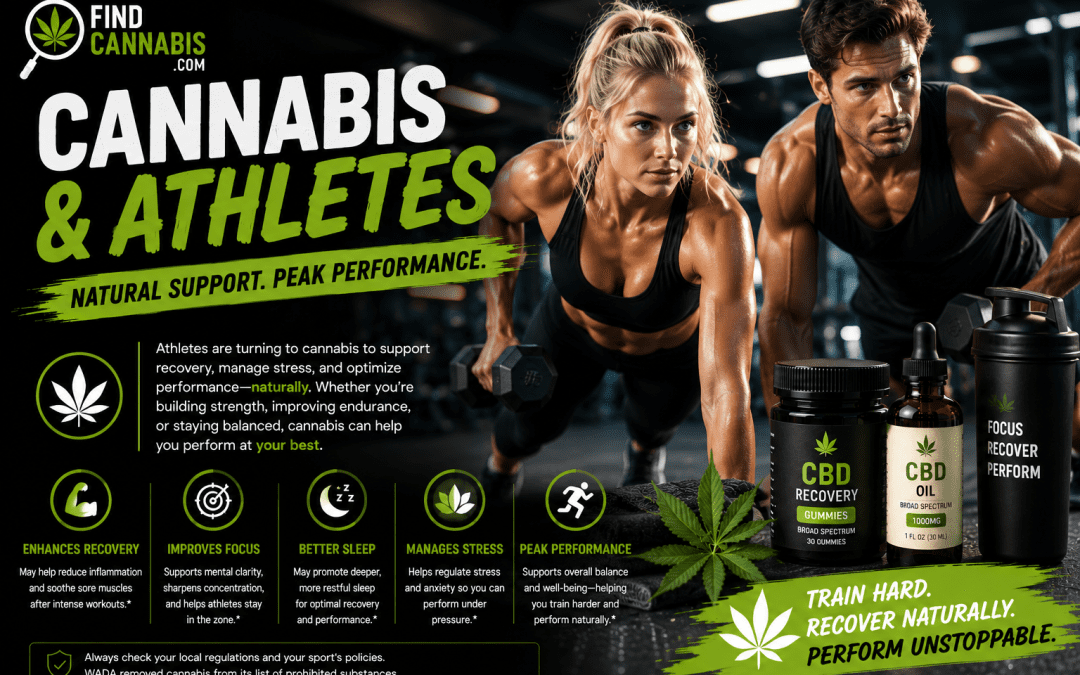
Cannabis and Athletes
If THC adds 30 beats per minute to your resting heart rate and you’re targeting zone 2 at 140bpm, you’re not training in zone 2. You’re training at a different physiological intensity, generating different adaptation signals, and producing meaningless heart rate data. This is the cannabis-and-exercise tradeoff most athletic cannabis discussions skip over — and it’s one of several reasons why the right answer for athletes isn’t simply “cannabis is good for performance” or “cannabis hurts performance.” It depends entirely on what you’re doing and when.
The Policy Inversion Worth Understanding First
Here’s what should be said plainly before anything else: for decades, sports leagues prohibited cannabis while team physicians routinely distributed opioid painkillers as standard medical treatment.
A 2011 study in Drug and Alcohol Dependence found retired NFL players misused opioids at more than four times the general population rate. Not recreational users who happened to become NFL players — players given opioids by team medical staff for the routine physical punishment of professional football. Eugene Monroe, one of the first active NFL players to publicly advocate for cannabis, described that distribution as routine rather than exceptional.
Cannabis was the prohibited substance. Opioids were the medical treatment. The same league that suspended players for cannabis use was generating opioid misuse at four times the population rate through its own medical practices.
WADA’s cannabis threshold — 15 ng/mL for decades — was multiplied by ten (to 150 ng/mL) following the public backlash from Sha’Carri Richardson’s 2021 Olympic suspension. The policy that excluded her from her home Olympics was defended as scientifically grounded. Then the threshold was increased by a factor of ten. The scientific grounding, it turned out, was mostly optics.
This history matters for athletes because it explains why the current research on cannabis in athletic contexts is both more developed than most people realize and more suppressed than it should be. The science has been catching up to a policy environment that was never primarily about health.
What Cannabis Does to the Exercising Body
The endocannabinoid system and exercise
The runner’s high isn’t endorphins. That explanation dominated sports science for decades, but endorphins don’t cross the blood-brain barrier efficiently enough to produce the central effects they were credited with. What actually produces exercise-induced euphoria is anandamide — your body’s own endocannabinoid, released during sustained aerobic effort. A 2021 study in Scientific Reports confirmed elevated blood anandamide levels correlating with exercise-induced euphoria following moderate-intensity exercise.
THC is also a CB1 agonist — working through the same receptor system anandamide activates. For endurance athletes who describe cannabis and exercise as synergistic, there’s a mechanistic basis for that experience. They’re augmenting a system that’s already engaged during training, not activating an unrelated one.
THC and exercise — the full cardiovascular picture
Research consistently documents THC-induced heart rate increases of 20-50 beats per minute above resting, persisting 1-3 hours post-administration. Zone 2 aerobic training requires sustained effort at 60-70% of maximum heart rate. An athlete targeting 140bpm with THC-induced tachycardia adding 30bpm to their baseline is training at a different physiological intensity, generating different adaptation signals, and producing misleading data about their aerobic development.
The analgesia, flow facilitation, and RPE reduction THC provides are real benefits. So is the cardiovascular distortion. Both are true simultaneously — which is why blanket statements about cannabis and performance miss the point.
THC’s impairment of cerebellar function and fine motor coordination is dose-dependent and sport-specific. For high-demand technical sports — Olympic lifting, precision shooting, gymnastics — any cerebellar impairment is consequential. For low-coordination endurance sports — distance running, cycling — the impairment profile is less operationally significant.
How CBD recovery actually works
CBD’s athletic recovery mechanisms operate through CB2 receptor-mediated suppression of pro-inflammatory cytokines — specifically TNF-α, IL-1β, and IL-6. Exercise induces inflammation through these same cytokine pathways, making the mechanistic match direct rather than theoretical.
Exercise-induced inflammation follows a predictable temporal pattern: acute inflammatory signaling during exercise, peak DOMS-associated inflammation at 24-72 hours, resolution over subsequent days. CBD’s CB2 activity provides anti-inflammatory coverage through the same pathways. Pre-workout CBD establishes this coverage before the inflammatory cascade begins; post-workout CBD provides it during the acute phase.
FAAH inhibition — CBD slows anandamide breakdown — means CBD also supports the body’s own exercise-related endocannabinoid response. CBD recovery isn’t working around the system. It’s supporting the same system exercise activates.
Terpenes — pharmacology, not marketing
Full-spectrum cannabis products contain terpenes with documented pharmacological activity directly relevant to athletic applications. Myrcene demonstrates sedative properties in animal models. Pinene has shown bronchodilator activity in preclinical research — potentially relevant for endurance athletes. Linalool demonstrates anxiolytic effects through GABAergic mechanisms.
The Gallily et al. (2015) study found full-spectrum cannabis extract significantly more effective than CBD isolate for anti-inflammatory activity at equivalent doses. For tested athletes steered toward CBD isolate for drug test safety, this is a real tradeoff — drug test protection exchanged for meaningfully less anti-inflammatory activity.
The Workout-Type Variable Nobody Mentions
Most cannabis-and-athlete discussions treat product selection as the primary variable. It isn’t. Workout type is.
For endurance athletes — distance runners, cyclists, swimmers — cannabis before exercise has genuine pharmacological support. Low coordination demands, sustained aerobic effort, and rhythm-based activity align directly with cannabis’s documented effects: RPE reduction, flow state facilitation, mild analgesia. A 2019 study in Frontiers in Physiology found cannabis-using runners reported lower perceived exertion at equivalent intensities. The endurance application is the strongest cannabis sports performance case in the literature.
Heavy compound movements are the opposite situation. THC impairs cerebellar function in dose-dependent ways that matter enormously for Olympic lifting, heavy squatting, and deadlifting — movements requiring precise mechanics under compressive or near-maximal loads, where form breakdown carries real injury risk.
The analgesic effect compounds this problem specifically. THC raises pain thresholds by modulating nociceptive signaling through CB1 receptors. During heavy lifting, pain is a protective mechanism — the warning signal that form is breaking down or loading is approaching structural limits. Raising that threshold under a heavy barbell isn’t a training advantage. It’s a mechanism for ignoring signals that exist for good reason.
Cannabis before endurance training: pharmacologically supported. Cannabis before heavy strength training: pharmacologically contraindicated. This is the distinction most cannabis-and-athlete discussions avoid, and it’s the most consequential one.
Cannabis for Athletic Recovery — What the Evidence Supports
Inflammation and muscle recovery
CBD topicals applied post-exercise address local CB2 receptor-mediated inflammation at the application site without systemic absorption. Full-spectrum oral CBD provides systemic CB2-mediated cytokine suppression alongside FAAH inhibition supporting the body’s own endocannabinoid recovery response.
Sports medicine practitioners who’ve worked with professional athletes incorporating CBD recovery protocols describe the most consistent benefits in high-volume training phases where cumulative inflammation is the primary limiting factor. The benefit compounds across training blocks — which is why consistent daily CBD recovery protocol outperforms episodic use.
Cannabis sleep recovery — matching product to problem
Sleep onset difficulty — common for athletes with elevated cortisol following evening competition — responds well to CBD’s anxiolytic 5-HT1A mechanisms and myrcene-mediated sedation from indica-dominant products. Sleep maintenance issues respond better to longer-acting edibles (4-8 hours of effect) and CBN’s potassium channel activation, a mechanism distinct from CB1 sedation.
The most common error cannabis sleep practitioners working with athlete populations describe: using inhalation-format products for sleep maintenance. Too short duration, effects waning mid-sleep, athlete waking at 2am. When sleep maintenance is the problem, edibles are the appropriate format.
CBD for pain relief
Localized joint and muscle pain responds to topical CBD through direct CB receptor activation in skin and subcutaneous tissue — targeted, no systemic absorption, appropriate for tested athletes and daytime use. For more significant acute pain, topical CBD (local CB2 activation) combined with oral full-spectrum CBD (systemic CB2 and anandamide effects) addresses multiple pain mechanisms simultaneously.
Sports medicine physicians working with professional athletes describe this combination approach as standard in athletic contexts where CBD for pain relief is legally permissible.
Managing competition anxiety
CBD’s anxiolytic mechanism — 5-HT1A partial agonism — is well-characterized. A 2011 Neuropsychopharmacology study found CBD significantly reduced anxiety in a simulated public speaking scenario. A 2019 observational study (Shannon et al.) found 79% of anxiety-focused patients reported decreased anxiety in the first month of CBD use.
Dose matters more than most consumer guidance acknowledges. Anxiety clinical trials used 300mg doses. Most consumer CBD products contain 25-50mg per serving. Athletes whose CBD anxiety protocol isn’t working should examine dose before concluding the compound doesn’t work — the mechanism is real; the dose may simply be insufficient.
CBD vs THC for Athletes
| CBD | THC | |
|---|---|---|
| Pain mechanism | CB2, TRPV1, FAAH inhibition | CB1 direct agonism |
| Anti-inflammatory | CB2 cytokine suppression — strong | CB2 activity — moderate |
| Sleep recovery | Anxiolytic support, modest direct | CB1 sedation — significant |
| Competition anxiety | 5-HT1A agonism — well documented | Variable — can worsen |
| Coordination | No impairment | Dose-dependent cerebellar impairment |
| Heart rate during exercise | No significant effect | 20-50bpm elevation |
| Drug test risk | Low-moderate (full spectrum) | High — THC-COOH |
| Legal in sport | Permitted by WADA, all major leagues | Prohibited by most governing bodies |
For the majority of athletic applications — recovery, inflammation, anxiety, daily wellness — CBD is the appropriate primary tool. THC has legitimate applications in cannabis sleep recovery and significant pain management but requires out-of-competition timing, sport policy awareness, and honest self-assessment of how it affects individual training quality.
Where the Leagues Stand in 2026
NFL: 150 ng/mL threshold, testing only in the first two weeks of training camp, no suspension for first offense. Effectively decriminalized — sports medicine staff now having open CBD conversations where categorical prohibition preceded the 2020 CBA.
NBA: Cannabis removed from the prohibited list entirely in the 2023 CBA. Most progressive policy of any major American league. Research partnerships established alongside the policy change.
MLB: Removed from the prohibited list in 2019. Not tested for, not a disciplinary matter. Along with the NBA, the most permissive framework in professional American sports.
NHL: Cannabis excluded from the performance-enhancing drug testing program. No disciplinary action for positive tests. Education-focused, not enforcement-focused.
MLS / WADA / Olympic sports: THC prohibited in-competition at 150 ng/mL — raised tenfold from 15 ng/mL ahead of the 2024 Olympics. CBD explicitly permitted. Out-of-competition use not prohibited.
UFC / MMA: In-competition thresholds raised, out-of-competition use effectively ignored. Individual sport culture more openly accepting of cannabis than team sport environments.
NCAA: THC on the banned list, championship testing, eligibility consequences. Individual conferences have moved; NCAA championship testing hasn’t followed.
Drug Testing — Specific Guidance for Tested Athletes
CBD in tested sports
CBD is explicitly permitted by WADA and all major sports organizations. The risk is trace THC in full-spectrum products — federal hemp limits allow up to 0.3% THC, which at sufficient quantities and frequency can produce THC-COOH metabolites exceeding test thresholds. CBD isolate with batch-specific COAs confirming non-detect THC eliminates this risk while accepting reduced anti-inflammatory efficacy compared to full-spectrum. Broad-spectrum products with verified non-detect THC represent a middle position.
THC detection windows
THC-COOH is highly lipophilic and accumulates in fat tissue:
- Occasional users (once weekly or less): 3-4 days typical
- Moderate users (several times weekly): 5-7 days
- Daily users: 10-30 days, significant individual variability
For tested athletes: understand your individual clearance rate through off-season testing where possible. Build margins significantly beyond average estimates. Don’t make career decisions based on population averages.
Threshold specifics
WADA’s 150 ng/mL is relatively protective, but individual sport federations sometimes apply stricter limits. Always verify the specific threshold for your competition and governing body — not just WADA’s general standard.
Evidence-Based Protocols
Recovery-focused:
- Morning: 15-25mg full-spectrum CBD tincture for baseline CB2-mediated anti-inflammatory support
- Post-training: CBD topical to worked muscle groups immediately after training, applied to clean skin with massage for improved absorption
- Pre-sleep: 25-40mg full-spectrum CBD tincture 30-45 minutes before bed; for non-tested athletes in THC-permitted sports, 5-10mg THC:CBD balanced edible 60-90 minutes before sleep for more potent CB1-mediated sedation
- For significant soreness: CBD bath (CBD oil in Epsom salt soak) for whole-body topical coverage alongside magnesium’s muscle relaxation effects
Sleep-specific:
- Onset difficulty: Indica-dominant products, myrcene-high terpene profile, tincture or flower for faster onset
- Maintenance difficulty: Edibles (4-8 hour effect), CBN-containing products
- Both: CBN + CBD:THC balanced edible, consumed 60-90 minutes before intended sleep
Competition anxiety:
- CBD tincture, 25-50mg, sublingual, 60-90 minutes before competition
- Establish personal response in training before relying on it in competition
- Never THC before competition — the cardiovascular and coordination effects create more problems than they solve
The Forward-Looking Thought
Return to the zone 2 example that opened this article. It’s a specific, precise problem — THC distorts heart rate in ways that undermine one of the most important training tools in endurance sports. Solving it requires knowing both the pharmacology of THC and the physiology of aerobic adaptation. Getting it right requires matching the cannabinoid to the training context rather than applying a blanket rule.
That’s the future of cannabis and athletes — not “cannabis is good” or “cannabis is bad,” but a precise pharmacological understanding of which cannabinoids, which terpene profiles, which delivery formats, and which timing relative to which training stimuli produce which outcomes. The sports policy environment spent decades on the blanket rule. The pharmacology was always more sophisticated than the policy.
Athletes who understand the distinction between endurance training and strength training, between CBD’s anti-inflammatory mechanism and THC’s CB1 agonism, between cannabis sleep recovery and pre-competition anxiety management — those athletes are already operating in that more sophisticated space.
The research is catching up. The policies are catching up. The athletes, as usual, got there first. 🌿🏆
Find dispensaries with athlete-focused cannabis products near you at FindCannabis.com.