Cannabis Tolerance Develops in Four Days. Most People Think It Takes Months.
You’re using the same amount you always have. Maybe a little more. The effect is there but it’s flat — present but distant, like a conversation happening in the next room. You’re not imagining it. Your brain has literally restructured itself in response to regular THC exposure. Here’s what actually happened and how to fix it.
What’s Actually Happening in Your Brain
Cannabis tolerance is not psychological. It’s a specific neurobiological adaptation: CB1 receptor downregulation.
THC is a partial agonist at CB1 receptors — it binds and activates them, but with lower intrinsic efficacy than your body’s own endocannabinoids like anandamide. With repeated exposure, the brain responds through two primary mechanisms.
Receptor desensitization: CB1 receptors become phosphorylated by G protein-coupled receptor kinases (GRKs), reducing their coupling efficiency to downstream signaling cascades. Still present, still binding THC — just producing a weaker signal.
Receptor internalization: Beta-arrestin recruitment leads to the receptor being pulled inside the cell via endocytosis, removing it from the cell surface where THC can reach it. This is the primary driver of measurable THC tolerance.
Over weeks of heavy use, receptor density in key brain regions decreases further through reduced synthesis and increased degradation. A landmark 2012 study in Molecular Psychiatry using PET imaging confirmed that chronic daily cannabis users showed CB1 receptor availability reductions of 11-29% across the prefrontal cortex, hippocampus, striatum, and cerebellum — correlating directly with years and severity of use.
These aren’t arbitrary brain regions. The prefrontal cortex handles executive function. The hippocampus governs memory consolidation. The striatum processes reward. The cerebellum coordinates motor function. CB1 downregulation in these specific areas explains the specific experiential consequences of weed tolerance — reduced reward, impaired short-term memory, diminished coordination effects.
The Problem With Every Published T-Break Timeline
Here’s what almost no tolerance break guide mentions: the research establishing recovery timelines was conducted when average cannabis THC concentrations were 10-15%. Today’s legal market flower averages 20-25%. Concentrates run 70-90%.
CB1 receptor downregulation is dose-dependent — higher THC exposure per session drives faster and more pronounced receptor internalization. A daily concentrate user consuming 50-80mg THC per session is delivering loads the tolerance research never anticipated. Published timelines, largely derived from lower-potency flower studies, are likely systematically too short for a significant portion of today’s consumers.
What this means practically: if you’re a concentrate user and a two-week T-break hasn’t produced the sensitivity reset you expected, that’s not a failure. It’s a dosing mismatch between the research and your actual consumption pattern. You probably need longer.
The four-day tolerance onset finding compounds this. A 2016 study in Psychopharmacology found measurable tolerance to THC’s subjective effects after just four days of twice-daily dosing. If tolerance starts building within days of regular use, and modern cannabis potency is accelerating that process, consumers are reaching meaningful CB1 downregulation faster than standard advice acknowledges.
How Quickly It Builds, How Slowly It Recovers
Cannabis tolerance builds faster than it recovers. This asymmetry is mechanistic, not arbitrary.
Receptor downregulation happens through internalization — a relatively fast cellular process. Recovery requires receptor synthesis — new receptors must be produced and trafficked to the cell surface. Synthesis is slower than internalization, which is why tolerance can accumulate over weeks of regular use and require an equivalent or longer period of abstinence to reverse.
The 2012 Molecular Psychiatry study that documented CB1 downregulation also followed recovery, finding significant normalization within four weeks of abstinence and near-complete recovery in most participants. Rodent studies — which allow direct receptor measurement — consistently show CB1 receptor density returning to baseline within 2-4 weeks.
Recovery timeline by use pattern:
- 2-3 days: Initial receptor resensitization begins
- 1-2 weeks: Significant recovery in most moderate users
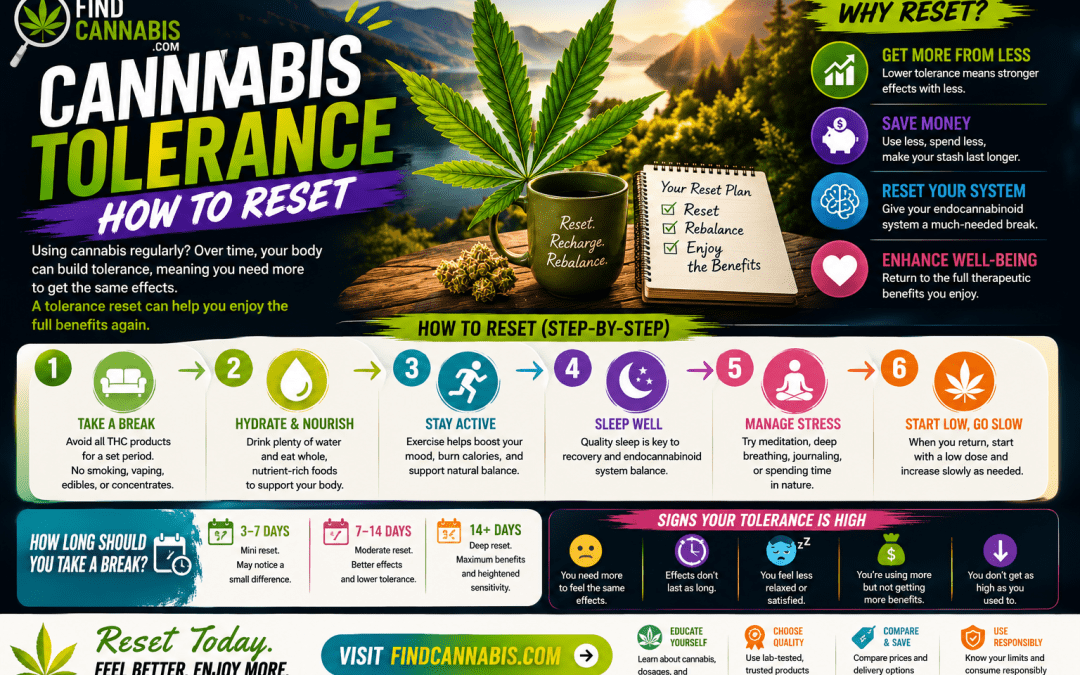
- 3-4 weeks: Near-complete cannabis tolerance reset for most regular users
- 6+ weeks: Full recovery for heavy long-term users
For concentrate users with years of daily heavy use, four weeks may not be sufficient. The practical test: if the first session after your break doesn’t produce markedly enhanced effects, the break was likely too short — not a sign that T-breaks don’t work.
Signs You Actually Need a Cannabis Tolerance Break
The clinical signs of significant CB1 downregulation map directly to what consumers describe experientially: consuming noticeably more than when you started for equivalent effects, cannabis feeling mechanical rather than pleasurable, therapeutic applications — sleep, pain relief, anxiety management — no longer delivering, spending substantially more to achieve the same result.
The flatness that characterizes significant weed tolerance isn’t psychological weakness. It’s the experiential consequence of a reward system that’s adapted to expect THC stimulation and produces diminished signal when it arrives. The solution is receptor recovery, not willpower.
How Long Your Cannabis Tolerance Break Actually Needs to Be
| User Type | Recommended Break |
|---|---|
| Light user (few times per week) | 1 week |
| Moderate user (daily flower) | 2 weeks |
| Heavy user (multiple daily sessions) | 3-4 weeks |
| Concentrate user (daily, 70-90% THC products) | 4-8 weeks |
Concentrate users deserve particular emphasis here. If you’re dabbing daily, treat yourself as a heavy user regardless of session frequency. Per-session THC load — not just frequency — determines the depth of receptor downregulation and therefore the length of cannabis tolerance break required.
Taking the Break — Practically
Start on a low-stress day. Cannabis withdrawal symptoms are manageable; managing them during a crisis is harder than it needs to be.
Tell someone you trust. External accountability meaningfully improves T-break completion rates — not because the break needs policing, but because social commitment creates a different relationship with the decision. Harm reduction practitioners report this consistently.
Remove cannabis from immediate access. Increasing friction for resuming reduces impulse decisions. This simple environmental change matters more than most people expect.
Replace the functional roles cannabis has been filling — specifically, not vaguely. Cannabis serves multiple simultaneous functions: stress relief, sleep initiation, pain management, boredom management. Each needs a specific placeholder. If cannabis is your evening wind-down, identify the replacement ritual before you start, not during.
What a Cannabis Tolerance Break Actually Feels Like
Days 1-3 are the hardest. The cannabis withdrawal symptom constellation — disrupted sleep, reduced appetite, irritability, anxiety, restlessness, cravings — is documented in a 2020 Drug and Alcohol Dependence review that found sleep disturbance, irritability, and anxiety appearing in 70-80% of regular users undergoing abstinence.
Real. Uncomfortable. Not medically dangerous. Not comparable to alcohol or opioid withdrawal. Most symptoms peak in the first two to three days and substantially improve by day seven.
Days 4-7: Significant improvement across the board. Sleep starts normalizing, appetite returns, mood stabilizes.
Days 7-14: Functionally normal for most people. REM rebound is common — THC suppresses REM sleep, and during a T-break the brain catches up through increased REM activity. The vivid, sometimes unsettling dreams are normal and temporary. Some people find them genuinely interesting once they understand what’s happening.
Weeks 2-4 is where it gets surprising. Many regular users report feeling better than they did before the break — sharper cognition, fuller emotional range, improved sleep quality. A chronically downregulated endocannabinoid system isn’t functioning optimally, and cannabis tolerance reset restores natural endocannabinoid function alongside THC receptor sensitivity. You’re not just recovering THC sensitivity. You’re recovering your baseline.
Managing specific symptoms:
Sleep disruption: Low-dose melatonin works — but the correct dose is 0.5-1mg, not the 5-10mg in most commercial gummies. That higher dose can paradoxically impair sleep architecture. Most people taking melatonin during a T-break are taking ten times more than the physiologically relevant amount. CBD at 25-50mg in the evening may also help. CBN-dominant products have growing anecdotal support for T-break sleep with lower tolerance recovery risk than THC.
Anxiety: Exercise is the most reliable intervention — endorphin release, HPA axis regulation, increased GABA activity. A 2023 Frontiers in Psychiatry analysis found exercise meaningfully reduced anxiety symptoms during cannabis abstinence. CBD at 15-25mg shows anxiolytic activity and doesn’t impede THC receptor recovery.
Cravings: Context-dependent and manageable with planning. Identify your trigger situations before the break starts. Most cravings peak and pass within 15-20 minutes if you don’t act on them — knowing that makes them significantly easier to outlast.
Should You Use CBD During a Cannabis Tolerance Break?
CBD doesn’t bind significantly to CB1 receptors and doesn’t drive CB1 internalization. There’s no meaningful mechanism by which CBD use impedes cannabis tolerance reset. This is the pharmacological basis for recommending it as a bridge compound.
During a tolerance break, CBD can address anxiety, sleep initiation, and pain management without meaningfully slowing THC receptor recovery. The one exception: individuals who experience CBD as a cue-triggered craving for THC. For these people, full cannabinoid abstinence produces a cleaner psychological reset. If that’s you, you’ll know — the pull toward THC following CBD use is noticeable.
For everyone else, CBD during a cannabis tolerance break is pharmacologically supported and practically useful.
When T-Breaks Aren’t the Real Issue
Here’s something most tolerance break guides won’t say: for some consumers, the T-break isn’t actually addressing the underlying problem.
Tolerance management assumes the goal is to use cannabis more efficiently. But for some regular users, a break reveals that cannabis has been filling roles tolerance management alone can’t fix — suppressing anxiety that needs treatment, managing pain that warrants medical attention, structuring time in the absence of other meaningful activity.
A cannabis tolerance break that feels harder than expected, or that surfaces discomfort disproportionate to the receptor recovery timeline, isn’t a failed break. It’s information. Cannabis has been doing something that isn’t just about THC sensitivity.
Harm reduction practitioners consistently report that users who get the most from a tolerance break are the ones who pay attention to what surfaces during it — not just monitoring for symptom improvement, but noticing what the break reveals about what cannabis has actually been doing. Coming back with that clarity produces more sustainable consumption patterns than coming back simply because the break is over.
This is distinct from cannabis use disorder, which involves consistent morning use before other activities, continued use despite recognized negative consequences, and repeated unsuccessful attempts to reduce use. If those apply, consultation with a healthcare provider or addiction specialist is appropriate. The SAMHSA National Helpline (1-800-662-4357) provides free, confidential referrals.
Returning After Your T-Break — The Mistake Almost Everyone Makes
The most common post-break error: returning at the pre-break dose. The outcome is predictable — either an overwhelming experience from a reset system, or rapid tolerance re-escalation because the cannabis tolerance reset was never allowed to change consumption patterns.
Week 1 back: 50-75% reduction from pre-break amount. For edible users, if you were taking 20mg, start at 5-10mg. For flower users, half your usual session or less. The THC tolerance recovery is real — dosing as if it isn’t produces exactly the outcomes that make people skeptical T-breaks work.
Week 2: Is the lower dose meeting the functional need? If yes, maintain. If genuinely insufficient, increase modestly — 20-25% increments, not a return to prior levels.
Ongoing: The minimum effective dose principle. Habitually consuming the minimum amount that achieves the desired effect preserves CB1 receptor density far better than escalation. Microdosing — 1-5mg THC — activates receptors with insufficient intensity to drive significant internalization. Periodic microdose weeks are one of the most underrated cannabis tolerance management strategies available.
Keeping Weed Tolerance Manageable Long-Term
Dose discipline: No pharmacological benefit to consuming more than needed. Additional THC beyond the threshold for desired effects drives receptor downregulation without proportional benefit.
Scheduled days off: Even one or two days without cannabis per week meaningfully slows tolerance accumulation — more than most people expect from such a modest change.
Proactive T-break calendar: Quarterly week-long breaks, annual two-to-four week resets — scheduled before tolerance becomes frustrating. Maintenance, not damage control. The distinction matters more than it sounds.
Microdose periods: Monthly weeks at 1-5mg THC prevents cannabis tolerance escalation without requiring full abstinence breaks — a sustainable middle path that most consumers overlook.
Product variety: Rotating between flower, edibles, and tinctures introduces variation that may modestly slow adaptation. Less robust evidence than dose and frequency strategies, but pharmacologically plausible and practically easy.
Cannabis Tolerance vs. Cannabis Dependence
Tolerance is a physiological adaptation — universal, expected, mechanistically understood. It does not indicate problematic use.
Cannabis dependence involves a withdrawal syndrome that motivates continued use, and continued use despite clear negative consequences. The withdrawal syndrome is real but substantially less severe than alcohol or opioid withdrawal on every clinical measure.
Signs that warrant attention beyond cannabis tolerance management:
- Consistent morning use before other daily activities
- Continued use despite recognized negative consequences — relationship problems, vocational impact, health concerns
- Subjective inability to function normally without cannabis
- Repeated unsuccessful attempts to reduce use despite motivation to do so
- Consistent prioritization of cannabis over established responsibilities
Cannabis use disorder is real, treatable, and under-diagnosed. If these patterns apply, the SAMHSA National Helpline (1-800-662-4357) provides free, confidential referrals.
The Psychological Side Nobody Mentions
Long-term cannabis use becomes entangled with identity, ritual, and coping in ways that tolerance management frameworks rarely address. Taking a break means getting a clear look at what cannabis has actually been doing — which can feel uncomfortable and is also genuinely useful information.
Many people come out of a cannabis tolerance break with clarity they didn’t expect: a better sense of what they actually value in cannabis versus what has become automatic or avoidant. Coming back with that awareness tends to produce more intentional, more sustainable consumption patterns than coming back simply because the break is over.
The Thing Worth Sitting With
The four-day tolerance onset finding isn’t just an interesting data point. It’s a reframe.
If cannabis tolerance starts building within days of regular use, and modern cannabis potency has accelerated that process well beyond what the original research anticipated, then tolerance management isn’t something you do reactively when cannabis stops working. It’s something you build into the relationship from the beginning — scheduled breaks, dose discipline, regular days off — or you’re always playing catch-up.
The consumers who maintain the most satisfying long-term relationship with cannabis aren’t the ones who use the most. They’re the ones who use the least amount that actually works, take breaks before they need to, and treat sensitivity as something worth protecting rather than something to push through.
That’s not restriction. That’s intelligent management of something you actually value. 🌿🔄
Find dispensaries near you at FindCannabis.com — search by city, see hours, and get directions.