
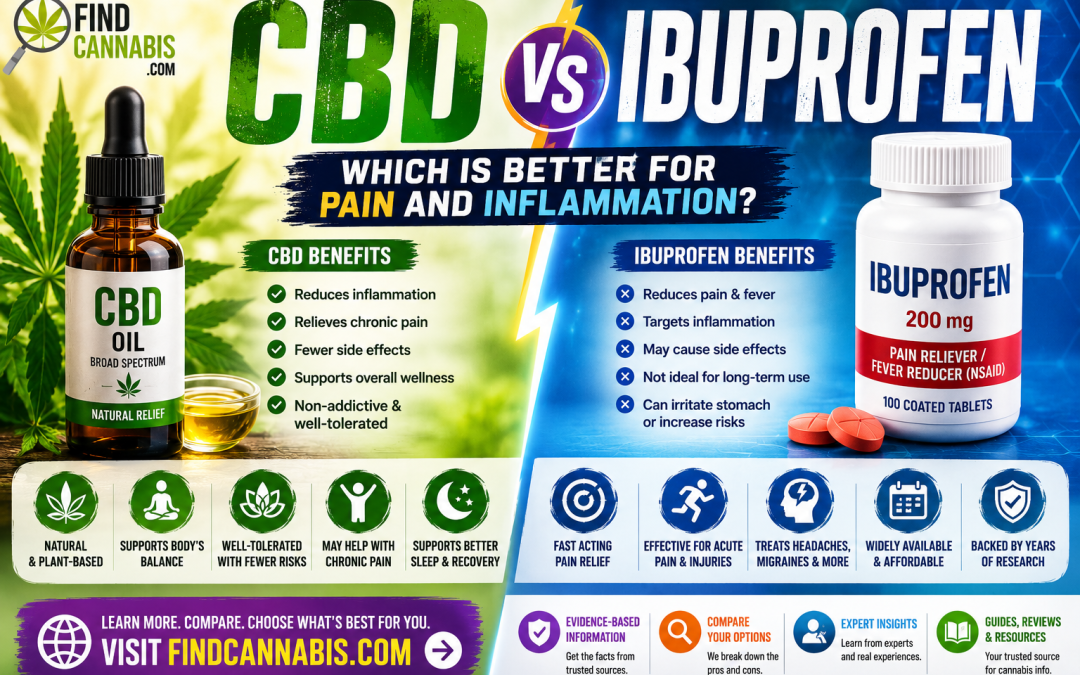
An evidence-based comparison of CBD and ibuprofen — mechanisms of action, clinical evidence, safety profiles, drug interactions, and a framework for deciding which is appropriate for your situation.
Ibuprofen is not as safe as you think it is. CBD is not as unproven as you’ve been told. Those two corrections, taken seriously, change the entire framework for thinking about pain management — and neither one requires you to become a wellness convert or abandon evidence-based medicine to accept them.
What Ibuprofen Is Actually Doing to Your Body
Ibuprofen works by inhibiting COX-1 and COX-2 enzymes that produce prostaglandins — the chemical messengers responsible for pain, inflammation, and fever. Block prostaglandin synthesis and you get less of all three. The mechanism is clean, well-characterized, and genuinely effective for acute pain: onset in 20-30 minutes, duration of 4-6 hours, decades of clinical validation. For immediate acute pain relief, ibuprofen remains the benchmark.
The problem is COX-1. Unlike COX-2, which is induced by inflammatory signals, COX-1 is constitutively expressed — active in normal physiological function, including gastric mucosal protection and platelet aggregation. Non-selective NSAIDs like ibuprofen inhibit both, which means every time you take ibuprofen for pain, you’re also suppressing the prostaglandins that protect your stomach lining from its own acid. That’s the direct mechanism behind ibuprofen-associated peptic ulcers and GI bleeding — and behind the number most people have never seen: a 1991 study in Annals of Internal Medicine estimated NSAIDs were responsible for approximately 16,500 deaths annually in the US from GI complications alone.
Renal risk follows the same logic. Prostaglandins maintain kidney perfusion, particularly in states of reduced blood volume or compromised function. Regular NSAID use suppresses this — which is why the FDA has strengthened warnings on NSAID-associated kidney risk multiple times over the past two decades. A 2017 BMJ meta-analysis found increased acute myocardial infarction risk with all NSAIDs including ibuprofen, highest in the first month of use.
None of this is an argument against ibuprofen. It’s an argument for understanding what it actually costs with regular use — which most people taking it several times a week simply don’t.
How CBD Works for Pain
Rather than targeting one enzymatic pathway the way ibuprofen does, CBD works through at least five distinct molecular pathways simultaneously. That’s either impressive pharmacology or marketing overclaim, depending on how seriously you take the underlying research. The research, it turns out, is fairly serious.
CB2 receptor modulation: CBD activates CB2 receptors on immune cells — macrophages, microglia, T-cells — suppressing pro-inflammatory cytokine release including TNF-α, IL-1β, and IL-6. Crucially, this is upstream anti-inflammatory activity: CBD works on cytokine production before it cascades into prostaglandin synthesis. Ibuprofen works downstream. Different point of intervention, different collateral effects.
TRPV1 receptor interaction: CBD acts as an agonist at TRPV1 receptors — the same channels activated by capsaicin — producing analgesia through receptor desensitization. Particularly relevant to inflammatory hyperalgesia, the increased pain sensitivity that accompanies tissue inflammation.
FAAH inhibition: CBD inhibits the enzyme that breaks down anandamide, your body’s endogenous pain-modulating cannabinoid. By slowing that degradation, CBD increases endocannabinoid tone — enhancing the body’s native pain relief system rather than overriding it with exogenous receptor agonism.
Serotonergic activity: Partial agonism at 5-HT1A serotonin receptors involved in pain perception and mood may contribute to CBD’s efficacy in centrally sensitized pain conditions — fibromyalgia, chronic widespread pain — where serotonergic signaling is relevant to the pathology.
Glycine receptor modulation: CBD enhances glycine receptor activity, contributing to inhibitory pain signaling at the spinal cord level — demonstrated in animal models of both inflammatory and neuropathic pain, with effects reversed by glycine receptor antagonists.
Clinically, CBD for pain has its strongest evidence base in neuropathic and chronic inflammatory conditions. A 2018 systematic review in Frontiers in Pharmacology found consistent cannabinoid analgesic efficacy across multiple pain types, with the strongest signal in neuropathic and cancer-related pain. Individual response variability is higher than with ibuprofen, and effective clinical doses have ranged from 5mg to several hundred milligrams daily — a wide range that reflects genuine inter-individual pharmacokinetic variation.
Onset: 15-45 minutes (sublingual), 30-120 minutes (oral edible), near-immediate (topical). Duration: 4-8 hours. Oral bioavailability runs 6-19% with conventional products, substantially improved with nanoemulsion formulations or administration alongside high-fat meals.
Which Pain Type Favors Which Compound
Acute nociceptive pain — headache, dental pain, minor injury: Ibuprofen is more reliably effective with faster, more predictable onset. CBD’s evidence for acute pain relief is limited and the dose-response poorly characterized. If you have a headache right now, ibuprofen is the right call.
Inflammatory pain — arthritis, post-injury inflammation: Both work through complementary mechanisms. Ibuprofen is faster for acute relief; CBD for chronic inflammatory pain offers more sustainable long-term management with substantially better safety for regular use.
Neuropathic pain — nerve damage, diabetic neuropathy, post-herpetic neuralgia: CBD has a genuine mechanistic advantage here. TRPV1 and CB2 mechanisms directly target the central and peripheral sensitization underlying neuropathic pain in ways that COX inhibition simply doesn’t reach. For nerve pain specifically, CBD is the more pharmacologically appropriate tool.
Chronic widespread pain — fibromyalgia, chronic back pain: CBD’s multi-pathway mechanism, including serotonergic activity and glycinergic modulation, may provide broader coverage than COX inhibition alone for these complex presentations.
Why Their Anti-Inflammatory Mechanisms Aren’t Interchangeable
Both compounds reduce inflammation — but through distinct, non-redundant pathways that produce meaningfully different consequences at the cellular level.
Ibuprofen’s COX inhibition suppresses prostaglandin synthesis: fast-acting, potent, and well-validated for acute inflammatory conditions. The collateral damage is the problem — those same prostaglandins serve gastric protection, renal perfusion, and platelet aggregation functions that get disrupted alongside the therapeutic effect.
CBD’s CB2-mediated cytokine suppression operates through upstream immune regulation, potentially delivering anti-inflammatory effects without that collateral damage. For neuroinflammation specifically — driven by microglial activation and pro-inflammatory cytokines rather than prostaglandins — CBD’s mechanism may be more directly relevant than ibuprofen’s. A 2020 study in Free Radical Biology and Medicine found that CBD’s multi-target mechanism produced anti-inflammatory effects across pathways that single-target compounds couldn’t replicate.
The Safety Comparison, Honestly
Gastrointestinal: Ibuprofen’s GI risk is mechanistically grounded and well-documented — it’s the source of the mortality data cited above. CBD has no identified GI toxicity mechanism. For anyone with existing GI disease or peptic ulcer history, this comparison isn’t close.
Renal: Ibuprofen’s renal concern follows directly from prostaglandin-dependent kidney perfusion. No renal toxicity mechanism has been identified for CBD, and high-dose clinical use of Epidiolex has produced no renal safety signals.
Cardiovascular: The NSAID cardiovascular risk signal is a class effect. CBD’s cardiovascular effects are distinct — preclinical data suggests potential cardioprotective effects through CB2-mediated inflammatory damage reduction, though human cardiovascular data for CBD specifically remains limited.
Drug interactions: Both compounds carry clinically significant interactions. Ibuprofen interacts with warfarin, SSRIs (tripling GI bleeding risk), ACE inhibitors, diuretics, methotrexate, and lithium. CBD inhibits CYP3A4 and CYP2C19 liver enzymes, producing interactions with warfarin (significantly elevated INR), antiepileptics, immunosuppressants, and certain statins. At high doses used in Epidiolex trials, transaminase elevations appeared in patients also taking valproate. If you’re on prescription medications, discuss CBD with your doctor before starting — this isn’t theoretical.
Long-term safety: Ibuprofen’s profile is well-characterized and genuinely concerning for chronic use: cumulative GI damage, progressive renal risk, sustained cardiovascular risk elevation. CBD’s long-term data, including post-marketing Epidiolex surveillance, has not identified organ damage, tolerance development, or physical dependence.
What Athletes Get Wrong About Post-Workout Recovery
Buried in the exercise physiology literature is a finding that should change how anyone training regularly thinks about post-workout ibuprofen.
The acute inflammatory response to resistance training — mediated by prostaglandins PGF2α and PGE2 — isn’t a side effect of exercise. It’s a necessary component of the adaptive process. These prostaglandins stimulate satellite cell proliferation and muscle protein synthesis following mechanical damage. Suppress them and you suppress the mechanism through which training produces results.
A 2001 study in American Journal of Physiology found ibuprofen following resistance exercise significantly suppressed satellite cell activity and muscle protein synthesis. A 2002 study in Journal of Applied Physiology showed high-dose NSAID use blunted the hypertrophic response to training over three weeks. CBD does not inhibit COX enzymes and doesn’t suppress prostaglandin-mediated adaptive signaling — which means CBD for post-workout pain and inflammation may reduce excessive inflammatory signaling without impeding the adaptation that makes training worth doing. For serious athletes using anti-inflammatory support consistently, this distinction matters more than most sports medicine conversations acknowledge.
CBD for Pain by Condition
Arthritis: A 2016 study in the European Journal of Pain found transdermal CBD significantly reduced pain and inflammation in an arthritis model. A 2020 phase 2 trial in Pain Medicine found CBD gel associated with statistically significant pain reductions in knee osteoarthritis patients. For chronic daily joint pain management where ibuprofen’s GI and renal risks accumulate, CBD for arthritis is a pharmacologically rational primary option — not a fallback.
Back pain: Acute back pain favors ibuprofen on speed. Chronic back pain requiring sustained daily management — precisely where cumulative NSAID safety risks become most concerning — is where CBD for back pain makes the stronger case. Combined oral and topical application addresses systemic and localized components simultaneously. The trade-off is onset speed. Everything after month one favors CBD.
Nerve pain: The strongest cannabinoid analgesic signal in the 2018 Frontiers in Pharmacology review was in neuropathic pain. CBD’s TRPV1 and CB2 mechanisms target the sensitization driving nerve pain more directly than COX inhibition can. For this pain type, CBD isn’t a second-line consideration — it’s mechanistically better suited than ibuprofen.
Migraine: A 2021 review in Headache cited reduced anandamide levels in the cerebrospinal fluid of migraine patients as evidence for endocannabinoid deficiency as a contributing pathological mechanism. CBD’s FAAH inhibition directly addresses that — increasing anandamide availability through the mechanism that may underlie the pathology. That reframes CBD for migraine prevention from anecdote to targeted pharmacology.
Menstrual pain: Ibuprofen has a clear acute advantage — COX inhibition directly suppresses the excess prostaglandin production driving uterine cramping. For immediate relief, it’s the right tool. For monthly ongoing management where cumulative use frequency makes the safety comparison increasingly relevant, CBD’s profile for regular use becomes a genuine clinical consideration rather than a lifestyle preference.
The Product Quality Problem Nobody Talks About
Here’s the contrarian point that pro-CBD content almost never makes: a significant portion of “CBD didn’t work for me” experiences are almost certainly cases of inadequate dosing from inaccurately labeled products.
A 2017 JAMA study found only 30.95% of CBD products tested were accurately labeled. Taking a product labeled 25mg that actually contains 8mg isn’t a test of whether CBD works for pain — it’s a test of whether a sub-therapeutic dose of an imprecisely manufactured product produces noticeable effects. The answer is predictably often no, and the conclusion most people draw from that experience is wrong.
Third-party certificate of analysis verification — independent lab confirmation of actual cannabinoid content and contaminant screening — is the minimum standard for therapeutic CBD use, not an optional quality signal. Without it, you’re not running a personal experiment. You’re just hoping.
Protocols Based on the Evidence
For athletes: Daily 25-50mg full-spectrum oral CBD for systemic anti-inflammatory support. Topical CBD on trained muscle groups post-session. Eliminate habitual post-workout ibuprofen based on the adaptation impairment evidence. Reserve ibuprofen for acute injury scenarios where pain management benefit clearly outweighs adaptation cost.
For chronic or neuropathic pain: CBD at 25-75mg daily as the primary analgesic, titrated from 15mg upward based on response. Full-spectrum products with verified COA. Multiple smaller doses throughout the day for more consistent plasma concentrations. Ibuprofen as occasional backup for acute flares — not the daily foundation.
For inflammatory conditions: Replace routine ibuprofen with 25-75mg daily CBD. Full-spectrum formulation preferred. CBD topicals for localized areas. Keep ibuprofen available for acute flares — the goal is limiting cumulative NSAID exposure, not guaranteeing you’ll never need it.
For general acute pain: Ibuprofen 200-400mg where speed and reliability are the priority and use will be genuinely occasional. A CBD baseline of 15-25mg daily may reduce the frequency and intensity of acute episodes over time — not as an acute replacement for ibuprofen, but as background support that shifts the terrain.
The Question Nobody Asks
Why is the compound with a documented GI mortality signal considered the safe, default option — and the compound with no identified organ toxicity mechanism considered the risky, unproven alternative?
Part of the answer is time: ibuprofen’s risks were normalized alongside its benefits over decades of widespread use before the full safety picture was clearly characterized. Part is regulatory familiarity — FDA approval creates a cultural assumption of safety that doesn’t always align with the pharmacological reality of regular use. And part is that pharmaceutical versus alternative framing shapes risk perception independent of what the data shows.
The pharmacology doesn’t care about any of that. It describes what each compound does, to which receptors, with which consequences, at which doses. On that basis — the only one that actually matters for your health — CBD for pain deserves evaluation with the same rigor applied to ibuprofen, and ibuprofen deserves scrutiny proportionate to its actual risk profile rather than its cultural familiarity.
Both corrections, taken seriously, change how you think about pain management. Neither requires abandoning evidence. Both require actually reading it. 🌿💊
Find dispensaries with quality CBD products near you at FindCannabis.com.
This article is for educational purposes and does not constitute medical advice. Consult a qualified healthcare provider before changing your pain management approach, particularly if you take prescription medications or have underlying health conditions.