
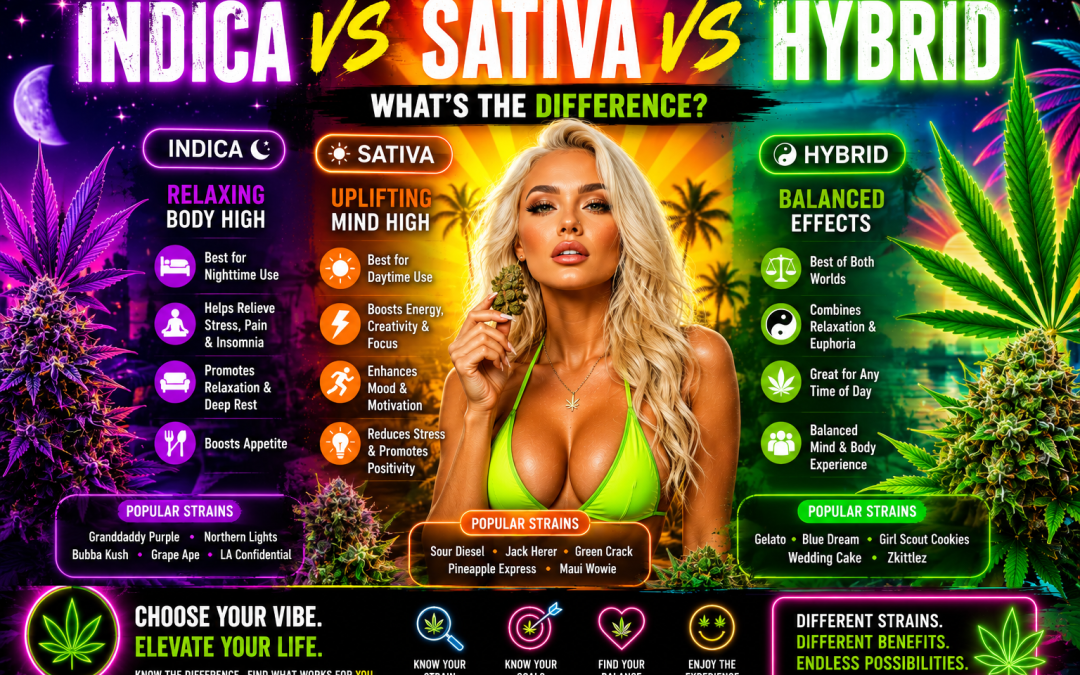
Indica vs Sativa vs Hybrid — What’s the Difference?
You’re at the dispensary. The budtender asks whether you want Indica, Sativa, or Hybrid. You say Sativa because you want energy and you’ve heard Indica makes people sleepy. Two hours later you’re anxious and uncomfortable and wondering what went wrong. What went wrong is that Sativa-dominant strains are actually more likely to produce anxiety than Indica — and “I want energy” and “I want Sativa” aren’t the same decision. Here’s the framework that actually helps you make the right call.
What the Labels Mean — And Where They Break Down
The Indica/Sativa/Hybrid framework is useful. It’s just not as precise as most dispensary menus imply.
The Indica vs Sativa difference has its origins in 18th-century botanical taxonomy. Carl Linnaeus classified cannabis as Cannabis sativa in 1753. Jean-Baptiste Lamarck described Cannabis indica in 1785. Both classifications were based entirely on plant morphology — physical appearance — not on chemical composition or pharmacological effect. The conflation of plant structure with effect categories happened through cannabis culture rather than rigorous science.
A 2015 study published in PLOS ONE by Sawler et al. analyzed the genetic structure of commercial cannabis varieties and found that genetic differentiation between Indica and Sativa labeled varieties was statistically significant — but that the relationship between genetic ancestry and pharmacological effect was not straightforward. The labels reflect real differences in plants. Those differences don’t reliably predict what you’ll feel.
What the research consistently shows is that cannabinoid and terpene profiles — not morphological classification — are the primary determinants of effect. Understanding that changes how you shop.
The accurate picture for each cannabis strain type:
Indica-labeled strains tend toward sedation and physical relaxation because they typically contain high concentrations of myrcene — a terpene with demonstrated sedative properties through GABA-A receptor activity. The same myrcene that makes mangoes smell like mangoes. A 1997 study in Phytomedicine found that myrcene produced significant sedation in mice at relevant doses, and research suggests it also increases blood-brain barrier permeability to cannabinoids, potentially amplifying THC effects.
Sativa-labeled strains tend toward mental stimulation and energy because of elevated limonene and terpinolene content — terpenes with documented mood-elevating and energizing effects. A 2019 human pilot study in Cannabis and Cannabinoid Research found limonene-rich cannabis produced acute anxiolytic effects compared to low-limonene controls.
Most strains labeled “Indica” or “Sativa” in commercial markets are Indica-dominant or Sativa-dominant hybrids. True landrace varieties represent a small fraction of commercial inventory. The pure categories consumers are shopping by have largely been bred out of existence.
The Part Most Cannabis Guides Won’t Say Directly
The Indica/Sativa/Hybrid framework, used the way most dispensaries use it, produces predictably imperfect consumer outcomes. The industry knows this.
Cannabis retail platforms have moved toward terpene-forward product descriptions precisely because experienced operators have recognized that the three-category label alone doesn’t give consumers enough information to predict their experience reliably. Dr. Ethan Russo’s influential 2011 paper in the British Journal of Pharmacology established the foundational argument: effects are produced by the full chemical profile of the strain — cannabinoids, terpenes, and their interactions — not by morphological classification.
The most significant consumer misconception the framework produces brings us back to the opening scenario. Many anxiety-prone consumers choose Sativa because it sounds lighter and less heavy than Indica. This is precisely backwards. Cannabis practitioners and consumer research consistently identify Sativa-dominant strains as more likely to produce anxiety and paranoia — the mentally stimulating terpene profiles that produce energy and creativity can also amplify THC-induced anxiety in susceptible individuals.
For the Sativa or Indica for anxiety question, the answer is almost always Indica or a balanced hybrid. The intuitive choice is frequently the wrong one.
Indica Effects — What the Research Shows
What indica actually feels like
Consumer experience data and clinical research consistently describe Indica-labeled strains as producing:
- Deep physical relaxation and reduced motor activity
- Sedation, particularly at higher doses
- Meaningful pain relief — both acute and chronic
- Faster sleep onset — the evidence base for Indica or Sativa for sleep strongly favors Indica
- Significant appetite stimulation
- Anxiolytic effects through physical calm
- Antiemetic effects — among the best-documented therapeutic cannabis applications
The terpenes driving indica effects
Myrcene — GABA-A receptor activity. Sedating and relaxing. The primary pharmacological driver of Indica effects. Also increases blood-brain barrier permeability to cannabinoids, potentially amplifying THC.
Linalool — Modulates glutamate and GABA systems. Anxiolytic and sedative. The same compound responsible for lavender’s documented calming effects. Works synergistically with myrcene in Indica-dominant strains.
Clinical evidence
A 2019 review in Medicines found cannabis effective for sleep onset and maintenance across multiple patient populations — making the Indica or Sativa for sleep question well-supported by evidence. A 2015 systematic review in JAMA Internal Medicine found moderate evidence for cannabinoids in neuropathic pain treatment. The FDA has approved synthetic cannabinoids for chemotherapy-induced nausea — the clearest federal acknowledgment that cannabis compounds have medical utility while cannabis itself remains Schedule I, which remains its own remarkable contradiction.
Indica strains worth knowing
- Northern Lights — Among the most genetically stable Indica varieties commercially available. Consistently high myrcene, predictable sedative indica effects. The benchmark.
- Granddaddy Purple — High myrcene and linalool alongside distinctive anthocyanin pigmentation. A terpene combination that produces particularly pronounced relaxation.
- Bubba Kush — Very high myrcene, significant caryophyllene. One of the most reliably sedating strains in the contemporary market.
- Hindu Kush — A true landrace Indica from its namesake mountain range. One of the few genetically pure Indica expressions still commercially available.
When Indica makes sense: Evening and nighttime. For Indica or Sativa for sleep, Indica is the clear answer — the myrcene and linalool profile supports both sleep onset and maintenance in ways Sativa-dominant strains structurally cannot.
Sativa Effects — What the Research Shows
What sativa actually feels like
Consumer data and clinical observations consistently describe Sativa strains as producing:
- Cerebral stimulation and heightened mental activity
- Energy and motivation enhancement
- Creative ideation and increased associative thinking
- Mood elevation and euphoria
- Social facilitation and reduced inhibition
- Enhanced sensory processing
- Daytime functional capacity
The terpenes driving sativa effects
Limonene — Serotonergic and dopaminergic activity. Mood-elevating and anxiolytic. The primary uplifting terpene in Sativa-dominant varieties.
Terpinolene — Uplifting and energizing. Found in high concentrations in Durban Poison and Jack Herer. Consistent cannabis terpenes effects patterns across consumer reporting.
Pinene — Acetylcholinesterase inhibitor that supports memory retention and counteracts THC-induced short-term memory impairment. Can reduce THC-induced anxiety — a meaningful consideration for Sativa or Indica for anxiety decisions.
Sativa strains worth knowing
- Durban Poison — Among the highest terpinolene content of any commercially available strain. Clear-headed, energetic sativa effects. The benchmark for what genuine Sativa experience feels like.
- Jack Herer — High terpinolene and pinene. Consistently uplifting with lower anxiety risk than many high-THC alternatives.
- Sour Diesel — High limonene, high THC. Pronounced cerebral stimulation. One of the most consistent sativa-effect strains in the contemporary market.
- Green Crack — Misleading name; produces energy without the anxiety some Sativas create because of its specific terpene balance.
When Sativa makes sense: Morning and daytime use only. For Sativa or Indica for anxiety, the answer is almost always Indica or a balanced hybrid. Cannabis sleep practitioners consistently identify Sativa use within 4-6 hours of bedtime as a sleep quality disruptor.
Hybrid Cannabis Strains — Where the Market Actually Lives
The genetic reality
Virtually every commercially available strain is a hybrid. Landrace varieties represent a small fraction of commercial inventory, and the Indica vs Sativa framework is being used to describe a market that has largely moved beyond those pure categories.
Hybrid cannabis strains by type:
- Indica-dominant — Maintains Indica effects while introducing some mental engagement. Typically 60-70% Indica genetics. The largest market segment by sales volume in most US legal cannabis markets.
- Sativa-dominant — Maintains Sativa effects while adding body effects that modulate anxiety. The more forgiving option for consumers sensitive to stimulating Sativa effects.
- Balanced (50/50) — Mental stimulation and physical relaxation simultaneously. Often consumers’ preferred cannabis strain type once they’ve explored the full spectrum.
Hybrid cannabis strains worth knowing
- Blue Dream — Sativa-dominant. High myrcene despite Sativa dominance — an example of how cannabis terpenes effects can diverge from genetic classification. Uplifting with reduced anxiety risk. Consistently one of the best-selling strains in US legal markets.
- OG Kush — Indica-dominant. Genetic foundation of a significant proportion of modern cannabis. Complex terpene profile (myrcene, caryophyllene, limonene) producing euphoria alongside deep relaxation.
- Girl Scout Cookies — Balanced hybrid. Caryophyllene-forward, producing stress relief alongside balanced mental and physical effects.
- Gelato — Balanced. High limonene and caryophyllene. Simultaneously mood-elevating and physically relaxing — the terpene combination that best represents genuine middle ground in the Indica vs Sativa vs Hybrid spectrum.
- Wedding Cake — Indica-dominant. Deep Indica effects with significant mood elevation from a complex terpene profile.
The Compounds That Actually Drive Effects
Cannabinoids
THC — CB1 receptor agonist. The primary psychoactive compound. Average THC concentrations have roughly doubled since the early 2000s — from 10-15% to 20-30% in contemporary legal markets. Most casual consumers don’t know this, and it significantly affects the Indica vs Sativa difference in anxiety risk.
CBD — CB1 partial antagonist. Modulates THC’s psychoactive effects — reduces anxiety while preserving analgesic benefits. The FDA approved Epidiolex (pharmaceutical CBD) for pediatric epilepsy in 2018, the first plant-derived cannabinoid approved as a prescription medication while cannabis itself remains federally illegal. Products with CBD:THC ratios of 1:1 or higher consistently produce more balanced, less anxiogenic effects — directly relevant to Sativa or Indica for anxiety decisions.
Cannabis terpenes effects — the six worth knowing
Myrcene — GABA-A receptor activity. Sedating. Functions as a cannabinoid permeability booster.
Limonene — Serotonergic and dopaminergic activity. Mood-elevating. Primary uplifting terpene in Sativa varieties.
Pinene — Acetylcholinesterase inhibitor. Counteracts THC-induced memory impairment. Anti-anxiety properties documented in animal models.
Linalool — GABA and glutamate modulation. Calming. Works synergistically with myrcene in Indica-dominant strains.
Caryophyllene — The only terpene that directly activates cannabinoid receptors (CB2). Anti-inflammatory. Uniquely functions as both a terpene and a dietary cannabinoid — arguably the most pharmacologically interesting compound on this list.
Terpinolene — Uplifting and energizing. High concentrations in Durban Poison and Jack Herer. Consistent cannabis terpenes effects patterns across consumer reporting.
Two strains carrying identical “Indica” labels can produce meaningfully different indica effects if their terpene profiles differ. The Indica vs Sativa label is a starting point. The cannabis terpenes effects profile is the destination.
How to Choose Between Indica vs Sativa vs Hybrid
| Goal | Recommended Cannabis Strain Type | Cannabis Terpenes to Seek | THC/CBD |
|---|---|---|---|
| Indica or sativa for sleep | Indica / Indica-dominant | High myrcene, linalool | High THC or 1:1 for gentler effect |
| Daytime relaxation | Indica-dominant hybrid | Moderate myrcene, caryophyllene | Moderate THC |
| Creative focus | Sativa / Sativa-dominant | Limonene, pinene, terpinolene | Moderate THC; avoid high THC if anxiety-prone |
| Sativa or indica for anxiety | Indica-dominant / balanced | Myrcene, linalool, caryophyllene | Some CBD strongly recommended |
| Pain management | Indica / Indica-dominant | Myrcene, caryophyllene | High THC or CBD-rich |
| Exercise / activity | Sativa-dominant | Terpinolene, pinene | Moderate THC |
| First-time use | Balanced hybrid | Balanced terpene profile | Under 18% THC, some CBD present |
| Wellness without psychoactivity | CBD-dominant | Any | 1:1 or higher CBD:THC ratio |
Indica vs Sativa vs Hybrid — Quick Reference
| Indica | Sativa | Hybrid | |
|---|---|---|---|
| Effects | Relaxing, sedating | Energizing, uplifting | Balanced mix |
| Best time | Evening/night | Morning/daytime | Anytime |
| Primary use | Sleep, pain, anxiety | Creativity, energy, mood | Flexible, everyday |
| Effect focus | Body-dominant | Mind-dominant | Both |
| Key cannabis terpenes | Myrcene, linalool | Limonene, terpinolene, pinene | Varies |
| Sativa or indica for anxiety | Indica preferred | Higher risk | Moderate risk |
| Appetite stimulation | Strong | Moderate | Varies |
Guidance for New Cannabis Consumers
Start with a balanced hybrid at moderate THC. Consumer outcome data consistently shows that new users who begin with balanced hybrid cannabis strain types at 15-18% THC or below have significantly better initial experiences than those who start with high-THC Sativas. The balanced cannabis terpenes effects profile is more forgiving and reduces the anxiety risk that accompanies high-potency sativa effects.
Titrate carefully. The most common source of negative cannabis experiences — documented in emergency department data from legal states — is overconsumption, particularly with edibles. Start with a minimal dose, wait the full onset period (15-45 minutes for inhalation, 60-120 minutes for edibles), and assess before consuming more.
Request terpene data at the dispensary. Quality dispensaries can provide terpene percentage breakdowns from the certificate of analysis for each product. Using cannabis terpenes effects data to match profiles to your desired experience is more predictive than relying on the Indica vs Sativa label alone.
Track your experiences. Cannabis effects are subject to significant individual variability based on endocannabinoid system tone and metabolism. Personal records of cannabis strain types, dose, delivery method, and effects are more predictive of your future preferences than generalized consumer reviews.
Find the Right Cannabis Strain at a Licensed Dispensary
The Indica vs Sativa vs Hybrid framework is most effectively applied in conversation with knowledgeable dispensary staff who can access real-time inventory data, COA terpene profiles, and consumer feedback specific to their market.
Use FindCannabis.com to find licensed dispensaries near you — search by city, see current hours, read reviews, and get directions. Whether you’re in Los Angeles, Denver, Miami, New York, or any legal cannabis market, FindCannabis.com provides current operational information for licensed retailers in your area.
The Thought Worth Sitting With
Return to the scenario that opened this article. A consumer chose Sativa because it seemed like the gentler option and had an anxiety response they didn’t expect. That outcome is documented, repeatable, and entirely predictable — if you know that Sativa’s stimulating terpene profile amplifies THC-induced anxiety in susceptible individuals. The information to prevent it exists. It just isn’t consistently communicated at the retail level.
The cannabis industry is at an inflection point on this question. Sophisticated operators are already moving toward terpene-forward product presentation. Consumer education around cannabis terpenes effects is accelerating in mature markets. The endgame probably looks something like the wine industry’s evolution from “red or white” to grape variety to terroir — consumers moving from broad categories toward specific chemical profiles.
The framework built on 18th-century leaf shape observations will eventually be replaced by something more pharmacologically accurate. The research already supports that evolution. The only things lagging are consumer education and the retail industry’s willingness to lead with complexity rather than simplicity.
In the meantime: when the budtender asks Indica, Sativa, or Hybrid, you now know enough to ask the follow-up question that actually matters. What are the dominant terpenes? 🌿
Find dispensaries near you and browse strain options at FindCannabis.com.
Related Articles
- First Time at a Dispensary — Complete Beginner’s Guide
- What is CBD? Complete Beginner’s Guide
- Cannabis Terpenes — What They Are and Why They Matter
- What is THCA vs THC?
- Best Dispensaries Near You — Search by City
Frequently Asked Questions About Indica vs Sativa vs Hybrid
What is the difference between Indica, Sativa, and Hybrid?
Indica strains are generally associated with relaxation, sedation, sleep, and body effects. Sativa strains are generally associated with energy, creativity, and mental stimulation. Hybrid strains combine traits from both, though terpene and cannabinoid profiles are more predictive than the label alone.
Is Indica or Sativa better for sleep?
Indica or Indica-dominant strains are usually better for sleep because they often contain higher levels of sedating terpenes such as myrcene and linalool.
Is Indica or Sativa better for anxiety?
Indica-dominant or balanced Hybrid strains are usually better choices for anxiety. Sativa-dominant strains can be more stimulating and may increase anxiety or paranoia in sensitive consumers.
Are most cannabis strains true Indica or Sativa?
No. Most commercial cannabis strains are Hybrids. True landrace Indica or Sativa varieties make up only a small portion of modern dispensary inventory.
What causes the effects of cannabis strains?
Cannabis effects are driven mainly by cannabinoid and terpene profiles, including THC, CBD, myrcene, limonene, pinene, linalool, caryophyllene, and terpinolene.
What is the best cannabis strain type for beginners?
Beginners are usually better off starting with a balanced Hybrid at moderate THC levels, ideally under 18% THC and with some CBD present.
Why can Sativa make some people anxious?
Sativa-dominant strains often have stimulating terpene profiles and higher THC levels, which can amplify anxiety, racing thoughts, or paranoia in sensitive users.
Should I ask for terpene data at a dispensary?
Yes. Terpene data from a Certificate of Analysis can help predict effects more accurately than simply choosing based on Indica, Sativa, or Hybrid labels.