THCA vs THC — What’s the Difference? (2026)
Cannabis plants don’t make THC. They make THCA — a chemically distinct compound that won’t get you high regardless of how much of it is in the flower. THC only exists because of heat. Every time you’ve ever gotten high from cannabis, it started as THCA and became something else in the seconds it took to burn, vaporize, or bake. That single fact explains most of what’s confusing about cannabis labels.
Cannabis Doesn’t Make THC. It Makes THCA.
This surprises most people, including many who’ve been using cannabis for years.
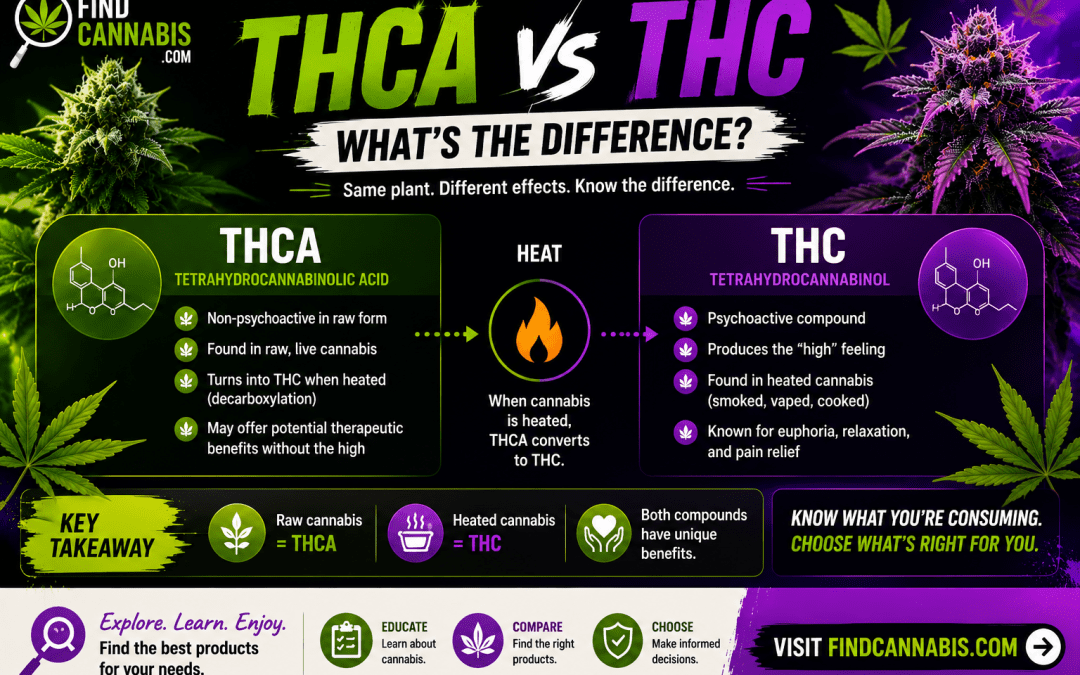
Cannabis plants synthesize THCA — tetrahydrocannabinolic acid — through an enzymatic pathway involving THCA synthase, accumulating in the trichomes of the flower. It stays as THCA in the living, harvested, and cured plant. THC forms only when heat is applied. Without decarboxylation, there is no meaningful THC in cannabis flower.
THCA and THC are structurally near-identical — the only chemical difference is a carboxyl group (COOH) attached to the THCA molecule. Apply heat and that group detaches, releasing carbon dioxide. What remains is THC. That process — decarboxylation — happens every time you smoke, vape, or properly prepare cannabis for edibles.
A 2011 study in British Journal of Pharmacology confirmed the pharmacological consequence: THCA has substantially lower CB1 receptor binding affinity than THC. Raw cannabis, regardless of THCA content, produces no meaningful intoxication. The compound that causes psychoactive effects simply doesn’t exist yet.
What THC Does Once It Exists
THC binds as a partial agonist at CB1 receptors concentrated in the prefrontal cortex, hippocampus, striatum, and cerebellum — regions governing executive function, memory, reward processing, and motor coordination. That binding produces the well-documented effects: euphoria, altered time perception, heightened sensory experience, relaxation, increased appetite, analgesia, and creative thinking. At higher doses in sensitive individuals, amygdala hyperactivation can produce anxiety and paranoia.
When a dispensary label shows THC%, it’s showing activated, psychoactive content — either already converted or expressed as the amount available after activation. THCA% shows the precursor. These are measuring different stages of the same compound, and treating them as equivalent is one of the most common mistakes in cannabis retail.
The Conversion Math — and Why It Changes Everything on a Label
The THCA to THC conversion follows a predictable formula based on molecular weight. When THCA loses its carboxyl group, the resulting THC molecule is 87.7% of the original’s weight:
Total THC = (THCA × 0.877) + THC
A product showing THCA 25.0% and THC 0.3% has a Total THC of 22.2%. That’s the number reflecting actual available psychoactive content — not the raw THCA figure most prominently displayed on flower packaging.
Different state markets handle this inconsistently. California and Colorado typically require or encourage Total THC labeling. Other markets report THCA and THC separately, leaving consumers to run the math themselves. Most don’t. The result: the number consumers use most often to compare products is frequently the least accurate representation of what they’ll experience.
How Temperature Shapes the Experience
Decarboxylation isn’t binary — it happens on a spectrum depending on temperature and duration, and that spectrum directly shapes what you feel.
Smoking: Combustion exceeds 400°F, driving essentially instantaneous, complete conversion. THCA flower smokes like cannabis because by the time vapor reaches you, it already is.
Vaporizing: Lower temperature settings (around 338°F/170°C) don’t fully convert all THCA, producing lighter effects. Higher settings (around 446°F/230°C) drive more complete conversion. Experienced vaporizer users who describe low-temp hits as “cleaner” or “more terpene-forward” are observing real chemistry — a different cannabinoid ratio, not just different flavor.
Cooking: Edibles require intentional decarboxylation before infusion — typically baking at 220-240°F (104-115°C) for 30-45 minutes. This range converts THCA efficiently without significant THC degradation into CBN, which occurs at higher temperatures with extended exposure. Skip this step and you infuse your butter or oil with primarily THCA — negligible psychoactive effect when consumed.
Storage and time: THCA degrades through exposure to heat, light, and oxidation. The degradation doesn’t cleanly produce THC — much of it converts to CBN instead. Elevated CBN on a lab report is a degradation marker, not a feature. It means the product is old or was stored poorly.
The Number You’re Using to Shop Doesn’t Tell You What You Think
Here’s the argument the cannabis industry consistently avoids making directly: the THCA percentage prominently displayed on flower packaging is one of the less predictive variables for actual experience quality.
Several things predict it better.
Terpene profile. The dominant terpenes — myrcene, limonene, caryophyllene, pinene, linalool, terpinolene — have documented pharmacological activity through mechanisms independent of CB1 binding. A 25% THCA flower with a well-developed terpene profile frequently produces a more nuanced experience than a 30% THCA flower with minimal terpene content. This isn’t anecdote — it’s consistent with what dispensary staff with deep product knowledge observe across consumer feedback.
Lab testing methodology. Cannabis testing labs use different extraction methods, calibration standards, and analytical approaches that produce legitimately different results from the same sample. A 2018 analysis documented coefficient of variation above 10% for THC measurements across labs testing identical samples — meaning a product testing at 24% at one lab might test at 27% at another. Brands seeking competitive advantage have structural incentive to test with labs that return high numbers. Consumers treating THCA% as an objective measurement are missing this entirely.
Total THC vs. raw THCA. The displayed number and the experienced potency aren’t the same thing without applying the conversion formula. Comparing THCA% on flower to THC% on an extract without that calculation is comparing raw dough to a finished loaf and calling it equivalent.
What Raw THCA Research Actually Shows
Some health-focused consumers use this chemistry deliberately — juicing fresh cannabis leaves and flowers to consume THCA without any decarboxylation. No THC is produced, which means no intoxication, and substantially larger quantities become practical.
The research on raw THCA’s distinct properties is real, if preclinical. A 2013 study in Phytomedicine found THCA demonstrated anti-inflammatory activity through inhibition of COX-1 and COX-2 enzymes — the same enzymes targeted by NSAIDs. A 2012 study in British Journal of Pharmacology documented neuroprotective effects in cellular and animal models. Antiemetic properties have also been examined.
None of this constitutes clinical proof of therapeutic efficacy in humans. THCA is not a proven treatment for anything. It is, however, a pharmacologically active compound with a distinct property profile that exists independent of its conversion to THC — and the research base is growing.
Hemp-Derived THCA — What’s Actually Happening in That Market
The emergence of hemp-derived THCA flower in states without legal cannabis follows directly from the THCA vs THC distinction — and the chemistry makes the practical reality immediately obvious.
Under the 2018 Farm Bill, hemp-derived products with less than 0.3% delta-9 THC are federally legal. THCA is technically not delta-9 THC. Hemp-derived THCA flower can contain substantial THCA concentrations while technically meeting the federal limit in its unactivated state.
Smoke or vape it and decarboxylation occurs immediately. The product produces effects identical to conventional cannabis and is pharmacologically indistinguishable from regulated flower — the legal distinction exists only in the unheated laboratory measurement.
Several states have moved to explicitly restrict these products, and federal DEA guidance has indicated that THCA converting to THC should be considered THC for regulatory purposes. This landscape is actively changing. Verify local laws before purchasing, especially online.
THCA diamonds represent the extreme end of this spectrum: crystalline concentrates testing at 95-99% THCA, typically combined with separated terpene sauce to restore aromatic complexity the pure crystalline form lacks. When dabbed or vaporized, conversion is immediate and complete. Experienced consumers only.
THCA vs THC — Side by Side
| THCA | THC | |
|---|---|---|
| Psychoactive? | No (in raw form) | Yes |
| Found in | Raw, fresh cannabis | Activated/heated cannabis |
| Converts to THC? | Yes — through decarboxylation | Already THC |
| Gets you high? | No (unless heated) | Yes |
| Potential raw benefits | Anti-inflammatory, neuroprotective | Pain, sleep, appetite |
| Legal status | Complex (hemp-derived gray area) | Restricted in many states |
| On dispensary labels | THCA% on flower | THC% on extracts/edibles |
THCA and Drug Testing
Standard urine immunoassay tests screen for THC-COOH — the primary urinary metabolite produced when the body processes THC. This metabolite is produced through the same hepatic pathway regardless of whether you consumed activated THC or THCA that converted to THC during consumption. A consumer who smokes hemp-derived THCA flower generates THC-COOH at essentially the same rate as someone smoking conventional cannabis with equivalent THCA content.
Raw THCA consumption presents a more complex picture. Partial gastric conversion may occur, and the metabolic handling of unconverted THCA isn’t fully characterized in human clinical literature. The accurate position: if drug test compliance matters, avoid all cannabis products regardless of whether the label says THCA or THC. There is no reliably safe THCA option for tested individuals.
Reading the Lab Report That Actually Tells You What You’re Buying
Any reputable dispensary can pull the Certificate of Analysis for any product on their menu. A complete COA shows:
THCA, THC, and Total THC — the full potency picture, including the calculated post-decarboxylation value that reflects actual psychoactive content.
Supporting cannabinoids — CBD, CBDA, CBG, CBN. Elevated CBN, as noted, signals age or poor storage.
Terpene panel — the most underutilized section of the COA and often the most predictive of experiential character. Read this before the THCA number.
Safety panels — pesticide residue, heavy metals, microbial contamination, residual solvents for extracts. The data that distinguishes regulated product from everything else.
Where This Is All Heading
The cannabis industry is in the middle of a slow reckoning with potency theater.
The race to higher THCA percentages — driven by consumer demand for big numbers and lab shopping by brands seeking competitive advantage — has produced a retail environment where the most prominently displayed metric is also one of the least reliable. Consumers compare THCA% to Total THC% across product categories without realizing they’re measuring different stages of the same compound. Terpene data that would tell them more gets ignored. The biggest number wins.
The resolution will probably look like labeling standardization — mandatory Total THC calculation, consistent terpene reporting, and eventually inter-laboratory testing standards that reduce the variation making lab shopping possible in the first place.
Until then: ask for the COA, apply the 0.877 conversion yourself, read the terpene panel, and stop letting the largest number on the label make the decision for you. The chemistry supports a much smarter approach — and now you have it. 🌿🔬
Find dispensaries near you at FindCannabis.com — search by city and get directions instantly.