The Cannabinoid That Kills Drug-Resistant Bacteria — And Nobody’s Talking About It Enough
CBG might be the most interesting cannabinoid most cannabis consumers have never seriously considered. Not because of hype — the CBG hype cycle is just getting started and will overshoot, the way CBD’s did. But because the underlying pharmacology is genuinely unusual: a non-psychoactive compound that’s mildly energizing rather than sedating, that works through receptor mechanisms neither THC nor CBD primarily engages, and that showed activity against drug-resistant MRSA in a 2020 study that the cannabis wellness space hasn’t fully processed yet.
Why CBG Is So Rare
Here’s the part that reframes everything: every THC molecule and every CBD molecule you’ve ever consumed started as CBG.
CBGA — cannabigerolic acid, the precursor to CBG — is the biochemical starting point for most major cannabinoids. Early in the plant’s development, it produces CBGA. As it matures, enzymes convert that CBGA into THCA, CBDA, and CBCA — the precursors to THC, CBD, and CBC. Whatever isn’t converted becomes cannabigerol through decarboxylation.
By harvest time, most cannabis plants contain less than 1% CBG by dry weight. The plant has spent most of its CBG making everything else — which means the cannabinoid that produces all other cannabinoids is almost entirely absent from the finished product most consumers actually use.
Getting commercially meaningful quantities requires either specialized high-CBG cultivars developed through selective breeding to reduce synthase enzyme expression, or harvesting before full maturation when CBGA conversion is still incomplete. Both approaches became viable around 2020, which is why the CBG product market exists at meaningful scale today and didn’t five years ago.
How CBG Works — And Why It’s Not Just CBD With a Different Name
Most people assume CBG is essentially CBD with a different label. It isn’t. The pharmacological differences are specific and consequential.
CBD works primarily through indirect mechanisms — low CB1 and CB2 binding affinity, effects primarily through FAAH inhibition and 5-HT1A serotonin receptor activity. THC directly activates CB1 receptors with high intrinsic efficacy, producing psychoactivity. CBG sits in a genuinely distinct position: a CB1 and CB2 partial agonist that binds directly to both receptor types like THC, but with much lower intrinsic efficacy that doesn’t produce intoxication.
Beyond that, CBG shares some of CBD’s mechanisms — FAAH inhibition, 5-HT1A activity — while engaging receptor targets neither THC nor CBD primarily reaches.
The alpha-2 adrenoceptor activity is the most pharmacologically interesting. CBG demonstrates agonist activity at alpha-2 adrenoceptors involved in norepinephrine regulation, blood pressure control, and sympathetic nervous system activity — the same receptor mechanism as clonidine, a pharmaceutical used for hypertension and anxiety disorders. When CBG users describe anxiety reduction that feels different from CBD — more energizing, less sedating — the alpha-2 mechanism is the most plausible explanation.
GABA reuptake inhibition adds another distinct layer: CBG may slow GABA reuptake, increasing GABAergic tone in ways that contribute to muscle relaxation and anxiolytic effects through pathways CBD doesn’t primarily engage.
The practical result of this multi-receptor profile: experienced cannabinoid users consistently describe CBG’s character as distinct from both CBD and THC. Not a high. Not sedation. A clear-headed, mildly energizing, functionally focused state that reflects the full pharmacological picture.
The Research — What’s There and What Isn’t
Antibacterial activity against MRSA
The Farha et al. (2020) ACS Infectious Diseases study is CBG’s most significant finding and the one most likely to drive pharmaceutical interest. CBG demonstrated activity against MRSA in planktonic form, in established biofilms, and in a mouse skin infection model — three progressively more clinically relevant contexts.
MRSA kills approximately 11,000 people annually in the United States and has evolved resistance to most conventional antibiotics through adaptation to cell wall synthesis inhibition. CBG disrupts bacterial membrane potential instead — a mechanism MRSA’s existing resistance hasn’t addressed. Cannabis researchers who track cannabinoid pharmaceutical development describe this as the most pharmacologically credible finding in the minor cannabinoid literature, grounded in a documented mechanism rather than generic antimicrobial activity.
Neuroprotection
Valdeolivas et al. (2015) found CBG neuroprotective in the 3-NP mouse model of Huntington’s disease — reducing striatal neurotoxicity and improving motor function through CB1 receptor-mediated and PPAR-γ mechanisms. Early research on MS and Parkinson’s applications follows similar neuroprotective logic. All preclinical; human translation unconfirmed.
Inflammatory bowel disease
Borrelli et al. (2013) found CBG reduced colon inflammation markers in mouse IBD models through CB2 receptor-mediated mechanisms. CB2 receptors are highly expressed on gut immune cells — making this one of the more mechanistically targeted applications in the CBG literature. Cannabis pharmacologists who work with IBD patients describe CB2-mediated mechanisms as particularly relevant precisely because of that specificity.
Glaucoma
CBG reduces intraocular pressure and increases aqueous humor outflow — likely through alpha-2 adrenoceptor activity in the ciliary body, the same mechanism as the pharmaceutical brimonidine. This research predates the current commercial CBG market by years.
Appetite stimulation
Brierley et al. (2016) found CBG stimulated food intake in rats more substantially than CBD and without psychoactive effects, through hypothalamic CB1 receptor activity. For cachexia patients where appetite stimulation without cognitive impairment is specifically needed, the profile is pharmacologically well-suited.
Bladder dysfunction
Pagano et al. (2015) found CBG the most effective of several cannabinoids tested for reducing acetylcholine-induced bladder contractions — a specific finding in a specific model that’s more clinically promising than generalized anti-inflammatory claims.
The caveat most CBG content skips
Every finding above is preclinical — animal and cell studies. Translation from “worked in mice” to “works in humans” is not automatic, and many compounds with compelling animal data fail in human trials. CBG has not produced the randomized controlled human trial data required to establish any application at the clinical evidence standard. Human trials are in development. They haven’t reported at sufficient scale yet.
What the CBG Market Isn’t Telling You
Here’s the perspective most CBG content avoids because it’s bad for sales: the CBG market has the same quality problem that plagued early CBD, and consumers are paying premium prices for products that may not contain what they claim.
Cannabis testing laboratory directors who’ve analyzed commercial CBG products describe significant variation between labeled and actual CBG content — the same pattern documented in the CBD market by the 2017 Bonn-Miller et al. JAMA study that found 69% of CBD products mislabeled. Less mature and less scrutinized, the CBG market has no particular reason to have solved this.
Scarcity economics make it worse. CBG genuinely costs more to produce than CBD — less of it in the plant, more complex extraction, newer cultivars. Those legitimate production costs create pricing pressure that also creates incentive to under-deliver on CBG content while charging CBG prices.
A COA from an independent, accredited laboratory showing actual CBG content isn’t optional in this category. It’s the primary protection against paying CBG prices for a product with negligible CBG. The brands that have earned trust here — Charlotte’s Web, Lazarus Naturals, Extract Labs, Medterra — earn it specifically through testing transparency and accurate labeling. The gap between these brands and undifferentiated CBG products in general wellness retail is substantially larger than the price difference suggests.
What CBG Actually Feels Like
Because CBG doesn’t produce intoxication, the experience is functional rather than recreational. Users consistently report mental clarity and focus — a clear-headed cognitive state, rather than the mental softening some experience with CBD. The energizing quality comes up repeatedly: comparable to a gentle cup of coffee, more activating than CBD without caffeine’s edge.
Anxiety reduction without sedation is the effect that most distinguishes CBG from other cannabinoids — calm without drowsiness, which the alpha-2 and GABA mechanisms help explain. Appetite stimulation is more pronounced than with CBD and noticeable enough that timing around meals matters for some users. Physical relaxation without impairment rounds out the profile — muscle relaxation without THC’s cognitive effects or the couch-lock of high-dose indica products.
The honest characterization: CBG effects are background improvements rather than foreground experiences. Most users notice them most clearly on days they haven’t taken it.
CBG vs CBD and THC
CBG vs CBD
| CBG | CBD | |
|---|---|---|
| Receptor mechanism | CB1/CB2 direct partial agonism + alpha-2 | Multiple indirect pathways |
| Energy profile | Mildly energizing | Neutral to mildly sedating |
| Appetite | Stimulating | Neutral to slightly suppressing |
| Antibacterial | Strong (MRSA documented) | Moderate |
| Anxiety mechanism | Alpha-2, GABA, 5-HT1A | Primarily 5-HT1A |
| Research maturity | Preclinical primarily | More extensive human data |
| Cost | Higher | Lower |
CBG vs THC
| CBG | THC | |
|---|---|---|
| Psychoactive | No | Yes |
| CB1 intrinsic efficacy | Low | High |
| Legal status (hemp-derived) | Federally legal | Federally controlled |
| Drug test risk | Low | High |
| Energy | Mildly energizing | Variable, often sedating |
The entourage effect case for combining CBG and CBD is pharmacologically grounded rather than speculative: shared mechanisms (FAAH inhibition, 5-HT1A) may produce additive effects while distinct mechanisms (CBG’s alpha-2 activity, direct CB binding vs CBD’s indirect modulation) address different targets simultaneously. Cannabis formulators describe CBG + CBD as among the most mechanistically justified combinations in the minor cannabinoid category — which explains why combination products have become the default.
Products Worth Buying
Charlotte’s Web CBG + CBD Oil (~$45-65) Full-spectrum, third-party tested, accurately labeled, US-grown hemp. Charlotte’s Web’s quality infrastructure is why they’ve maintained category leadership through multiple cannabinoid hype cycles.
Lazarus Naturals CBG + CBD Tincture (~$30-45) High-potency CBG at prices that make daily use economically sustainable — the value benchmark in the category. Veteran and low-income assistance programs address access gaps that matter in a still-premium-priced product category.
Extract Labs CBG Gummies (~$35-50) Testing transparency as a deliberate brand differentiator — current, batch-specific COAs and consistent dosing. The gummy format’s bioavailability limitations apply, but the quality assurance is real.
Medterra CBG + CBD Gummies (~$30-45) Clean formulation, precise dosing, combination format with mechanistic rationale — consistent with Medterra’s established quality standards.
CBG Flower (dispensary-dependent) The most complete cannabinoid and terpene experience in the category and the format most requiring verification. Target 10%+ CBG content, current third-party testing confirming THC below 0.3%, and batch-specific results rather than historical tests applied to ongoing production.
Dosage, Legality, and Drug Testing
Official CBG dosage guidelines don’t exist — the human trial data needed to establish them isn’t there yet. Based on consumer reports and preclinical research:
- Starting: 5-15mg per day
- Moderate: 15-30mg per day
- Higher: 30-50mg per day
Daytime administration suits CBG’s energizing character better than evening use. Give consistent dosing at least two weeks before evaluating — cannabinoid accumulation means early impressions often underrepresent eventual response.
Legal status: Hemp-derived CBG from cannabis with less than 0.3% delta-9 THC is federally legal under the 2018 Farm Bill. CBG from marijuana plants follows state cannabis regulations.
Drug testing: Standard tests screen for THC-COOH, not CBG metabolites. Pure CBG isolate presents negligible drug test risk. Full-spectrum products containing trace THC carry the same low-but-nonzero risk as full-spectrum CBD — verify non-detect THC on current COAs if subject to testing.
The Thought Worth Sitting With
CBG is the cannabinoid that made all other cannabinoids. Every THC experience and every CBD product is downstream of a biosynthetic process that started with CBGA and spent most of the CBG to get there. The cannabis industry optimized THC content for decades and built the CBD market over years. The compound that biochemically enables both is only now becoming commercially accessible.
Whether CBG becomes a wellness staple or something more significant depends largely on what human clinical trials produce — particularly on the antibacterial front. If MRSA activity holds in human contexts and membrane disruption proves durable against a pathogen that has defeated most pharmaceutical approaches, CBG’s story stops being a cannabinoid wellness story and becomes something considerably more important.
That outcome isn’t guaranteed. Preclinical findings fail in human trials routinely, and CBG is no exception to that uncertainty. But the mechanism is sound, the initial findings are specific, and the global health need is unambiguous.
A cannabinoid the plant almost entirely converts into THC and CBD before you encounter it. Non-psychoactive. Mildly energizing. Potentially active against one of the most dangerous drug-resistant pathogens in medicine.
Whatever CBG turns out to be, it isn’t boring. 🌿🔬
Find dispensaries carrying CBG products near you at FindCannabis.com.
Frequently Asked Questions About CBG
What is CBG?
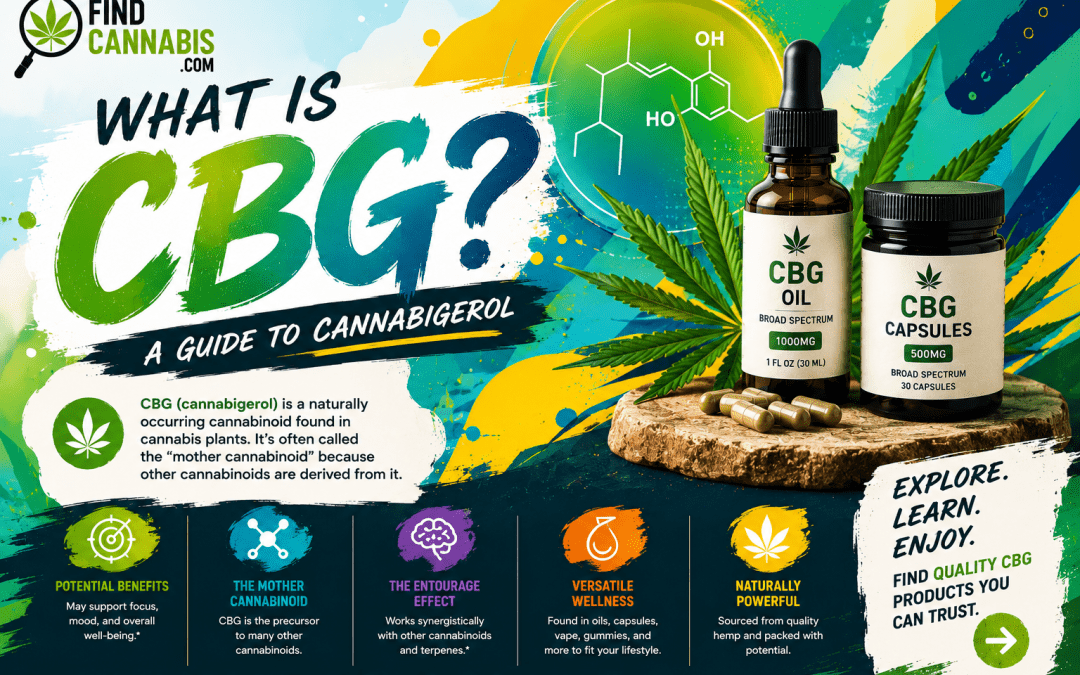
CBG, or cannabigerol, is a non-psychoactive cannabinoid found in cannabis. It comes from CBGA, the precursor molecule that also gives rise to THC, CBD, and CBC.
Does CBG get you high?
No. CBG does not get you high. It interacts with cannabinoid receptors differently than THC and does not produce intoxicating effects.
How is CBG different from CBD?
CBG binds more directly to CB1 and CB2 receptors and may also affect alpha-2 adrenoceptors and GABA signaling. CBD works mostly through indirect pathways such as FAAH inhibition and serotonin receptor activity.
What does CBG feel like?
CBG is commonly described as clear-headed, mildly energizing, calming without heavy sedation, and functionally focused. Most users describe it as subtle rather than intoxicating.
Why is CBG so rare?
CBG is rare because cannabis plants convert most CBGA into other cannabinoids like THCA, CBDA, and CBCA as the plant matures. By harvest time, most cannabis plants contain less than 1% CBG.
Can CBG fight drug-resistant bacteria?
Preclinical research has found that CBG showed activity against MRSA in lab and animal models. That finding is promising, but CBG is not yet a proven antibiotic treatment in humans.
What is a typical CBG dosage?
There are no official CBG dosage guidelines. Many consumers start with 5–15mg per day, with moderate use around 15–30mg and higher use around 30–50mg.
Can CBG make you fail a drug test?
CBG itself is not usually what drug tests screen for. However, full-spectrum CBG products may contain trace THC, which can create a low but possible drug testing risk with regular use.