
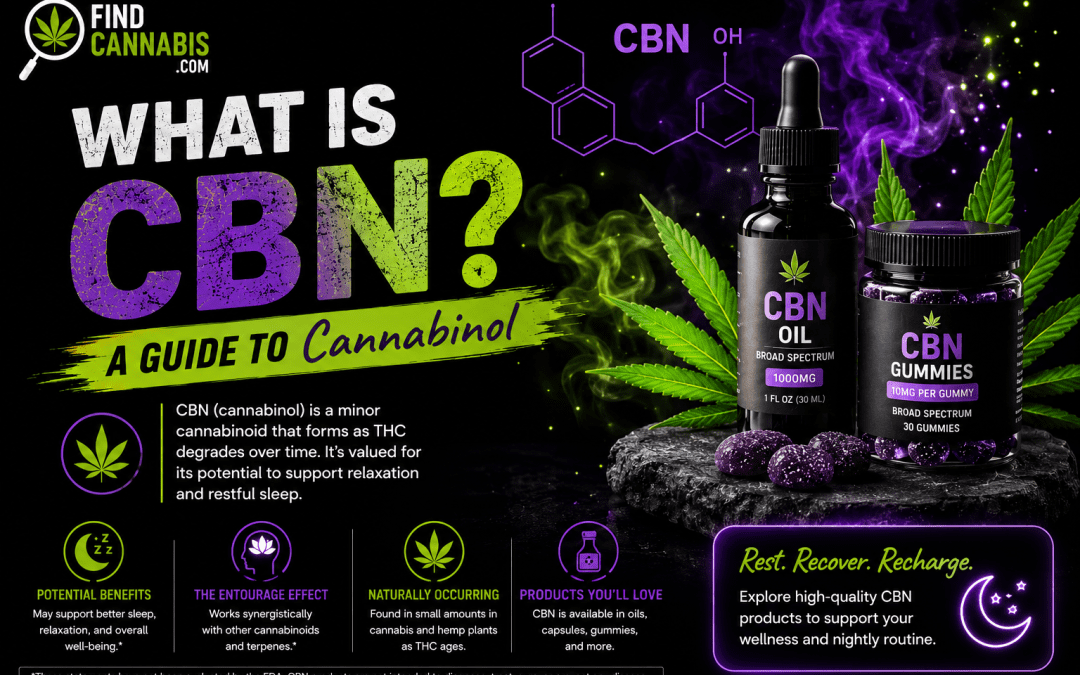
The CBN Sleep Industry Is Built on a Five-Subject Study From 1975
The entire CBN sleep industry — hundreds of millions in product sales, dispensary shelves stacked with sleep gummies, tinctures, and capsules — traces back primarily to a 1975 study with five subjects. Five people. CBN tested alongside THC, not alone. The study’s own authors noted the sedation might be mostly THC’s doing. That’s the foundation. Everything that follows is worth understanding with that context in mind.
What CBN Actually Is
CBN (cannabinol) is the only major cannabinoid whose primary commercial source is not direct plant biosynthesis but the oxidative degradation of THC.
When THC is exposed to heat, UV light, oxygen, or extended time, it degrades through a well-characterized chemical pathway — and CBN is the primary product. This is why cannabis that’s been poorly stored or left aging develops higher CBN content. The THC is converting. Freshly harvested, properly cured cannabis contains less than 1% CBN by dry weight.
The structural relationship matters pharmacologically. Cannabinol retains THC’s tricyclic terpenoid structure but with a fully aromatic A-ring — the chemical signature of oxidation. That structural difference reduces CBN’s CB1 receptor binding affinity to approximately one-tenth of THC’s, which is the primary reason CBN produces dramatically less psychoactivity than its precursor.
The implication most consumers don’t know: the premium-priced cannabinol in wellness shop sleep gummies is chemically identical to the compound forming in cannabis that got left in a hot car. What experienced smokers call “degraded weed” and what wellness brands charge a premium for are the same thing.
The 2021 Study the CBN Industry Prefers You Don’t Read
Bhagavan et al. (2021), published in the Journal of Sleep Research, is the most methodologically rigorous CBN sleep research available. It examined CBN alone, CBD alone, and CBN + CBD in combination on sleep outcomes in adults with mild to moderate sleep disturbance.
The findings are the most important thing to understand about CBN:
CBN alone produced no statistically significant improvement in any measured sleep parameter compared to placebo. CBD alone produced modest improvements. CBN + CBD in combination produced the most significant improvements — more than either compound alone.
The CBN industry has not prominently featured this study, and the reason is obvious. It demonstrates that products sold as “CBN sleep support” work primarily because of the CBD they’re combined with, with CBN playing a supporting and synergistic role rather than the starring one implied by the marketing.
This isn’t a reason to dismiss CBN. It’s a reason to understand what you’re actually buying — and why combination products consistently outperform the single-cannabinoid positioning on most CBN labels.
Why CBN Products Work Despite the Clinical Gap
If CBN alone doesn’t significantly improve sleep in clinical trials, why do so many consumers report genuine benefit?
Three things are working simultaneously. First, the products aren’t really CBN alone. Most commercial CBN products contain CBN alongside CBD and, in full-spectrum formulations, trace THC and other cannabinoids. The consistent consumer experience reflects the combination — which the 2021 study confirmed is meaningfully more effective than either compound alone.
Second, CBN’s receptor mechanisms are real even where their clinical translation in isolation is limited. CBN is a partial CB1 agonist with approximately 10-fold lower binding affinity than THC — producing partial activation in hypothalamic and basal forebrain regions involved in sleep-wake regulation. More distinctively, CBN activates large-conductance calcium-activated potassium (BKCa) channels, producing neuronal hyperpolarization through a mechanism distinct from CB1 agonism. BKCa activation contributes to sedation and anxiolysis in ways that standard cannabinoid receptor pharmacology doesn’t capture.
Third, CBD’s mechanisms complement CBN’s specifically. CBD’s FAAH inhibition increases anandamide at CB1 receptors, potentially enhancing CBN’s CB1-mediated effects. CBD’s 5-HT1A anxiolytic activity addresses the anxiety component of sleep disruption that CBN’s mechanisms don’t primarily target. The combination works through multiple pathways simultaneously — which is exactly why it outperforms either compound alone.
Cannabis dispensary staff who work with sleep-focused customers consistently describe multi-cannabinoid CBN products as among the most re-purchased items in their sleep category. Repeat purchase behavior is a meaningful signal — it’s consistent with genuine efficacy rather than first-night placebo response.
What the CBN Market Is Actually Selling You
Here’s the perspective the CBN industry won’t put on its packaging: most CBN sleep products are primarily CBD sleep products with CBN added.
The typical formulation — 2-5mg CBN alongside 25-30mg CBD — reflects what the Bhagavan data actually supports. CBD provides the primary sleep-supportive foundation; CBN contributes complementary sedating mechanisms that enhance the combination. In most products, the CBN dose is low. The CBD dose is doing significant work.
For consumers, this means the premium you’re paying for CBN is for genuine combination value — not for CBN doing what the label implies on its own. Try CBN isolate and find it ineffective? You’ve replicated exactly what the 2021 study found. The effective version is the combination.
For product selection, the CBN:CBD ratio matters more than most reviews acknowledge. Products with very low CBN relative to CBD are essentially CBD sleep products with a CBN marketing angle. Products with more balanced ratios — where CBN is present at doses where its BKCa and CB1 mechanisms are pharmacologically meaningful — are more likely to produce the combination dynamic the research supports.
The industry isn’t lying about CBN working. It’s being imprecise about why.
What the Sleep Narrative Buries
CBN has legitimate research outside sleep that gets almost no attention because sleep marketing dominates the conversation.
Pain is the most developed non-sleep application. Wong and Cairns (2019) found CBN reduced mechanical sensitization in a rat myofascial pain model through TRPV2 receptor activity and endocannabinoid modulation — a mechanism distinct from CBD’s primary pain pathways, making CBN a potential complement for pain management at different receptor targets. For people using cannabis for both sleep and pain, the overlap in CBN’s mechanisms is relevant.
Beyond pain: CBN has shown MRSA antibacterial activity in preclinical research (earlier stage than CBG’s more developed MRSA literature, but part of the same pattern); Weydt et al. (2005) found CBN delayed ALS symptom onset in mouse models, generating sustained neuroprotective research interest; CBN stimulates appetite through CB1 hypothalamic mechanisms without THC’s robust psychoactivity; and preclinical research has identified potential bone marrow stromal cell stimulation relevant to osteoporosis research.
None of these applications are as developed as the sleep category. All of them suggest a cannabinoid with meaningful pharmacology that the sleep marketing has largely crowded out.
What CBN Actually Feels Like
CBN effects are real and distinct from CBD. The subjective experience consistent users describe: sedation and physical heaviness as the dominant effect at typical doses — noticeably different from CBD’s more neutral profile — mild appetite stimulation more pronounced than with CBD, and in sensitive individuals at higher doses, perceptible mild psychoactivity that can surprise users expecting a fully non-intoxicating experience.
That mild psychoactivity classification is pharmacologically accurate and meaningfully distinct from CBD and CBG. Cannabis clinical educators who work with cannabinoid-naive patients describe cannabinol as the minor cannabinoid most likely to produce unexpected mild psychoactive effects in sensitive individuals — worth knowing before a first-time user takes a high-dose product without context.
What CBN effects are not: a meaningful high, significant cognitive alteration, or anything approaching THC’s intensity at normal product doses.
CBN vs CBD — The Comparison That Actually Matters
| CBN | CBD | |
|---|---|---|
| Origin | THC oxidative degradation | Direct biosynthesis |
| Psychoactive | Mildly (partial CB1 agonism) | No |
| Primary mechanism | CB1/CB2 partial agonism, BKCa activation, TRPV2 | FAAH inhibition, 5-HT1A, CB2 |
| Sleep (isolated) | Not clinically demonstrated | Modest improvement |
| Sleep (combined) | Significantly more effective | Significantly more effective |
| Appetite | Stimulating | Neutral to suppressing |
| Drug test risk | Low-moderate | Low (isolate) |
| Research maturity | Limited human data | More extensive human data |
The practical takeaway: CBN and CBD are complementary, not competitive. The Bhagavan combination data makes the strongest argument for using both — CBD during the day for anxiety and general wellness, CBN + CBD at night for sleep.
CBN vs THC
| CBN | THC | |
|---|---|---|
| CB1 binding affinity | ~10-fold lower | High |
| Psychoactive | Mildly | Strongly |
| Sedating | Yes | Yes (dose dependent) |
| Legal status | Federally legal (hemp-derived) | Federally controlled |
| Drug test risk | Moderate | High |
| Appetite | Moderate stimulation | Strong stimulation |
The Drug Test Risk Nobody Mentions
The CBN drug test concern is the most consistently omitted piece of information in CBN product marketing — and it matters.
Standard immunoassay urine tests screen for THC-COOH. CBN is metabolized through partially overlapping hepatic pathways, producing metabolites that can cross-react with THC-COOH antibodies in some immunoassay formats — a risk that doesn’t apply to CBD isolate. Forensic toxicologists who work with cannabis drug testing describe cannabinol as the minor cannabinoid most likely to produce unexpected immunoassay interference among those marketed as non-psychoactive.
The risk is lower than THC but meaningfully higher than CBD isolate — a distinction absent from virtually all CBN product labeling. Full-spectrum CBN products add the standard trace THC drug test concern on top.
If you’re regularly tested: choose verified THC-free hemp-derived CBN isolate products, understand the uncertainty exceeds CBD isolate, and make this decision before committing to a nightly routine.
Products Worth Buying
CBDistillery CBN + CBD Gummies (~$45-55 / 30 count | 2mg CBN + 30mg CBD)
The formulation ratio reflects what Bhagavan et al. actually supports — CBD providing the primary sleep foundation with CBN adding complementary sedating mechanisms. For a product built around the evidence rather than the marketing narrative, this combination ratio is appropriate.
Best for: CBN for sleep, first-time CBN users, evidence-aligned combination approach
Medterra CBN + CBD Sleep Tight Capsules (~$40-55 / 30 count)
Higher CBN dosage for consumers whose sleep disturbance needs more than entry-level products provide. Capsule format delivers consistent dosing without edible bioavailability variability.
Best for: More significant sleep disturbance, higher CBN dosage requirements
Charlotte’s Web CBN Sleep Tincture (~$50-70)
Full-spectrum formulation — CBN, CBD, and sleep-relevant terpenes including myrcene and linalool — with sublingual delivery producing 15-30 minute onset vs. 60-90 minutes for edibles. Relevant for consumers who want predictable timing relative to sleep.
Best for: Tincture preference, faster onset, complete terpene matrix
Social CBD CBN Gummies (~$25-35 / 30 count)
Quality-verified hemp-derived CBN at prices that support a genuine 2-week trial period — the minimum needed to assess individual response. Good third-party testing transparency for a budget-positioned product.
Best for: First-time CBN consumers, budget-conscious assessment of personal response
Wyld CBN + CBD Sleep Gummies (~$40-50 / 20 count)
Full-spectrum hemp extract including cannabinol alongside real fruit — the complete minor cannabinoid and terpene matrix for maximum entourage effect. Higher trace THC content than isolate products, relevant for drug-tested consumers but potentially beneficial for sleep efficacy.
Best for: Full-spectrum entourage approach, complete cannabinoid profile, flavor quality
CBN Dosage and Legal Status
Dosage (no official guidelines; based on Bhagavan et al. data and consumer experience):
- Starting: 2-5mg CBN + 10-25mg CBD
- Moderate: 5-10mg CBN + 25-40mg CBD
- Higher: 10-20mg CBN + 40-50mg CBD
Tinctures: 15-30 minutes before sleep. Edibles and capsules: 45-60 minutes before sleep. Give consistent use at least two weeks before evaluating — cannabinoid accumulation means early responses underrepresent eventual steady-state effects.
Legal status: Hemp-derived CBN from cannabis with less than 0.3% delta-9 THC is federally legal under the 2018 Farm Bill. Cannabis-derived CBN follows state regulations.
The Thought Worth Sitting With
The 2021 Bhagavan finding — that CBN alone doesn’t significantly improve sleep but CBN combined with CBD does — is actually more interesting than the original sleep narrative it undermined.
It suggests the future of cannabinoid wellness isn’t single-compound products but rationally formulated combinations where each cannabinoid addresses a specific mechanism the others don’t reach. CBN’s BKCa potassium channel activation. CBD’s 5-HT1A anxiolytic activity. THC’s robust CB1 agonism. These are complementary mechanisms addressing sleep through different pathways simultaneously.
The CBN market built itself on a shaky foundation. The more solid one — combination pharmacology grounded in mechanism rather than a five-subject study from 1975 — is what the next generation of cannabinoid sleep products will be built on.
CBN won’t be the star of that story. But it’ll be an important part of it, doing what the 2021 data says it does best.
Working better with others than it does alone. 🌿😴
Find dispensaries with CBN products near you at FindCannabis.com.