
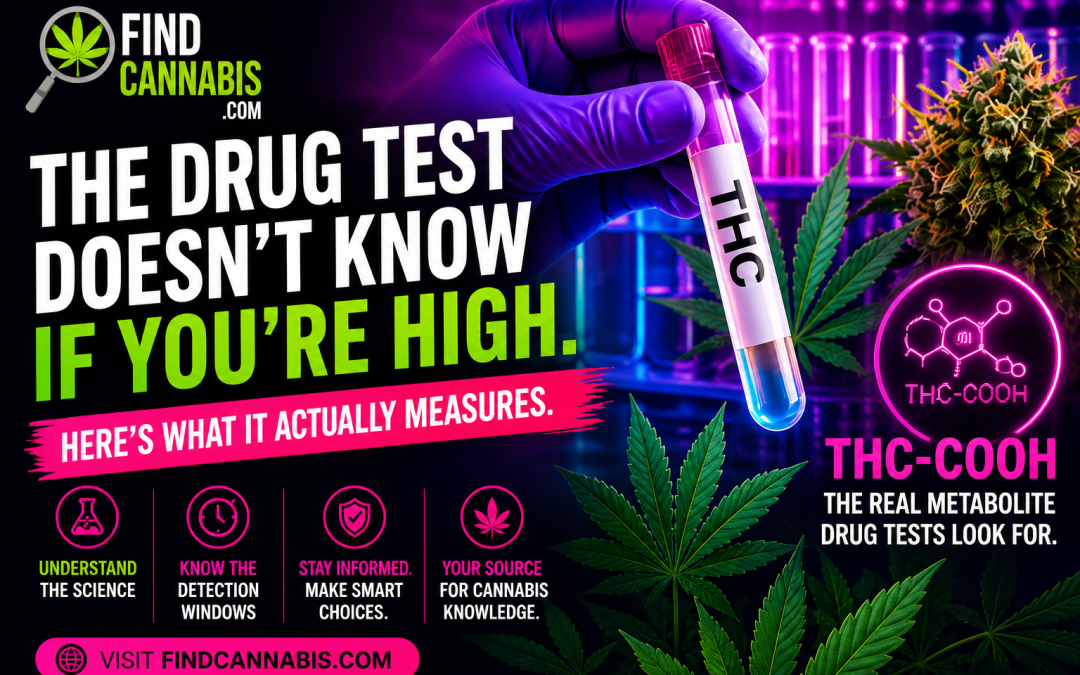
Here’s something that should be more widely known: a standard workplace urine drug test cannot tell whether you’re impaired. It can’t tell whether you were impaired yesterday, last week, or at any specific point in time. What it detects is a non-psychoactive metabolite called THC-COOH — a compound your liver produces when it breaks down THC — that has no psychoactive effect and can linger in your body for weeks or months after your last use.
You can fail a drug test completely sober. You can test positive while your last cannabis experience is weeks behind you and your cognitive performance is perfectly intact. This isn’t a loophole or an edge case — it’s how urine testing works, by design, and it’s been the American workplace standard since the Reagan administration.
That context matters — not just for policy debates, but for understanding what you’re actually dealing with when you ask how long weed stays in your system. The answer depends entirely on which test is being used, what it measures, and what it’s actually capable of detecting. Those are three different questions, and most articles on cannabis detection windows skip the first two entirely.
What “In Your System” Actually Means
The phrase is doing a lot of heavy lifting here, and it conflates things that are genuinely different.
Active THC — the compound responsible for the high — clears from your bloodstream within hours of smoking. For an occasional user, blood THC levels typically drop below standard detection thresholds within 3 to 4 hours of inhalation. The psychoactive experience is over. Any impairment has passed.
What sticks around much longer is THC-COOH. Fat-soluble by nature, it doesn’t exit your body on a clean linear timeline the way alcohol does. Instead, it parks in fat cells and seeps back into the bloodstream gradually — a slow-release process that takes days for occasional users and weeks or months for heavy, long-term consumers whose fat tissue has been accumulating metabolites over time.
This is the biological reality behind every detection window estimate you’ll find. When someone says weed stays in your system for 30 days, they mean a non-psychoactive byproduct is still measurable in urine 30 days after your last use — not that you were high for 30 days, not that you were impaired for 30 days. Just that the chemical fingerprint of past consumption is still present. That distinction is why cannabis drug testing is increasingly contested among toxicologists, employment attorneys, and state legislatures alike.
The Numbers You Actually Need
With that foundation in place, here’s how detection windows break down across the four main test types:
| Test Type | Occasional User | Moderate User | Heavy Daily User |
|---|---|---|---|
| Urine | 3-4 days | 5-7 days | 10-30+ days |
| Blood | 3-4 hours | 12-24 hours | Up to 7 days |
| Saliva | 24-72 hours | 1-3 days | 1-7 days |
| Hair | Up to 90 days | Up to 90 days | Up to 90 days |
These are population-level estimates drawn from peer-reviewed research — primarily studies in Drug and Alcohol Dependence, Therapeutic Drug Monitoring, and the Journal of Analytical Toxicology. Use them as a framework, not a personal forecast.
A 2017 study in Drug and Alcohol Dependence illustrates exactly why: researchers followed daily users through complete abstinence and found significant spread even within the same use category. Some participants cleared the standard 50 ng/mL urine threshold within two weeks. One outlier remained positive at day 48. Same general use pattern, very different biology. No table can fully account for that.
The Test You’re Facing Changes Everything
Urine — What Most Employers Use
Urine testing has been the default in American workplace drug screening since Reagan’s 1986 Executive Order mandating drug-free federal workplaces. The 50 ng/mL cut-off wasn’t derived from impairment science — it was a practical compromise designed to reduce false positives while catching regular users. There is no impairment research behind that number.
Detection windows by use frequency:
- Occasional user (once or twice weekly or less): 3-4 days
- Moderate user (several times weekly): 5-7 days
- Daily user: 10-30 days
- Chronic heavy user (multiple times daily for months): 45-90 days in documented cases
That upper bound is real. It requires sustained heavy use and a specific body composition to reach, but it isn’t an exaggeration — and if you’re in that category, plan accordingly.
One thing worth knowing about the confirmation process: a presumptive positive on an initial immunoassay screen gets confirmed by GC-MS testing at 15 ng/mL, a meaningfully lower threshold. Home test kits use the 50 ng/mL cut-off. If you’re getting borderline readings at home in the days before a formal lab test, you’re not necessarily in the clear.
Blood — The Closest Proxy for Impairment, Still Imperfect
Blood tests detect active THC, making them theoretically more relevant to current intoxication. In practice, the relationship between blood THC concentration and actual impairment is surprisingly weak — a point with significant legal implications that we’ll come back to.
Occasional users clear detectable blood THC within 3-4 hours of smoking. Heavy daily users can show positive blood results for up to 7 days after their last use, because stored THC in fat tissue continuously re-enters circulation. Practically speaking, you’ll rarely encounter blood testing in routine employment contexts — it’s invasive and logistically cumbersome, reserved mainly for DUI investigations, post-accident workplace testing, and some clinical settings.
Saliva — The Roadside Option That’s Becoming Harder to Avoid
Oral fluid testing detects THC itself rather than a stored metabolite, making it more temporally honest than urine testing. Detection windows are shorter — 24-72 hours for occasional users, up to 7 days for heavy daily users — and the samples are harder to adulterate, which is why law enforcement has adopted saliva testing for roadside screening in a growing number of states.
Worth knowing: smoking or vaping deposits THC directly into oral tissue, temporarily spiking saliva concentrations to high levels right after use before dropping sharply. Edibles produce lower initial oral concentrations. If you’re facing a roadside saliva test shortly after smoking, the reading can look alarming even as your systemic THC levels are already falling.
Hair — The 90-Day Window That Isn’t What It Sounds Like
Hair follicle testing is the most misrepresented method in common use. Yes, it can detect metabolite presence up to 90 days back. What that framing consistently leaves out is almost as important.
Hair testing is genuinely poor at catching occasional use. A 2015 study in Drug Testing and Analysis found that single or low-frequency consumption often doesn’t produce sufficient metabolite deposition in the hair shaft to trigger a positive. These tests are calibrated to find regular consumers — whether or not that’s how employers describe them to their workforce.
There’s also a documented equity problem. Dark hair retains THC metabolites at significantly higher concentrations than lighter hair at equivalent systemic exposure — a finding published in Forensic Science International that toxicologists have acknowledged and that is beginning to surface in legal challenges to hair testing programs. External contamination adds another layer of complexity: cannabis smoke can deposit THC onto hair in concentrations sufficient to trigger positives even after standard lab washing procedures, as the same 2015 study demonstrated. Labs have improved since then, but contamination remains a recognized confounder in the scientific literature.
And if you’re thinking about shaving your head — labs will collect body hair instead, which grows more slowly and can push the detection window beyond 90 days.
The Variables That Actually Move Your Number
Frequency and accumulated dose — The dominant variable, and it’s not close. Every session adds to the pool of metabolites stored in fat tissue. Occasional users haven’t built that reservoir. Chronic users have spent months filling it, and clearance scales accordingly in a relationship that isn’t linear.
Potency — Legal market average THC concentration climbed from roughly 12% in 2012 to over 20% in many state markets today, with concentrates routinely testing at 70-90%. Most detection window research was conducted when average THC content was far lower. Heavy concentrate users are operating in territory the published literature didn’t anticipate — assume the upper end of the window applies.
Body fat percentage — More fat means more metabolite storage and slower clearance. A 2012 study in Addiction documented measurably longer persistence in higher-body-fat participants versus leaner individuals with equivalent use patterns. It’s simple biology, not a judgment.
CYP2C9 genetics — The enzyme most responsible for metabolizing THC is encoded by a gene with well-documented polymorphisms. Some people metabolize THC significantly faster than others at a purely genetic level, which explains clearance variation that can’t be accounted for by use pattern or body composition alone.
Exercise timing — Regular cardio accelerates clearance by burning fat stores over time, but a 2013 study in Drug and Alcohol Dependence documented a statistically significant spike in blood THC-COOH following moderate exercise in regular users. The counterintuitive takeaway: exercise consistently over time, but stop 48 hours before a test. Going for a hard run the morning of your drug test is genuinely counterproductive.
What the Detox Industry Counts On You Not Knowing
The cannabis detox product market is large, almost entirely unregulated, and broadly ineffective at doing what the label claims.
Detox drinks work — when they work at all — by diluting urine and adding compounds like creatinine and B vitamins to make that diluted urine look less diluted to validity testing. They don’t remove metabolites. They attempt to mask the attempt to remove them. Modern lab testing includes specific validity checks for creatinine concentration, specific gravity, and pH, and the margin for successfully fooling those checks has narrowed considerably as protocols have improved.
Niacin flushing is a persistent myth. It doesn’t accelerate THC clearance, and at the doses people typically take for this purpose, it causes genuine harm. Sweating it out — saunas, aggressive cardio right before a test — is equally ineffective. The excretion pathway for THC metabolites is primarily fecal and urinary; sweat accounts for a trace amount that won’t move your timeline.
The interventions with actual evidence behind them: time, consistent hydration, cardiovascular exercise over time, and dietary fiber to support fecal excretion. None of them are exciting. None of them come in a bottle with a money-back guarantee.
A Testing System Built for a Different Era
Here’s the part that rarely makes it into these articles: the entire infrastructure of cannabis drug testing in the United States was constructed during a period when THC pharmacology was poorly understood, cannabis was uniformly illegal, and the political goal was deterrence — not impairment detection.
The 50 ng/mL urine threshold was set in the 1980s. The 5 ng/mL blood DUI limit adopted by most states was modeled on alcohol BAC limits — not on cannabis impairment research, because that research didn’t exist robustly when the laws were written and still doesn’t support that specific number today. The National Highway Traffic Safety Administration has acknowledged in its own published work that no reliable blood THC concentration has been established as a universal impairment threshold for driving. Several states, including Vermont, declined to establish per se blood THC limits for exactly this reason.
What a positive cannabis drug test actually tells you: that someone used cannabis within a detection window. That’s it. Nothing about when, nothing about impairment, nothing about whether performance or safety was affected in any meaningful way. Courts are increasingly aware of this. Employers in states with consumer protection laws are being forced to reckon with it. The science hasn’t changed — the political and legal willingness to act on it has.
If a Test Is Coming
Stop consuming immediately — the clock starts when you actually stop, not when you start thinking about stopping.
Hydrate consistently over days and weeks, not just the night before. Buy home urine test kits at the pharmacy — same 50 ng/mL threshold as standard employment screening — and track your actual progress every couple of days rather than guessing. Exercise regularly, but taper off 48 hours before the test.
Find out your cut-off level. Being tested at 50 ng/mL and being tested at 15 ng/mL are meaningfully different situations, and the answer is usually in your employer’s drug testing policy documentation if you know where to look.
Know your state’s protections. California, Colorado, Illinois, New Jersey, New York, Nevada, Montana, and a growing list of others have enacted employment protections for cannabis consumers — though scope varies significantly and is still being tested in courts. Federal employment and DOT-regulated roles remain unprotected regardless of what your state says.
Where This Is All Headed
Thirty-five years after that urine threshold was established, we’re still using the same basic testing infrastructure to make employment decisions about a substance that is now legal for adult use in the majority of U.S. states — and that the DOJ formally reclassified to Schedule III in April 2026.
The pharmacological question — how long does weed stay in your system — has a reasonably well-understood answer. The policy question of whether that information should determine someone’s employment, their custody arrangement, or their freedom is a different matter entirely, and it’s moving faster than most people realize.
The tests haven’t caught up with the science. The laws are starting to.
Find dispensaries near you at FindCannabis.com — search by city, see hours, and get directions.