Your body produces its own cannabinoids. The runner’s high — attributed to endorphins for decades — is now understood to be primarily driven by anandamide, your endocannabinoid system’s own signaling molecule. Which means your body already knows how to microdose itself. Low-dose cannabis works, in part, by helping that system do what it’s already trying to do. That’s a different thing than getting high. It’s worth understanding the distinction.
Why More THC Doesn’t Mean More Benefit
The most important concept in cannabis pharmacology that most consumers have never heard of is the biphasic dose-response relationship — and it’s the pharmacological reason a 2012 clinical trial found that cancer patients given the lowest dose of cannabis reported greater pain relief than patients given higher doses. Not slightly more. Meaningfully more.
At low doses, THC produces anxiolytic, mood-elevating, mildly stimulating, and focus-enhancing effects through partial agonism at CB1 receptors — concentrations that modulate signaling without saturating receptors. Push the dose higher and the picture shifts categorically: CB1 saturation produces sedation, cognitive impairment, and in predisposed individuals, anxiety and paranoia through prefrontal cortical disruption and amygdala hyperactivation.
Increasing THC past a certain individual threshold doesn’t give you more of the same effects. It gives you different effects — many of which are therapeutically counterproductive. The curve doesn’t just flatten. It inverts.
Cannabis physicians who’ve practiced since the pre-recreational medical era describe the biphasic relationship as the most clinically important and most consistently misunderstood feature of cannabinoid pharmacology. Most recreational consumers have never encountered it, which explains a significant proportion of negative cannabis experiences — and a significant proportion of people who conclude the plant simply isn’t for them.
What a Cannabis Microdose Actually Is
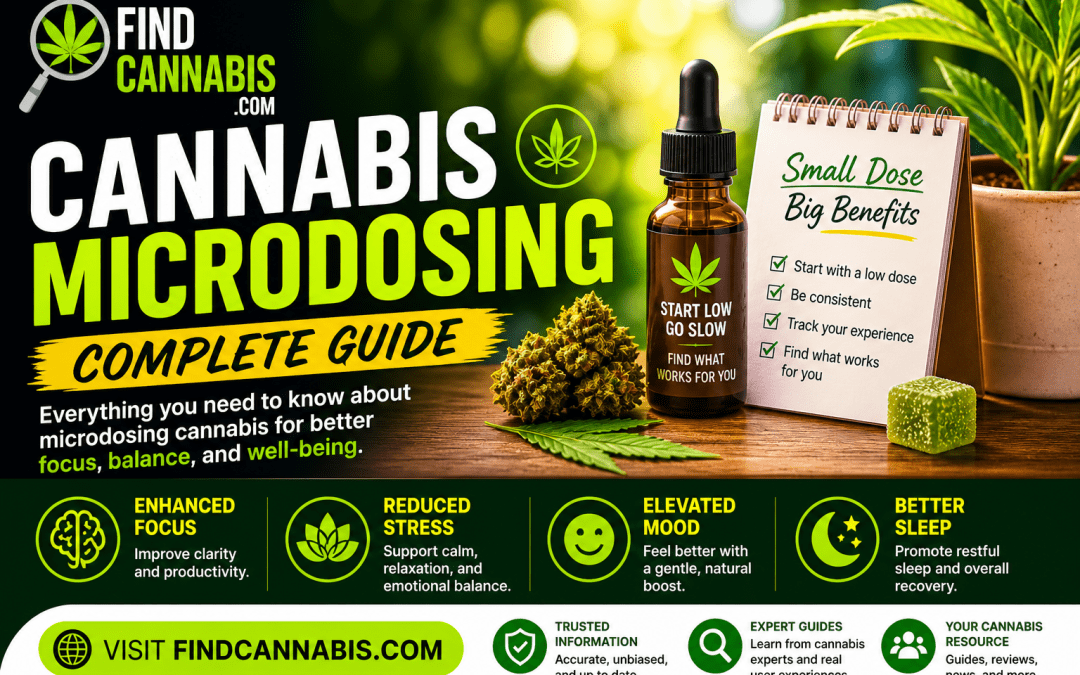
Clinically, microdosing cannabis means consuming THC below the threshold of subjective intoxication — typically 1-5mg per dose, compared to the 10-30mg that characterizes typical recreational use.
At those levels, plasma THC concentrations are estimated at 1-3 ng/mL — well below the 5-10 ng/mL associated with measurable cognitive impairment. THC acts as a low-efficacy partial agonist at CB1 receptors, producing signal modulation that more closely resembles endocannabinoid tone enhancement than the exogenous agonism of recreational doses. The goal isn’t an experience. It’s a physiological outcome: subtle modulation of mood, cognition, pain signaling, or anxiety while preserving full functional capacity.
That’s not a marketing claim. It’s a pharmacological consequence of staying below the intoxication threshold.
Your Body Already Does This
The endocannabinoid system maintains homeostasis across multiple physiological processes using internally produced cannabinoids — primarily anandamide and 2-AG. During sustained aerobic exercise, anandamide release produces the flow state we’ve called the runner’s high for decades. Your body microdoses itself on a long run. Low-dose THC interacts with that same system.
At microdose levels, THC appears to inhibit fatty acid amide hydrolase (FAAH) — the enzyme responsible for breaking down anandamide — effectively increasing endogenous anandamide concentrations rather than flooding the system with external agonist. This “boost rather than flood” mechanism likely explains why a cannabis microdose feels qualitatively different from recreational use. It isn’t a smaller version of being high. It’s a different pharmacological event.
Neurologist Ethan Russo has proposed that certain chronic conditions — fibromyalgia, migraine, IBS — may involve clinical endocannabinoid deficiency (CECD): insufficient endocannabinoid tone as a contributing pathological mechanism. If accurate, low-dose cannabis may be correcting a physiological deficit rather than producing a recreational effect. The CECD hypothesis remains incompletely validated, but the circumstantial clinical support is substantial enough to take seriously.
What the Wellness Industry Gets Wrong
Here’s the contrarian perspective that rarely appears in microdosing content, including content produced by companies selling microdose products: microdosing cannabis won’t work for everyone, and for a specific subset of people it won’t work at all without a significant prerequisite step.
CB1 receptor downregulation from chronic high-dose THC use is well-documented in the neuroscience literature. Regular heavy use produces measurable reductions in CB1 receptor density and sensitivity — a tolerance mechanism that takes approximately 2-4 weeks of abstinence to substantially reverse. Heavy users who attempt microdosing without a prior tolerance break are titrating against a downregulated receptor system. The doses that produce therapeutic effects in a cannabis-naive individual produce nothing — not because the pharmacology doesn’t work, but because the receptor system has adapted to expect much higher stimulation.
These individuals frequently conclude that microdosing doesn’t work for them. Some are right that it didn’t work. None are right about why. Their MED isn’t 2.5mg — it’s 2.5mg plus a four-week tolerance break first.
The microdose product market has limited commercial incentive to foreground this prominently. It’s worth knowing before you spend money on precision-dosed mints and wonder why nothing’s happening.
The Genetics Nobody Mentions
Almost universally absent from microdosing content is CYP2C9 metabolism — and it explains more inter-individual variation than most people realize.
THC is primarily metabolized by CYP2C9 into 11-OH-THC, an active metabolite with greater CB1 receptor affinity than THC itself. CYP2C9 poor metabolizers — estimated at 8-13% of European populations, with varying frequencies in other groups — produce higher plasma concentrations of 11-OH-THC per unit THC dose. For these individuals, a 2mg microdose doesn’t produce the concentration profile of a 2mg dose. It produces something meaningfully higher.
This accounts for the population who find microdosing cannabis more potent than expected and have been implicitly told they’re being dramatic about a 2.5mg mint. They’re not. Their pharmacogenetics are different, and their MED is likely below 1mg. If very low doses feel stronger than expected, start at 0.5mg and titrate more gradually than the standard protocol suggests.
The Numbers
| Route | Onset | Duration | Precision |
|---|---|---|---|
| Sublingual tincture | 15-45 min | 4-6 hours | High |
| Oral edible | 30-90 min | 6-8 hours | Moderate |
| Inhalation | 2-5 min | 2-3 hours | Lower |
Most people find their cannabis microdose sweet spot between 1-5mg THC. Sensitive individuals or CYP2C9 poor metabolizers may find benefit below 1mg. Heavy users starting after a tolerance break should expect to begin at 3-5mg before finding their actual floor as receptor sensitivity recovers.
Finding Your Dose
Week 1 — Start Lower Than You Think You Should
Begin at 1mg THC. For individuals with anxiety disorders, THC sensitivity, or no prior cannabis experience, start with CBD alone at 5-25mg — the anxiolytic evidence base is more robust and less variable than for THC, with no intoxication risk.
Same time daily. Morning works best for most therapeutic goals — it establishes a plasma concentration baseline during peak activity hours. Hold the dose for 3-5 days before adjusting anything. You’re looking for subtle mood elevation, reduced anxiety, improved focus, mild analgesia — without any subjective intoxication.
Week 2 — Adjust on Evidence, Not Impatience
No effect at 1mg: move to 2mg. Subtle positive effects: hold for another week. Mild impairment: drop to 0.5mg. Individual CB1 receptor density, FAAH activity, and CYP2C9 metabolic rate produce enough variation that 0.5mg increments are meaningful, not excessive.
The 90-Minute Rule
Oral THC follows a sigmoidal absorption curve with peak plasma concentrations at 1-3 hours post-ingestion. Redosing at 45 minutes because nothing seems to be happening is pharmacokinetically equivalent to doubling the dose — with both arriving simultaneously. This is the single most common way a 2.5mg intention becomes a 10mg afternoon. Treat it as a hard constraint, not a guideline.
Week 3 Onward
Most people land between 1-5mg. Adjust in 0.5-1mg increments and keep a simple log — dose, timing, observed effects. Without tracking, you’re not running a calibration protocol. You’re just taking something occasionally and hoping.
Products Worth Using
Level Protabs ~$20-30 per pack | 2.5mg, 5mg, 10mg options | levelblends.com
Fast-dissolving tablet format produces more consistent sublingual absorption than oil-based edibles, reducing the bioavailability variability that undermines precise microdose practice. Formulation-specific cannabinoid and terpene combinations — Relax, Calm, Focus, Bliss — reflect genuine engagement with entourage effect pharmacology rather than marketing differentiation.
Best for: Precision microdosing, daytime functional use, targeted formulations
Kiva’s Petra Mints ~$20-25 per tin | 2.5mg THC per mint | kivaconfections.com
High batch-to-batch reliability at a clinically sensible entry-point dose. The 2.5mg format sits above the sub-perceptual threshold for most individuals while staying in the therapeutic range. Socially invisible, discreet, and consistent — which matters more for daytime use than most product descriptions acknowledge.
Best for: Discreet consistent dosing, social contexts, 2.5mg entry-point
Charlotte’s Web Daily Wellness Gummies ~$30-40 for 30 count | 10mg CBD per gummy | charlottesweb.com
10mg CBD sits within the range associated with anxiolytic effects in daily maintenance protocols. Manufacturing consistency and third-party testing make Charlotte’s Web a pharmacologically reliable choice in a category where quality varies substantially and label accuracy isn’t always guaranteed.
Best for: THC-free daily microdosing, anxiety management, beginners
Dosist Calm Tincture ~$30-50 | Precisely measured low doses | dosist.com
Calibrated droppers that reliably deliver 1mg increments address the core precision challenge of low-dose cannabis practice. At 1-2mg THC, a 0.5mg measurement error represents a 25-50% dose variance — large enough to determine whether you land in the therapeutic window or miss it entirely.
Best for: 1mg precision dosing, dose-sensitive individuals, CYP2C9 slow metabolizers
PAX Era Pro Device ~$49, pods ~$25-45 | paxvapor.com
Dose-locking introduces reproducibility to inhalation-based microdosing that standard vaporizers don’t offer. Inhalation remains the most challenging route for precision — puff volume, breath-hold duration, and pulmonary absorption all introduce variability — but the Era Pro meaningfully narrows that variance.
Best for: Fast-acting microdosing, experienced inhalation-preferring users
Caliper CBD Dissolve Packets ~$30-40 | 20mg CBD per packet | trycaliper.com
Oil-based CBD bioavailability runs 6-19% in the literature, with substantial inter-individual variation. Water-soluble nanoemulsion formulations achieve higher and more consistent absorption — a meaningful difference at low doses where taking more to compensate for poor bioavailability defeats the purpose.
Best for: Consistent CBD absorption, morning routine integration
Matching Protocol to Goal
Focus and Cognitive Performance
Low-dose THC’s attention-enhancing effects likely involve CB1-mediated dopaminergic modulation in the prefrontal cortex. Protocol: 2.5mg THC with 10-25mg CBD, sativa-dominant terpene profile with α-pinene and limonene, 30-45 minutes before cognitive work.
Anxiety
CBD (25-50mg) as the primary daily intervention — more robust anxiolytic evidence base, lower inter-individual variability than THC. Optional 1-2.5mg THC on elevated-anxiety days. Terpene priorities: linalool, caryophyllene. Dose discipline is critical here: the anxiety-reducing effect at low doses inverts at higher doses through CB1 saturation in the basolateral amygdala. This is not a theoretical concern. It’s the mechanism behind a significant number of “cannabis makes my anxiety worse” reports.
Pain
5-10mg THC combined with 25-50mg CBD. Full-spectrum formulation. Fractionated dosing throughout the day rather than a single larger dose — sustained low-level cannabinoid presence produces more consistent analgesia than pharmacokinetic peaks and troughs.
Mood
1-2.5mg THC with CBD as a daily foundation. Sativa-dominant terpene profile with limonene and terpinolene. Higher doses activate HPA axis stress responses and cortisol release that can worsen mood — the pharmacological basis for the association between heavy cannabis use and depressive symptoms. Less really is more here, and the margin for error is narrower than in other applications.
Athletic Performance
1-2.5mg THC 30-45 minutes pre-training, CBD as the daily foundation for recovery and anti-inflammatory support. The endocannabinoid system’s involvement in exercise-induced flow states — through the same anandamide mechanisms underlying the runner’s high — makes this one of the more pharmacologically coherent applications for low-dose THC.
The Mistakes That Actually Matter
Starting too high. Published case series describe therapeutic responses at 0.5mg THC. Starting at 5mg guarantees these individuals overshoot their MED and conclude microdosing doesn’t work. It does — they started in the wrong place.
Redosing before full onset. Already covered above. The 90-minute rule exists because of sigmoidal absorption kinetics, not arbitrary caution.
Skipping the tolerance break. The most important prerequisite for heavy users, and the most consistently skipped step. CB1 receptor downregulation doesn’t self-correct because you switched to a smaller dose. It requires abstinence.
Dosing at random times. Consistent timing produces more stable endocannabinoid modulation. It’s a pharmacological variable, not a scheduling preference.
Not keeping notes. A dose log is the only way to distinguish signal from noise when the effects are, by design, subtle. Memory isn’t reliable enough for this kind of calibration.
Who Should Proceed with Additional Caution
Personal or family history of psychotic disorders warrants real caution — THC’s dopaminergic effects carry psychosis risk that, while substantially reduced at microdose levels, isn’t zero. CYP2C9 and CYP3A4 drug interactions are relevant for anyone on concurrent medications. Pregnancy and breastfeeding are absolute contraindications at any dose.
Consultation with a physician familiar with cannabinoid pharmacology is appropriate before beginning, particularly for anyone managing diagnosed conditions or taking medications with known cannabinoid interactions.
What the 2012 Study Is Still Trying to Tell Us
Return to that pain trial. Cancer patients. Chronic pain. Three dose groups. Lowest dose wins.
Published over a decade ago, that finding was largely absorbed by the industry and set aside. Average THC concentration in legal market cannabis has climbed from roughly 12% in 2012 to over 20% in many state markets today, with concentrates routinely at 70-90%. The industry optimized hard for the variable the pharmacology suggests matters least.
Microdosing cannabis isn’t a wellness trend or a cautious person’s compromise. It’s what happens when you take the pharmacology seriously instead of the marketing. The data has been pointing this direction for over a decade.
The question was never whether low-dose cannabis works. The question is what took the conversation so long to catch up to the evidence — and whether an industry built on selling more will ever have genuine incentive to tell you that less is enough. 🌿
Find dispensaries with microdose cannabis products near you at FindCannabis.com.